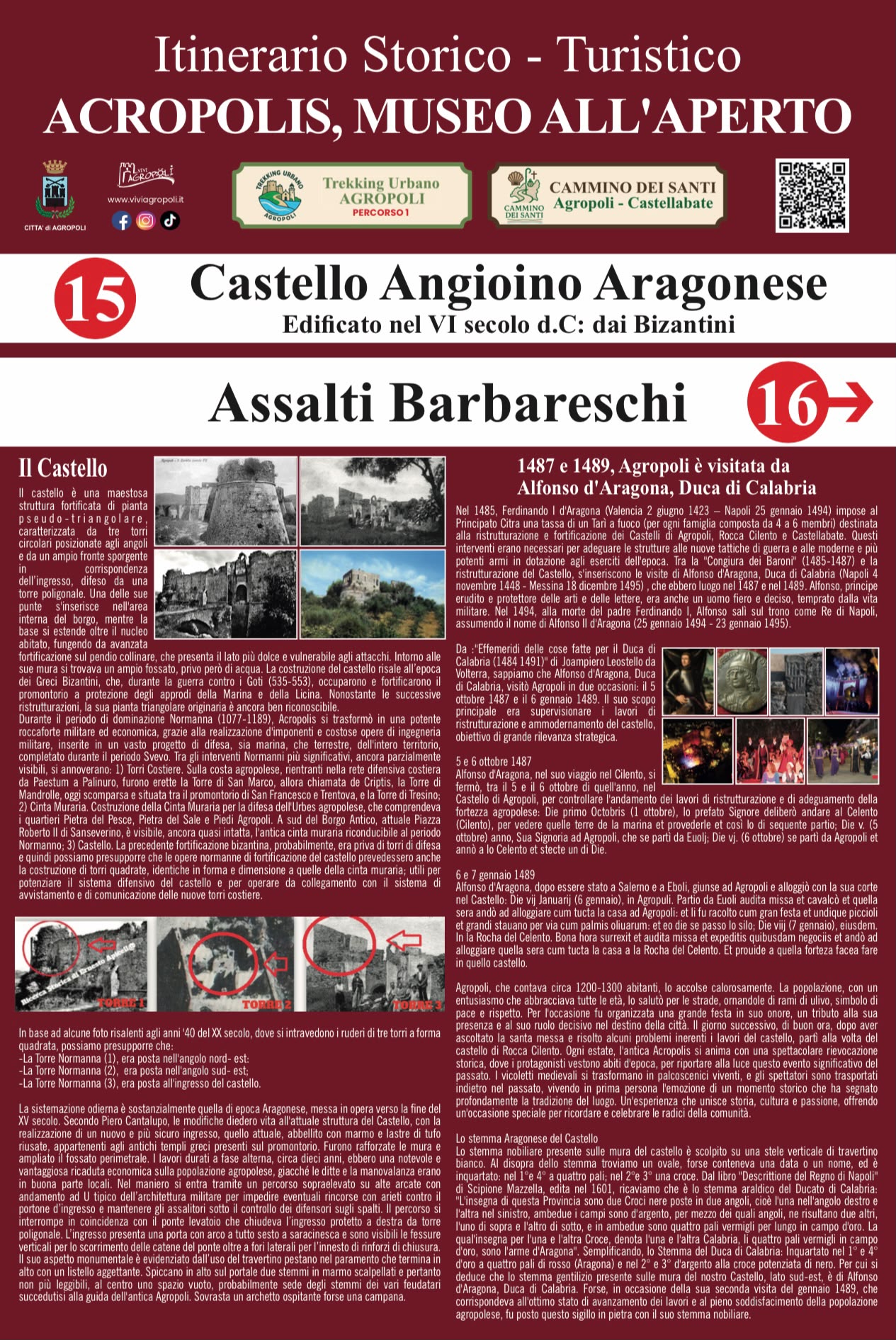
🇬🇧 The Castle
The castle is a majestic fortified structure with a pseudo-triangular plan, characterized by three circular towers positioned at its corners and a wide projecting front corresponding to the entrance, defended by a polygonal tower. One of its points extends into the inner area of the village, while the base stretches beyond the inhabited center, serving as an advanced fortification on the hillside, which has the gentler and more vulnerable slope to attacks. Around its walls, there was a wide moat, although it lacked water.
The construction of the castle dates back to the Byzantine Greek period, when, during the war against the Goths (535–553), the promontory was occupied and fortified to protect the landings at Marina and Licina. Despite subsequent restorations, its original triangular plan remains clearly recognizable.
During the Norman rule (1077–1189), Acropolis was transformed into a powerful military and economic stronghold, thanks to the creation of imposing and costly military engineering works, part of a vast defense project covering both maritime and land areas of the territory, completed during the Swabian period. Among the most significant Norman interventions, still partially visible today, were:
- Coastal Towers: On the Agropoli coast, part of the coastal defense network from Paestum to Palinuro, the Torre di San Marco (then called de Criptis), the Torre di Mandrolle (now disappeared, located between the promontory of San Francesco and Trentova), and the Torre di Tresino were erected.
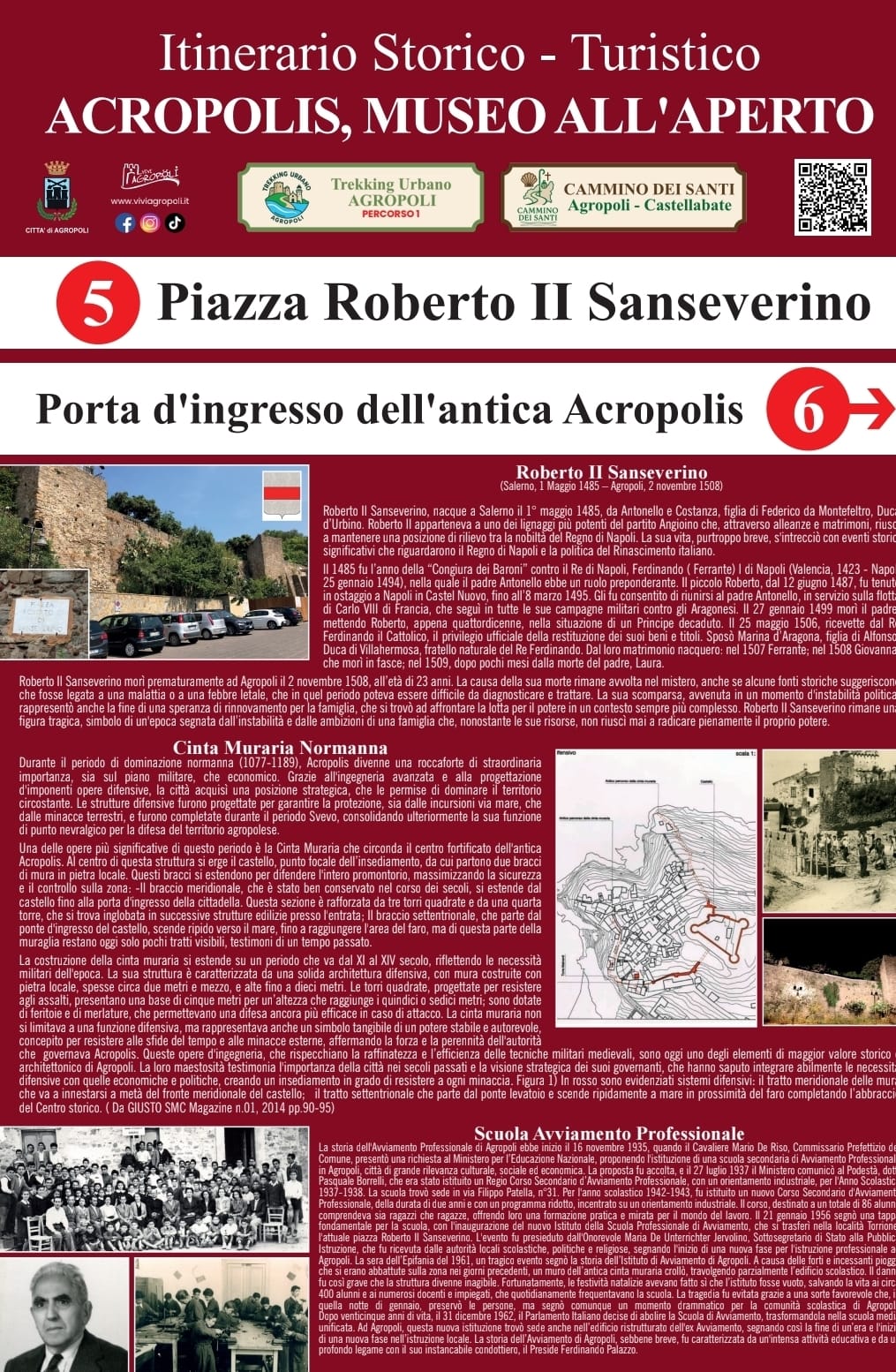
- City Walls: Construction of defensive walls for the Urbes of Agropoli, which included the neighborhoods of Pietra del Pesce, Pietra del Sale, and Piedi Agropoli. South of the Old Town, the current Piazza Roberto II di Sanseverino, the ancient Norman walls are still almost intact.
- Castle: The previous Byzantine fortification likely lacked defensive towers, so it can be assumed that the Norman fortification works included the construction of square towers, identical in shape and size to those of the city walls. These were used to strengthen the castle’s defensive system and to connect with the observation and communication system of the new coastal towers.
Based on photographs from the 1940s, showing the ruins of three square towers, it is presumed that:
- Norman Tower (1) was located at the northeast corner;
- Norman Tower (2) was located at the southeast corner;
- Norman Tower (3) was located at the castle entrance.
The current configuration is essentially that of the Aragonese period, implemented toward the end of the 15th century. According to Piero Cantalupo, these modifications gave rise to the present structure of the castle, with the creation of a new, safer entrance—the current one—adorned with marble and reused tuff slabs, taken from the ancient Greek temples on the promontory. The walls were reinforced, and the surrounding moat expanded. The works, carried out intermittently over about ten years, brought significant economic benefits to the people of Agropoli, as many of the contractors and laborers were local.
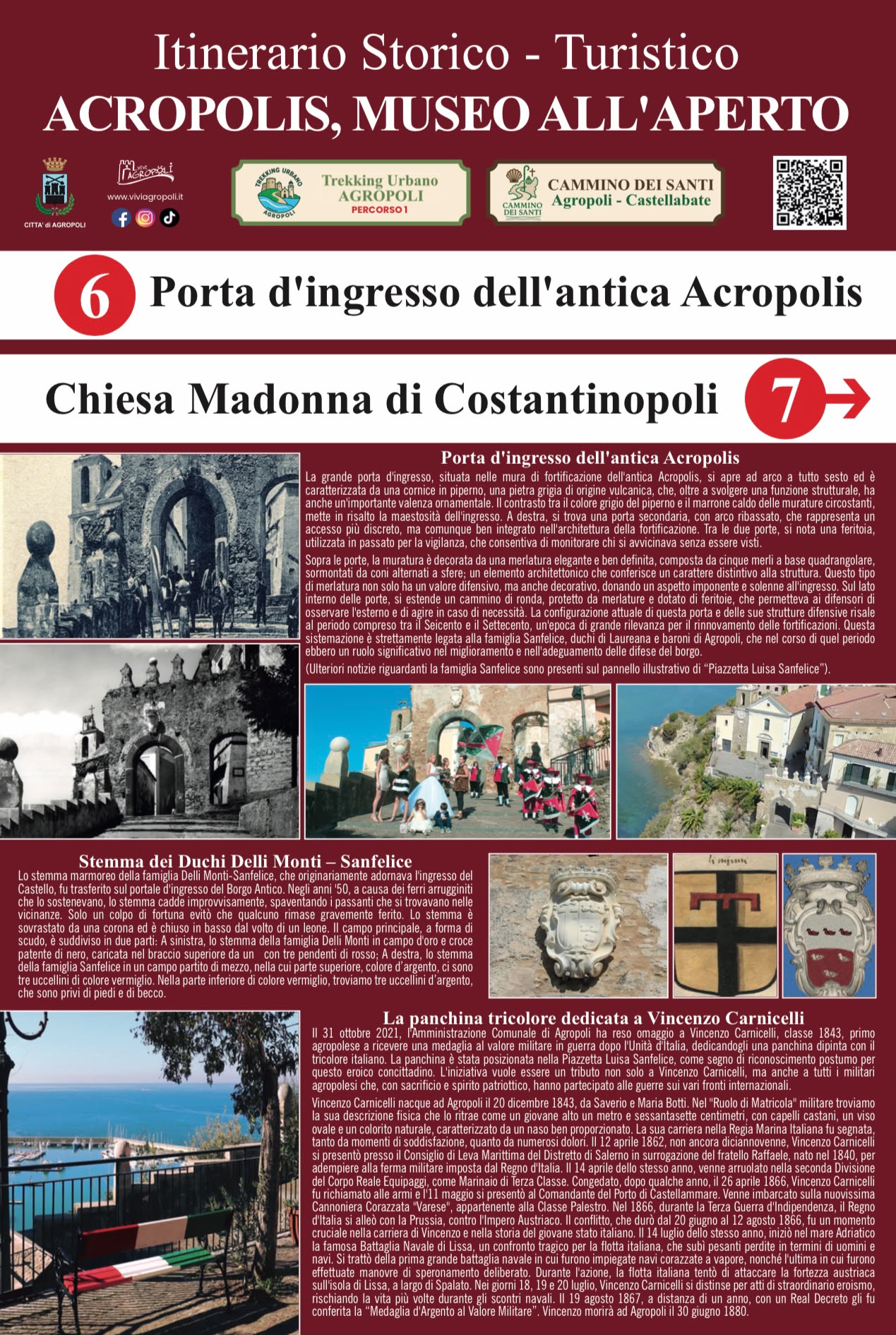
The castle is accessed via an elevated U-shaped walkway over high arches, typical of military architecture, designed to prevent battering rams from reaching the main gate and to keep attackers under the control of the defenders on the battlements. The walkway ends at the drawbridge, which closed the entrance, protected on the right by a polygonal tower. The entrance features a round-arched gate with a portcullis, with visible vertical grooves for the chains of the drawbridge, as well as lateral holes for inserting reinforcement bars.
Its monumental appearance is highlighted by the use of Pestano travertine on the facade, which ends at the top with a projecting band. Two marble coats of arms, now illegible, stand above the portal, with an empty space in the center, probably intended for the arms of the various feudal lords who ruled ancient Agropoli. Above is a small arch that may have once housed a bell.
Visits of Alfonso of Aragon, Duke of Calabria (1487 and 1489)
In 1485, Ferdinand I of Aragon (Valencia, June 2, 1423 – Naples, January 25, 1494) imposed a Tarì per household tax on the Principato Citra (for families of 4 to 6 members) to fund the reconstruction and fortification of the castles of Agropoli, Rocca Cilento, and Castellabate. These works were necessary to adapt the structures to new war tactics and the modern, more powerful weapons of contemporary armies.
Between the “Conspiracy of the Barons” (1485–1487) and the castle’s renovation, Alfonso of Aragon, Duke of Calabria (Naples, November 4, 1448 – Messina, December 18, 1495), visited Agropoli in 1487 and 1489. Alfonso, a learned prince and patron of the arts and letters, was also a proud and determined man, seasoned by military life. In 1494, upon the death of his father Ferdinand I, Alfonso ascended the throne as King of Naples, taking the name Alfonso II of Aragon (January 25, 1494 – January 23, 1495).
From “Effemeridi delle cose fatte per il Duca di Calabria (1484–1491)” by Joampiero Leostello da Volterra, we know that Alfonso visited Agropoli twice: on October 5, 1487, and January 6, 1489. His main goal was to supervise the renovation and modernization works of the castle, a project of great strategic importance.
- October 5–6, 1487: During his journey through Cilento, Alfonso stopped at the Castle of Agropoli to check the progress of the renovation and adaptation of the fortress. The town, with about 1,200–1,300 inhabitants, welcomed him warmly. People of all ages lined the streets, decorating them with olive branches, symbols of peace and respect. A grand celebration was organized in his honor, recognizing his presence and decisive role in the city’s fate. The next morning, after attending Mass and resolving some issues related to the castle, he departed for the Castle of Rocca Cilento.
- January 6–7, 1489: After visiting Salerno and Eboli, Alfonso arrived at Agropoli and lodged at the castle with his court. The town received him with great joy and festivities, and he oversaw further works on the fortress.
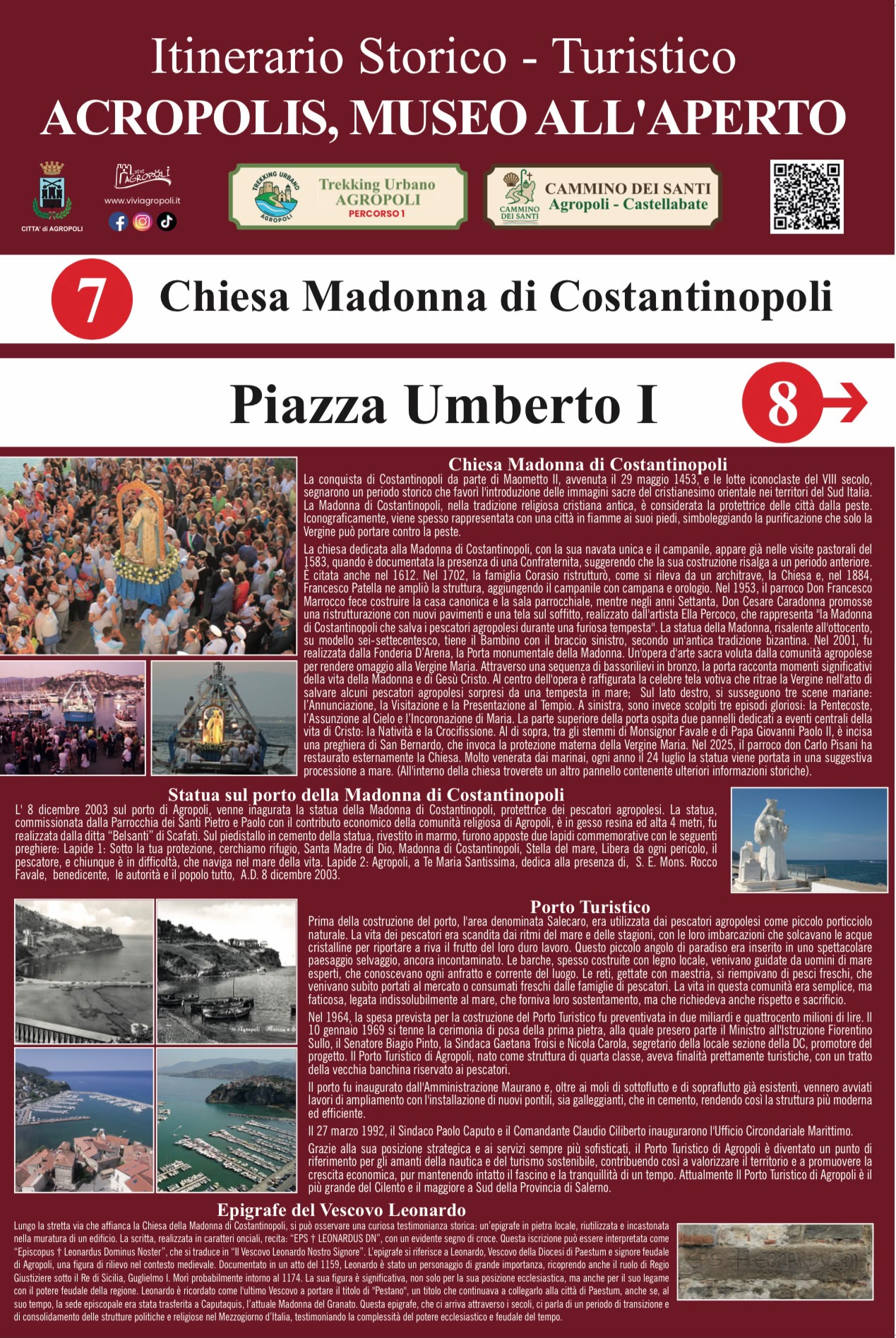
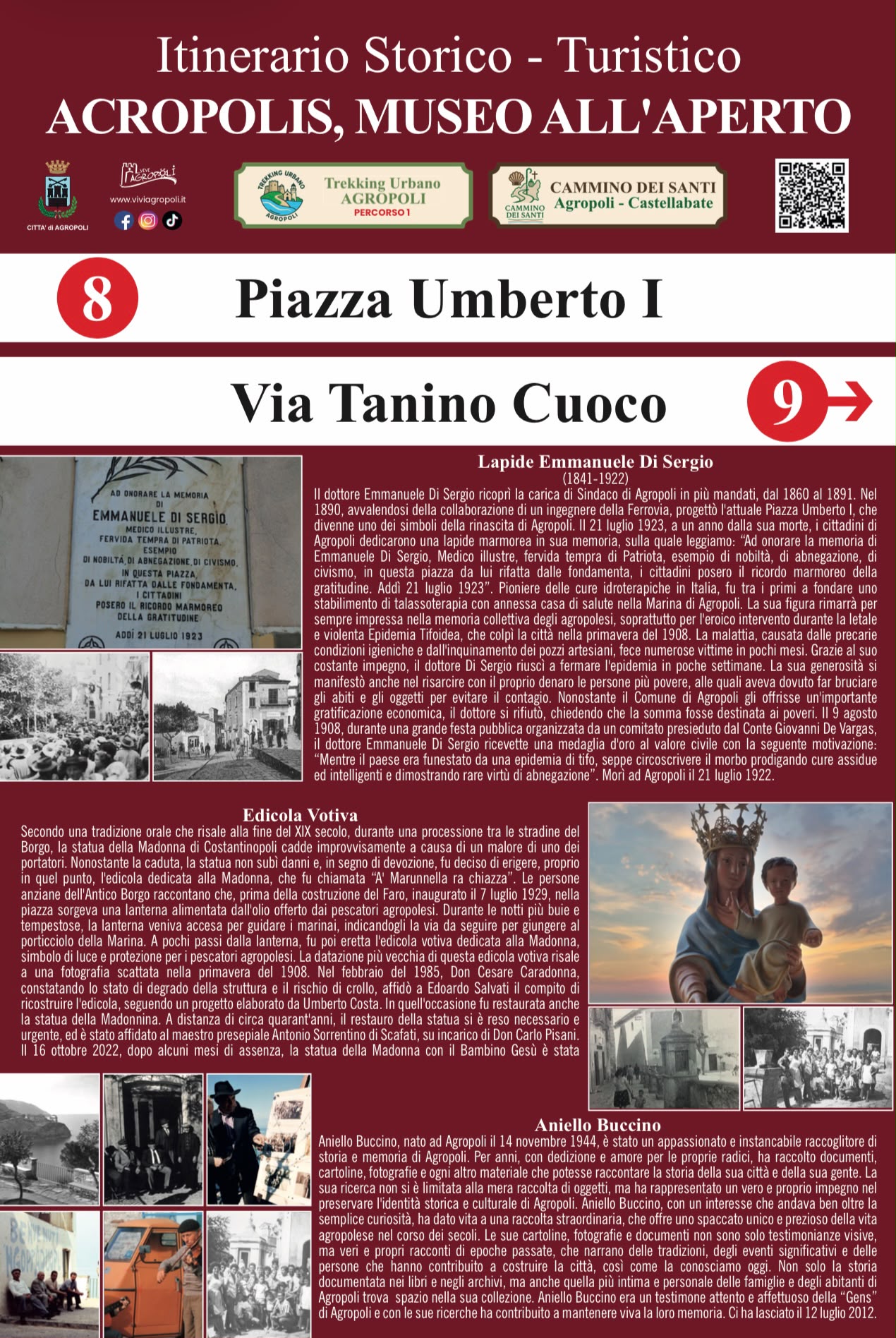
Every summer, the ancient Acropolis comes alive with a spectacular historical reenactment, where participants wear period costumes to bring this significant past event back to life. Medieval alleys become living stages, and spectators are transported back in time, experiencing firsthand a historical moment that deeply shaped local tradition—an event combining history, culture, and passion.
The Aragonese Coat of Arms of the Castle
The noble coat of arms on the castle walls is carved on a vertical white travertine stele. Above the shield is an oval, which may have contained a date or a name. The shield is quartered: the 1st and 4th quarters feature four vertical red bars on a gold field (Aragon), and the 2nd and 3rd quarters a black cross on a silver field.
According to Scipione Mazzella’s “Descrittione del Regno di Napoli” (1601), this is the heraldic emblem of the Duchy of Calabria: “The province’s insignia consists of two black crosses in two corners, right and left, both fields being silver, with four vertical red bars on a gold field in the other two corners—symbolizing Aragon.”
Thus, the coat of arms on the southeast wall of the castle belongs to Alfonso of Aragon, Duke of Calabria. It was probably placed during his second visit in January 1489, marking the excellent progress of the works and the full satisfaction of the citizens of Agropoli.
🇩🇪 Die Burg
Die Burg ist eine majestätische befestigte Anlage mit einem pseudo-dreieckigen Grundriss, die durch drei runde Türme an den Ecken und eine breite vorspringende Front am Eingang gekennzeichnet ist, der durch einen polygonalen Turm geschützt wird. Einer ihrer Spitzen ragt in das Innere des Dorfes hinein, während die Basis über den bewohnten Kern hinausgeht und als vorgeschobene Festung am Hügelhang dient, der die sanftere und angreifbarere Seite aufweist. Um ihre Mauern verlief ein weiter Graben, der jedoch kein Wasser führte.
Der Bau der Burg geht auf die Zeit der Byzantinischen Griechen zurück, die während des Krieges gegen die Goten (535–553) den Vorsprung besetzten und befestigten, um die Landungen bei Marina und Licina zu schützen. Trotz späterer Umbauten ist ihr ursprünglicher dreieckiger Grundriss noch deutlich erkennbar.
Während der normannischen Herrschaft (1077–1189) verwandelte sich die Akropolis in eine mächtige militärische und wirtschaftliche Festung, dank imposanter und kostspieliger militärischer Ingenieurarbeiten, die Teil eines umfassenden Verteidigungsprojekts sowohl für das Meer als auch für das Land waren und in der Stauferzeit abgeschlossen wurden. Zu den bedeutendsten normannischen Eingriffen, die noch teilweise sichtbar sind, gehören:
- Küstenwachtürme: An der Küste von Agropoli, Teil des Küstenverteidigungsnetzes von Paestum bis Palinuro, wurden der Torre di San Marco (damals de Criptis genannt), der Torre di Mandrolle (heute verschwunden, zwischen dem Vorgebirge von San Francesco und Trentova) und der Torre di Tresino errichtet.
- Stadtmauern: Bau der Stadtmauern zur Verteidigung des Urbes von Agropoli, die die Viertel Pietra del Pesce, Pietra del Sale und Piedi Agropoli einschlossen. Südlich der Altstadt, dem heutigen Piazza Roberto II di Sanseverino, sind die alten normannischen Mauern noch fast vollständig erhalten.
- Burg: Die vorherige byzantinische Festung hatte vermutlich keine Verteidigungstürme, daher kann angenommen werden, dass die normannischen Befestigungsarbeiten den Bau von quadratischen Türmen einschlossen, identisch in Form und Größe mit denen der Stadtmauern. Diese dienten der Verstärkung des Verteidigungssystems der Burg und als Verbindung zu den neuen Küstentürmen für Beobachtung und Kommunikation.
Basierend auf Fotos aus den 1940er-Jahren, die die Ruinen von drei quadratischen Türmen zeigen, wird angenommen, dass:
- Normannischer Turm (1) an der nordöstlichen Ecke stand;
- Normannischer Turm (2) an der südöstlichen Ecke stand;
- Normannischer Turm (3) am Eingang der Burg stand.
Die heutige Gestaltung stammt im Wesentlichen aus der aragonesischen Epoche, umgesetzt gegen Ende des 15. Jahrhunderts. Laut Piero Cantalupo führten diese Änderungen zur heutigen Struktur der Burg, mit einem neuen, sicheren Eingang – dem heutigen – geschmückt mit Marmor und wiederverwendeten Tuffplatten, die von den antiken griechischen Tempeln auf dem Vorgebirge stammen. Die Mauern wurden verstärkt und der umgebende Graben erweitert. Die Arbeiten, die in etwa zehn Jahren phasenweise durchgeführt wurden, brachten der Bevölkerung von Agropoli erhebliche wirtschaftliche Vorteile, da viele Unternehmen und Arbeiter aus der Region stammten.
Der Zugang zur Burg erfolgt über einen erhöhten U-förmigen Gang über hohe Bögen, typisch für Militärarchitektur, um zu verhindern, dass Rammböcke das Haupttor erreichen, und um die Angreifer unter Kontrolle der Verteidiger auf den Zinnen zu halten. Der Gang endet am Zugbrücken-Eingang, der rechts von einem polygonalen Turm geschützt ist.
Der Eingang verfügt über ein Rundbogen-Tor mit Fallgitter, mit sichtbaren vertikalen Rillen für die Ketten der Zugbrücke sowie seitlichen Löchern für Verstärkungsstangen.
Ihr monumentales Erscheinungsbild wird durch die Verwendung von Pestano-Travertin an der Fassade unterstrichen, die oben mit einem vorspringenden Band abschließt. Zwei Marmorschilde, jetzt unleserlich, befinden sich über dem Portal, mit einem leeren Feld in der Mitte, vermutlich für die Wappen der verschiedenen Feudalherren, die das alte Agropoli regierten. Darüber befindet sich ein kleiner Bogen, der möglicherweise einst eine Glocke beherbergte.
Besuche von Alfonso von Aragon, Herzog von Kalabrien (1487 und 1489)
1485 verhängte Ferdinand I. von Aragon (Valencia, 2. Juni 1423 – Neapel, 25. Januar 1494) im Fürstentum Citra eine Steuer von einem Tarì pro Haushalt (für Familien von 4 bis 6 Mitgliedern) zur Finanzierung der Wiederherstellung und Befestigung der Burgen von Agropoli, Rocca Cilento und Castellabate. Diese Maßnahmen waren notwendig, um die Anlagen an neue Kriegstaktiken und die modernen, stärkeren Waffen der damaligen Armeen anzupassen.
Zwischen der “Verschwörung der Barone” (1485–1487) und der Renovierung der Burg besuchte Alfonso von Aragon, Herzog von Kalabrien (Neapel, 4. November 1448 – Messina, 18. Dezember 1495), Agropoli 1487 und 1489. Alfonso, ein gelehrter Prinz und Förderer der Künste und Literatur, war auch ein stolzer und entschlossener Mann, geprägt vom Militärdienst. 1494 bestieg er nach dem Tod seines Vaters Ferdinand I. den Thron als König von Neapel unter dem Namen Alfonso II. von Aragon (25. Januar 1494 – 23. Januar 1495).
Laut “Effemeridi delle cose fatte per il Duca di Calabria (1484–1491)” von Joampiero Leostello da Volterra besuchte Alfonso Agropoli zweimal: am 5. Oktober 1487 und am 6. Januar 1489. Sein Hauptziel war die Überwachung der Renovierungs- und Modernisierungsarbeiten an der Burg, ein Projekt von großer strategischer Bedeutung.
- –6. Oktober 1487: Während seiner Reise durch Cilento hielt Alfonso in der Burg von Agropoli, um den Fortschritt der Renovierung zu prüfen. Die Stadt mit etwa 1.200–1.300 Einwohnern empfing ihn herzlich. Menschen aller Altersgruppen säumten die Straßen, geschmückt mit Olivenzweigen, Symbolen des Friedens und Respekts. Zu seinen Ehren wurde eine große Feier veranstaltet. Am nächsten Morgen, nach der Messe und der Klärung einiger Probleme im Zusammenhang mit der Burg, reiste er zur Burg von Rocca Cilento.
- –7. Januar 1489: Nach einem Besuch in Salerno und Eboli kam Alfonso nach Agropoli und logierte mit seinem Hof in der Burg. Die Stadt empfing ihn mit großer Freude und Festlichkeiten, und er überwachte weitere Arbeiten an der Festung.
Jeden Sommer erwacht die alte Akropolis mit einer spektakulären historischen Nachstellung zum Leben, bei der die Teilnehmer Kostüme aus der Epoche tragen, um dieses bedeutende historische Ereignis wieder aufleben zu lassen. Mittelalterliche Gassen werden zu lebendigen Bühnen, und die Zuschauer werden in die Vergangenheit zurückversetzt, um einen historischen Moment hautnah zu erleben, der die Tradition des Ortes tief geprägt hat – ein Erlebnis, das Geschichte, Kultur und Leidenschaft vereint.
Das aragonesische Wappen der Burg
Das adelige Wappen an der Burgmauer ist auf einer vertikalen weißen Travertinstele eingraviert. Über dem Schild befindet sich ein Oval, das möglicherweise ein Datum oder einen Namen enthielt. Der Schild ist geviertelt: 1. und 4. Feld: vier rote Balken auf goldenem Grund (Aragon), 2. und 3. Feld: schwarzes Kreuz auf silbernem Grund.
Laut Scipione Mazzella in “Descrittione del Regno di Napoli” (1601) ist dies das heraldische Wappen des Herzogtums Kalabrien: “Die Insignien der Provinz bestehen aus zwei schwarzen Kreuzen in zwei Ecken, rechts und links, beide Felder silbern, mit vier roten Balken auf goldenem Grund in den anderen beiden Ecken – Symbol Aragon.”
Daraus folgt, dass das Wappen an der Südostseite der Burg Alfonso von Aragon, Herzog von Kalabrien, gehört. Es wurde vermutlich bei seinem zweiten Besuch im Januar 1489 angebracht, um den hervorragenden Fortschritt der Arbeiten und die volle Zufriedenheit der Bürger von Agropoli zu kennzeichnen.
🇫🇷 Le Château
Le château est une imposante structure fortifiée de plan pseudo-triangulaire, caractérisée par trois tours circulaires situées aux angles et par une large façade saillante au niveau de l’entrée, protégée par une tour polygonale. L’une de ses pointes pénètre dans la zone intérieure du village, tandis que sa base s’étend au-delà du noyau habité, servant de fortification avancée sur le versant collineux, qui présente le côté le plus doux et vulnérable aux attaques. Autour de ses murailles se trouvait un large fossé, mais sans eau.
La construction du château remonte à l’époque des Grecs byzantins, qui, pendant la guerre contre les Goths (535-553), occupèrent et fortifièrent le promontoire pour protéger les débarquements de Marina et de Licina. Malgré les rénovations ultérieures, son plan triangulaire d’origine est encore bien reconnaissable.
Pendant la domination normande (1077-1189), l’Acropole se transforma en une puissante forteresse militaire et économique, grâce à la réalisation de travaux d’ingénierie militaire imposants et coûteux, intégrés dans un vaste projet de défense, à la fois maritime et terrestre, de tout le territoire, achevé à l’époque des Stauffer. Parmi les interventions normandes les plus significatives, encore partiellement visibles, on peut citer :
- Tours côtières : Sur la côte d’Agropoli, faisant partie du réseau défensif côtier de Paestum à Palinuro, furent érigées la Torre di San Marco (alors appelée de Criptis), la Torre di Mandrolle (aujourd’hui disparue, située entre le promontoire de San Francesco et Trentova) et la Torre di Tresino.
- Enceinte urbaine : Construction des murailles pour la défense de l’Urbes d’Agropoli, incluant les quartiers Pietra del Pesce, Pietra del Sale et Piedi Agropoli. Au sud du Borgo Antico, aujourd’hui Piazza Roberto II di Sanseverino, les anciennes murailles normandes sont encore presque intactes.
- Château : La précédente fortification byzantine ne possédait probablement pas de tours de défense, on peut donc supposer que les travaux normands de fortification du château comprenaient la construction de tours carrées, identiques en forme et dimension à celles des murailles, utiles pour renforcer le système défensif du château et pour servir de liaison avec le système d’observation et de communication des nouvelles tours côtières.
D’après certaines photos datant des années 1940, montrant les ruines de trois tours carrées, on peut supposer que :
- La Tour Normande (1) se trouvait dans l’angle nord-est ;
- La Tour Normande (2) se trouvait dans l’angle sud-est ;
- La Tour Normande (3) se trouvait à l’entrée du château.
L’aménagement actuel correspond essentiellement à l’époque aragonaise, réalisé vers la fin du XVe siècle. Selon Piero Cantalupo, ces modifications ont donné naissance à la structure actuelle du château, avec la réalisation d’une nouvelle entrée plus sûre – l’actuelle – embellie de marbre et de dalles de tuf réutilisées provenant des anciens temples grecs du promontoire. Les murailles furent renforcées et le fossé périphérique élargi. Ces travaux, réalisés par phases sur environ dix ans, eurent un impact économique considérable et favorable sur la population d’Agropoli, car les entreprises et la main-d’œuvre étaient en grande partie locales.
L’accès au château se fait par un passage surélevé au-dessus de hautes arches en forme de U, typique de l’architecture militaire, pour empêcher les assauts avec des béliers contre la porte d’entrée et maintenir les assaillants sous le contrôle des défenseurs sur les créneaux. Le passage se termine au niveau du pont-levis, protégé à droite par une tour polygonale.
L’entrée présente une porte en arc plein cintre avec herse, avec des rainures verticales visibles pour le passage des chaînes du pont, ainsi que des trous latéraux pour l’insertion de barres de renfort.
Son aspect monumental est mis en valeur par l’utilisation de travertin de Peste sur la façade, qui se termine en haut par une corniche saillante. Deux blasons en marbre, aujourd’hui illisibles, surplombent le portail, avec un espace vide au centre, probablement pour les blasons des différents seigneurs ayant dirigé l’ancienne Agropoli. Au-dessus se trouve un petit arc pouvant abriter une cloche.
Visites d’Alphonse d’Aragon, duc de Calabre (1487 et 1489)
En 1485, Ferdinand Ier d’Aragon (Valence, 2 juin 1423 – Naples, 25 janvier 1494) imposa au Principat Citra une taxe d’un Tarì par foyer (pour les familles de 4 à 6 membres) destinée à la rénovation et à la fortification des châteaux d’Agropoli, Rocca Cilento et Castellabate. Ces interventions étaient nécessaires pour adapter les structures aux nouvelles tactiques de guerre et aux armes modernes plus puissantes des armées de l’époque.
Entre la « Conjuration des Barons » (1485-1487) et la rénovation du château, les visites d’Alphonse d’Aragon, duc de Calabre (Naples, 4 novembre 1448 – Messine, 18 décembre 1495), eurent lieu en 1487 et 1489. Alphonse, prince érudit et protecteur des arts et des lettres, était également un homme fier et décidé, forgé par la vie militaire. En 1494, à la mort de son père Ferdinand Ier, Alphonse monta sur le trône en tant que roi de Naples sous le nom d’Alphonse II d’Aragon (25 janvier 1494 – 23 janvier 1495).
Selon “Effemeridi delle cose fatte per il Duca di Calabria (1484–1491)” de Joampiero Leostello da Volterra, Alphonse visita Agropoli à deux reprises : le 5 octobre 1487 et le 6 janvier 1489, principalement pour superviser les travaux de rénovation et de modernisation du château, un projet d’une grande importance stratégique.
- 5–6 octobre 1487 : Lors de son voyage dans le Cilento, Alphonse s’arrêta au château d’Agropoli pour vérifier l’avancement des travaux. La ville, comptant environ 1 200 à 1 300 habitants, l’accueillit chaleureusement. La population, de tous âges, orna les rues de branches d’olivier, symboles de paix et de respect, et une grande fête fut organisée en son honneur. Le lendemain matin, après la messe et la résolution de certains problèmes liés aux travaux du château, il se rendit au château de Rocca Cilento.
- 6–7 janvier 1489 : Après avoir visité Salerne et Eboli, Alphonse arriva à Agropoli et séjourna avec sa cour au château. La ville l’accueillit avec joie et festivités, et il supervisa les travaux de la forteresse.
Chaque été, l’ancienne Acropole s’anime grâce à une spectaculaire reconstitution historique, où les participants portent des costumes d’époque pour faire revivre cet événement significatif du passé. Les ruelles médiévales deviennent des scènes vivantes, et les spectateurs sont transportés dans le temps, vivant directement l’émotion d’un moment historique qui a profondément marqué la tradition locale – une expérience alliant histoire, culture et passion.
Le blason aragonais du château
Le blason noble sur la muraille du château est gravé sur une stèle verticale en travertin blanc. Au-dessus se trouve un ovale, peut-être pour une date ou un nom. Le blason est écartelé : 1er et 4e champ : quatre pals rouges sur fond d’or (Aragon) ; 2e et 3e champ : croix noire sur fond argent.
Selon Scipione Mazzella dans “Descrittione del Regno di Napoli” (1601), il s’agit du blason héraldique du duché de Calabre : « Les armoiries de cette province sont deux croix noires placées dans deux angles, l’une à droite et l’autre à gauche, tous deux champs d’argent, avec quatre pals rouges sur fond d’or dans les autres angles – symbole d’Aragon. »
On en déduit que le blason présent sur le côté sud-est du château appartient à Alphonse d’Aragon, duc de Calabre. Il fut probablement apposé lors de sa deuxième visite de janvier 1489, marquant l’avancement remarquable des travaux et la pleine satisfaction de la population d’Agropoli.