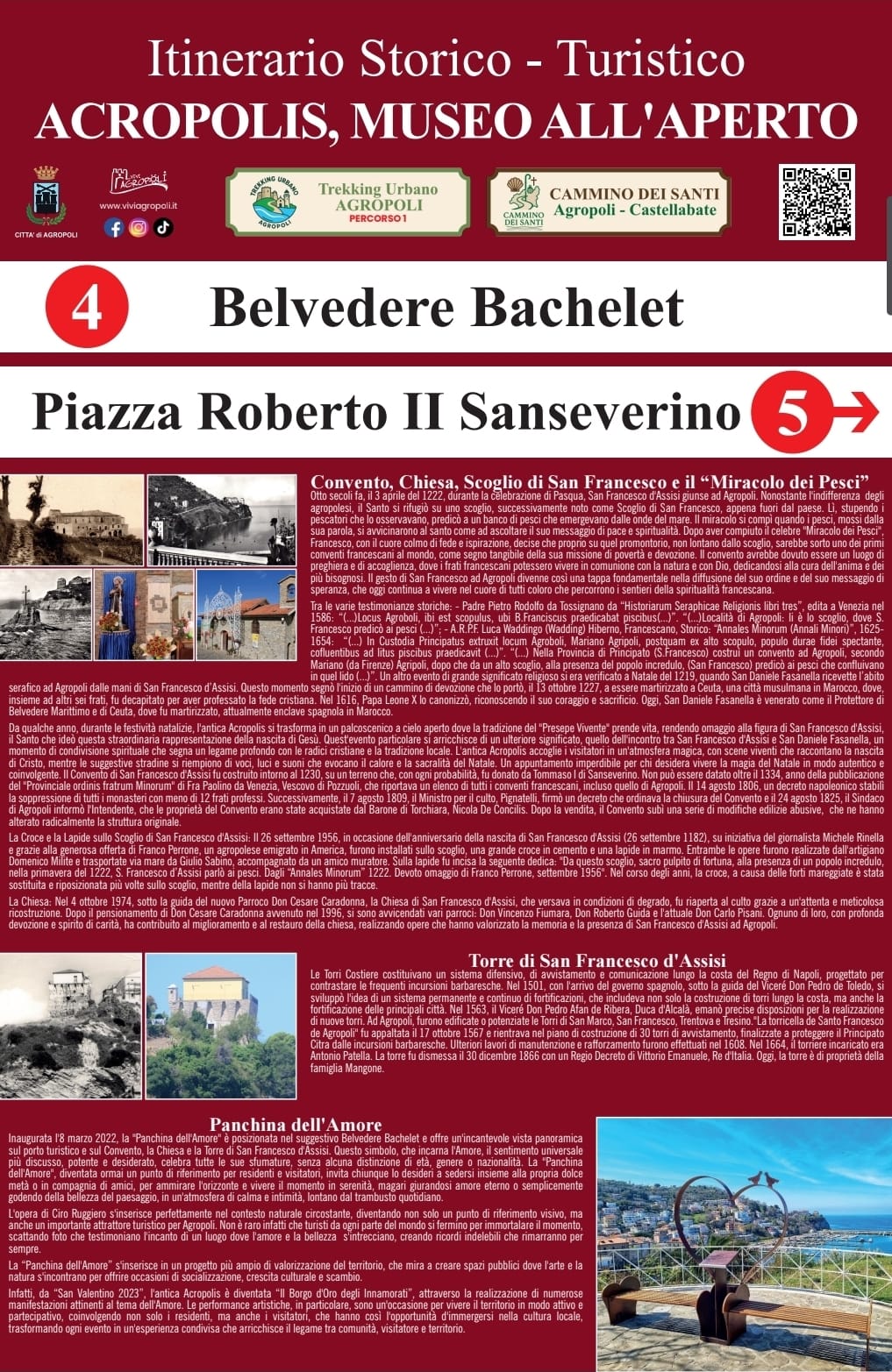
🇬🇧 Convent, Church, the Rock of Saint Francis and the “Miracle of the Fish”
Eight centuries ago, on April 3, 1222, during the celebration of Easter, Saint Francis of Assisi arrived in Agropoli. Despite the indifference of the townspeople, the Saint took refuge on a rock just outside the town, later known as the Rock of Saint Francis. There, astonishing the fishermen who were watching him, he preached to a shoal of fish that emerged from the waves of the sea.
The miracle occurred when the fish, moved by his words, approached the saint as if to listen to his message of peace and spirituality. After performing the famous “Miracle of the Fish,” Francis, with his heart filled with faith and inspiration, decided that on that very promontory, not far from the rock, one of the first Franciscan convents in the world would be built, as a tangible sign of his mission of poverty and devotion.
The convent was intended to be a place of prayer and hospitality, where Franciscan friars could live in communion with nature and with God, dedicating themselves to the care of the soul and to helping those most in need. Saint Francis’ gesture in Agropoli thus became an important milestone in the spread of his order and his message of hope, which continues to live today in the hearts of those who follow the paths of Franciscan spirituality.
Among the various historical testimonies:
- Father Pietro Rodolfo da Tossignano, from Historiarum Seraphicae Religionis libri tres, published in Venice in 1586:
“(…) Locus Agroboli, ibi est scopulus, ubi B. Franciscus praedicabat piscibus (…)”
“(…) Place of Agropoli: there is the rock where Saint Francis preached to the fish (…).” - A.R.P.F. Luca Wadding (Waddingo), Irish Franciscan and historian, Annales Minorum, 1625–1654:
“(…) In Custodia Principatus extruxit locum Agroboli, Mariano Agripoli, postquam ex alto scopulo, populo durae fidei spectante, confluentibus ad litus piscibus praedicavit (…)”
“(…) In the Province of the Principato (Saint Francis) built a convent in Agropoli, according to Mariano (of Florence) Agripoli, after from a high rock, in the presence of the unbelieving people, he preached to the fish that gathered along that shore (…).”
Another event of great religious significance had occurred at Christmas in 1219, when Saint Daniel Fasanella received the Franciscan habit in Agropoli from the hands of Saint Francis of Assisi. This moment marked the beginning of a path of devotion that led him, on October 13, 1227, to be martyred in Ceuta, a Muslim city in Morocco, where, together with six other friars, he was beheaded for professing the Christian faith. In 1616, Pope Leo X canonized him, recognizing his courage and sacrifice. Today Saint Daniel Fasanella is venerated as the patron saint of Belvedere Marittimo and of Ceuta, where he was martyred, today a Spanish enclave in Morocco.
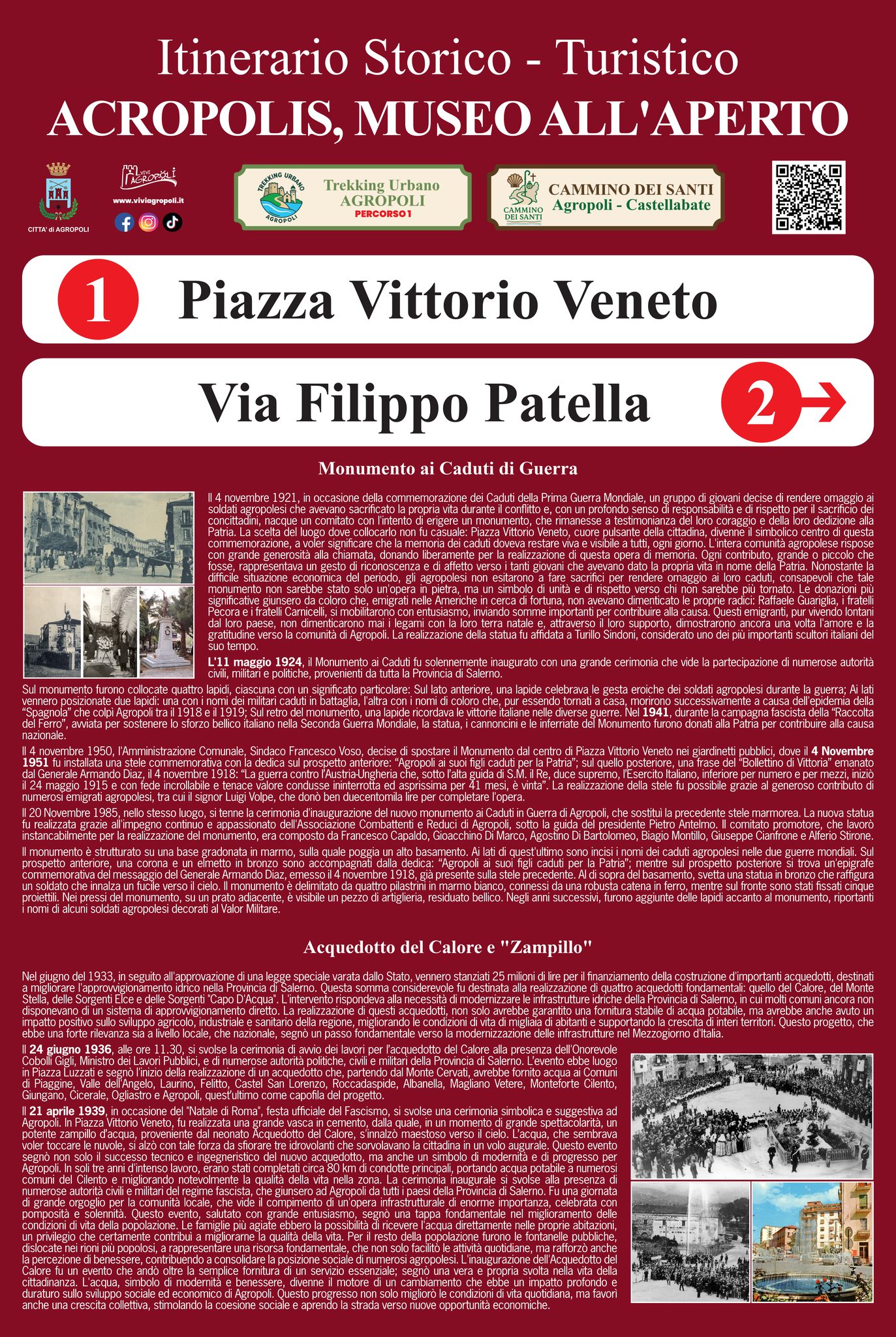
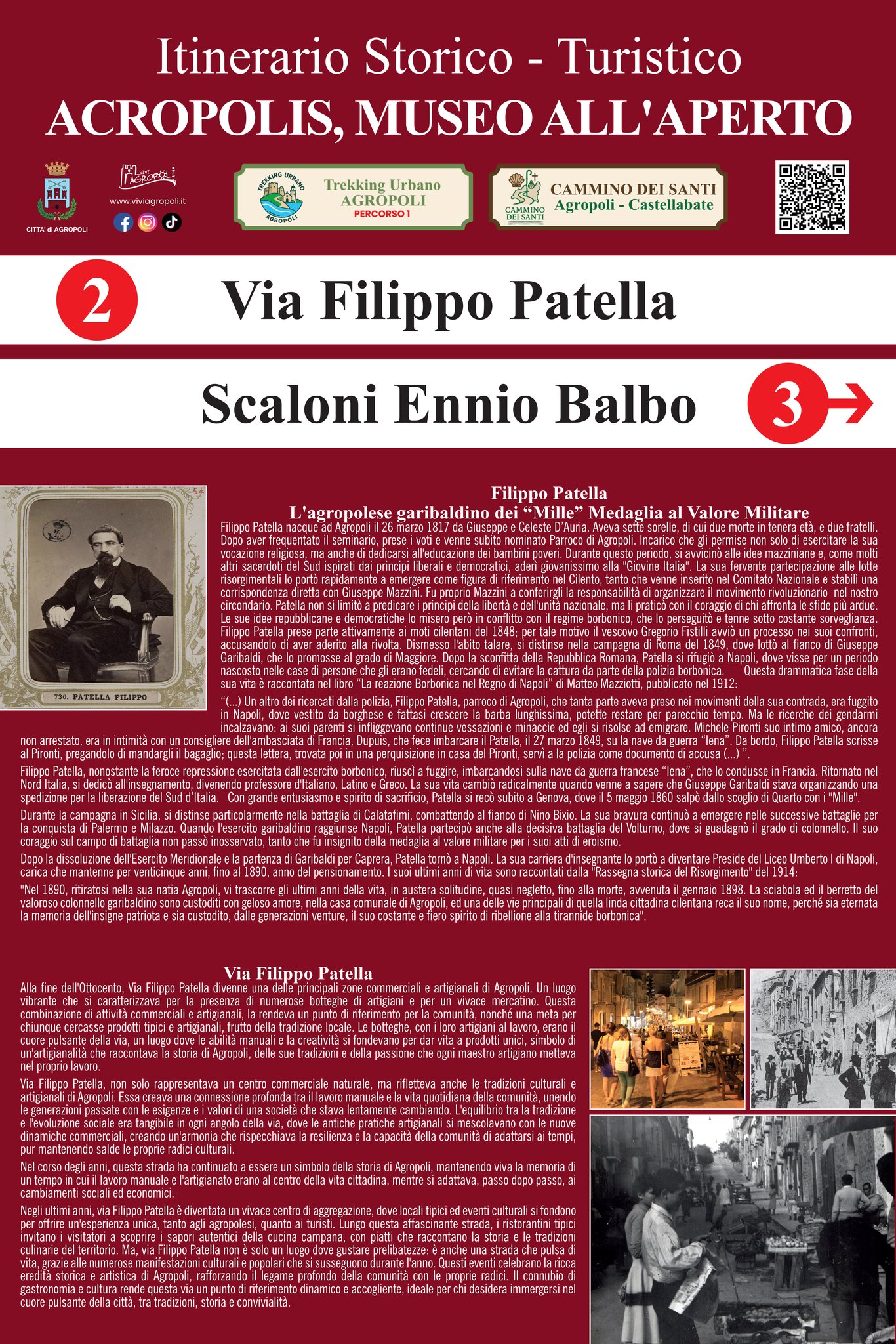
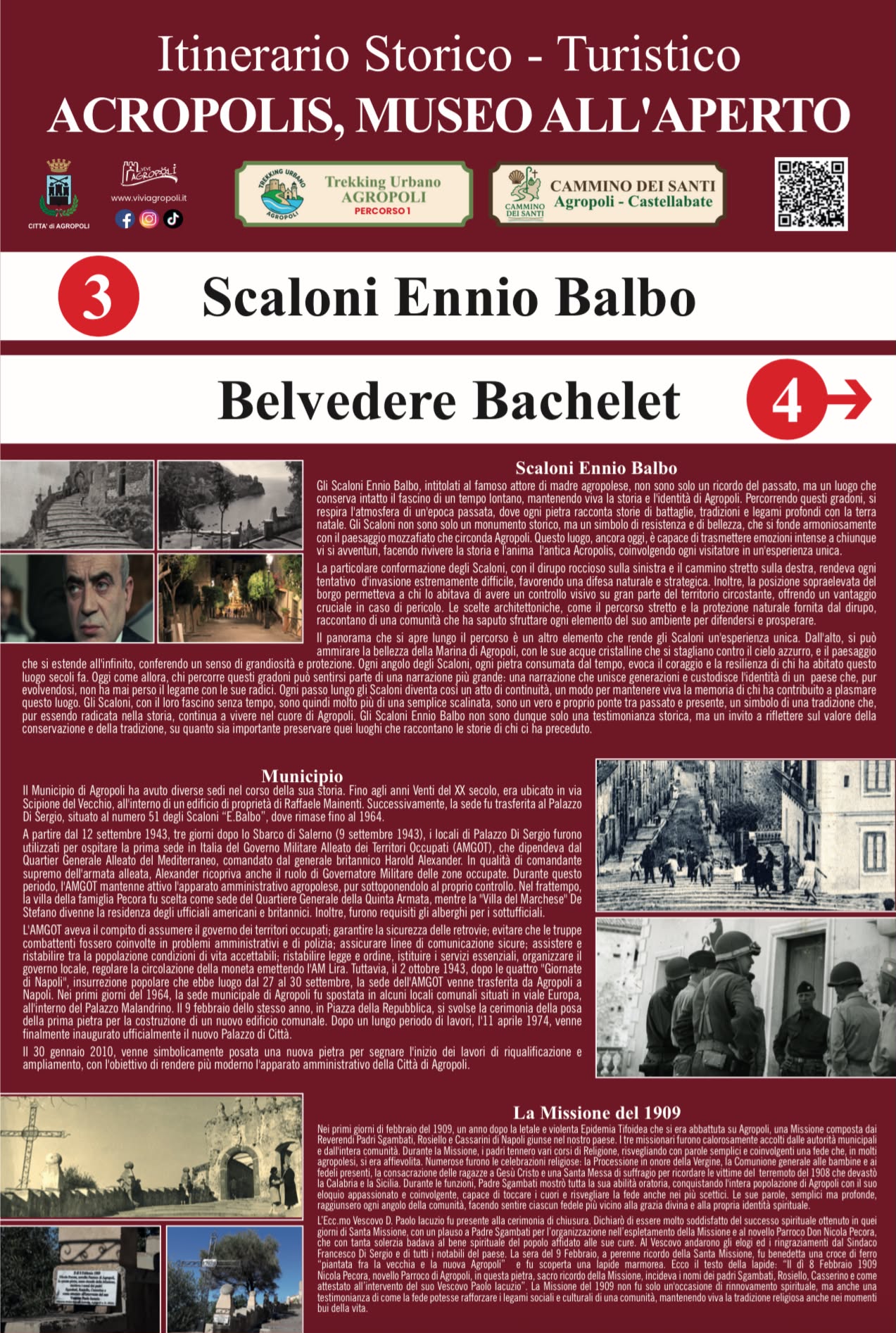
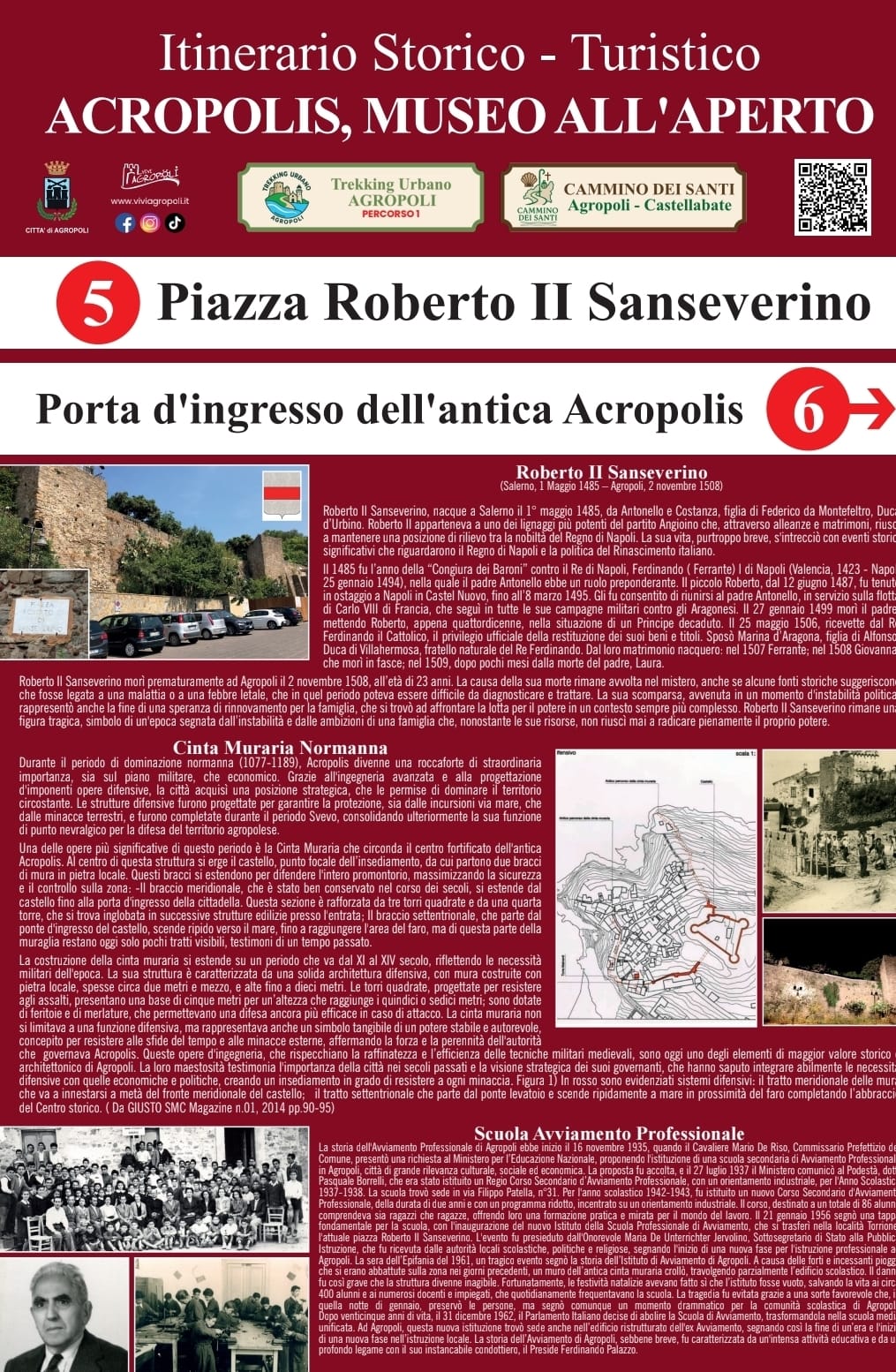
For several years now, during the Christmas holidays, the ancient Acropolis has been transformed into an open-air stage where the tradition of the “Living Nativity Scene” comes to life, paying tribute to Saint Francis of Assisi, the saint who conceived this extraordinary representation of the birth of Jesus.
This special event gains further meaning through the symbolic meeting between Saint Francis of Assisi and Saint Daniel Fasanella, a moment of spiritual sharing that reflects a deep connection with Christian roots and local tradition. The ancient Acropolis welcomes visitors in a magical atmosphere, with living scenes narrating the birth of Christ, while the charming narrow streets fill with voices, lights, and sounds that evoke the warmth and sacredness of Christmas. It is an unmissable event for anyone who wishes to experience the magic of Christmas in an authentic and engaging way.
The Convent of Saint Francis of Assisi was built around 1230 on land that was most likely donated by Tommaso I of Sanseverino. It cannot be dated later than 1334, the year in which the Provinciale ordinis fratrum Minorum by Fra Paolino da Venezia, Bishop of Pozzuoli, was published, listing all Franciscan convents, including the one in Agropoli.
On August 14, 1806, a Napoleonic decree ordered the suppression of all monasteries with fewer than twelve professed friars. Later, on August 7, 1809, the Minister for Worship, Pignatelli, signed a decree ordering the closure of the convent. On August 24, 1825, the Mayor of Agropoli informed the Intendant that the convent’s properties had been purchased by the Baron of Torchiara, Nicola De Concilis. After the sale, the convent underwent a series of unauthorized building modifications that drastically altered its original structure.
The Cross and the Plaque on the Rock of Saint Francis of Assisi
On September 26, 1956, on the anniversary of the birth of Saint Francis of Assisi (September 26, 1182), on the initiative of the journalist Michele Rinella and thanks to the generous donation of Franco Perrone, a native of Agropoli who had emigrated to America, a large concrete cross and a marble plaque were installed on the rock.
Both works were created by the craftsman Domenico Milite and transported by sea by Giulio Sabino, accompanied by a mason friend. The following dedication was engraved on the plaque:
“From this rock, a sacred and improvised pulpit, in the presence of an unbelieving people, in the spring of 1222, Saint Francis of Assisi spoke to the fish. From the Annales Minorum 1222. Devout tribute of Franco Perrone, September 1956.”
Over the years, due to strong sea storms, the cross has been replaced and repositioned several times on the rock, while the plaque has unfortunately been lost.
The Church
On October 4, 1974, under the guidance of the new parish priest Don Cesare Caradonna, the Church of Saint Francis of Assisi, which had fallen into a state of decay, was reopened for worship thanks to a careful and meticulous reconstruction.
After Don Cesare Caradonna retired in 1996, several parish priests followed: Don Vincenzo Fiumara, Don Roberto Guida, and the current Don Carlo Pisani. Each of them, with deep devotion and a spirit of charity, contributed to the improvement and restoration of the church, carrying out works that enhanced the memory and presence of Saint Francis of Assisi in Agropoli.
Tower of Saint Francis of Assisi
The coastal towers formed a defensive, observation, and communication system along the coast of the Kingdom of Naples, designed to counter the frequent Barbary pirate raids.
In 1501, with the arrival of Spanish rule under the Viceroy Don Pedro de Toledo, the idea of a permanent and continuous system of fortifications was developed. This plan included not only the construction of towers along the coast but also the fortification of the main cities.
In 1563, the Viceroy Don Pedro Afán de Ribera, Duke of Alcalá, issued precise provisions for the construction of new towers. In Agropoli, the towers of San Marco, San Francesco, Trentova, and Tresino were built or strengthened.
“La torricella de Santo Francesco de Agropoli” was commissioned on October 17, 1567, as part of a plan to build thirty watchtowers aimed at protecting the Principato Citra from Barbary incursions. Further maintenance and reinforcement works were carried out in 1608.
In 1664, the appointed tower guard was Antonio Patella. The tower was decommissioned on December 30, 1866, by a Royal Decree of Victor Emmanuel, King of Italy. Today, the tower is owned by the Mangone family.
The “Love Bench”
Inaugurated on March 8, 2022, the “Love Bench” is located in the picturesque Belvedere Bachelet and offers a charming panoramic view over the tourist port and the Convent, Church, and Tower of Saint Francis of Assisi.
This symbol, representing love—the most discussed, powerful, and desired universal feeling—celebrates all its forms, without distinction of age, gender, or nationality. The Love Bench, which has become a landmark for both residents and visitors, invites anyone to sit with their partner or friends to admire the horizon and enjoy a peaceful moment, perhaps promising eternal love or simply appreciating the beauty of the landscape in an atmosphere of calm and intimacy, far from the bustle of daily life.
The work by Ciro Ruggiero fits perfectly into the surrounding natural environment, becoming not only a visual landmark but also an important tourist attraction for Agropoli. It is not uncommon for tourists from all over the world to stop here to capture the moment, taking photos that bear witness to the enchantment of a place where love and beauty intertwine, creating unforgettable memories.
The “Love Bench” is part of a broader project aimed at enhancing the territory by creating public spaces where art and nature meet, offering opportunities for social interaction, cultural growth, and exchange.
Indeed, since Valentine’s Day 2023, the ancient Acropolis has become the “Golden Village of Lovers”, through the organization of numerous events dedicated to the theme of love. Artistic performances, in particular, provide an opportunity to experience the territory in an active and participatory way, involving not only residents but also visitors, who are thus able to immerse themselves in local culture, turning every event into a shared experience that strengthens the bond between community, visitor, and territory.
🇩🇪 Kloster, Kirche, der Felsen des Heiligen Franziskus und das „Wunder der Fische“
Vor acht Jahrhunderten, am 3. April 1222, während der Osterfeierlichkeiten, kam der heilige Franziskus von Assisi nach Agropoli. Trotz der Gleichgültigkeit der Einwohner zog sich der Heilige auf einen Felsen außerhalb der Stadt zurück, der später als Felsen des heiligen Franziskus bekannt wurde. Dort predigte er, zum Erstaunen der Fischer, die ihn beobachteten, zu einem Schwarm von Fischen, der aus den Wellen des Meeres auftauchte.
Das Wunder geschah, als sich die Fische, von seinen Worten bewegt, dem Heiligen näherten, als wollten sie seiner Botschaft des Friedens und der Spiritualität lauschen. Nachdem er das berühmte „Wunder der Fische“ vollbracht hatte, beschloss Franziskus, erfüllt von Glauben und Inspiration, dass auf eben diesem Vorgebirge, nicht weit von dem Felsen entfernt, eines der ersten franziskanischen Klöster der Welt errichtet werden sollte – als greifbares Zeichen seiner Mission der Armut und Hingabe.
Das Kloster sollte ein Ort des Gebets und der Gastfreundschaft sein, an dem die Franziskaner in Gemeinschaft mit der Natur und mit Gott leben konnten, indem sie sich der Sorge um die Seele und der Hilfe für die Bedürftigsten widmeten. Die Tat des heiligen Franziskus in Agropoli wurde so zu einem wichtigen Meilenstein für die Verbreitung seines Ordens und seiner Botschaft der Hoffnung, die bis heute in den Herzen jener weiterlebt, die den Wegen der franziskanischen Spiritualität folgen.
Unter den verschiedenen historischen Zeugnissen:
- Pater Pietro Rodolfo da Tossignano, aus Historiarum Seraphicae Religionis libri tres, veröffentlicht in Venedig im Jahr 1586:
„(…) Locus Agroboli, ibi est scopulus, ubi B. Franciscus praedicabat piscibus (…)“
„(…) Ort Agropoli: Dort befindet sich der Felsen, auf dem der heilige Franziskus den Fischen predigte (…).“ - A.R.P.F. Luca Wadding (Waddingo), irischer Franziskaner und Historiker, Annales Minorum, 1625–1654:
„(…) In Custodia Principatus extruxit locum Agroboli, Mariano Agripoli, postquam ex alto scopulo, populo durae fidei spectante, confluentibus ad litus piscibus praedicavit (…)“
„(…) In der Provinz des Principato errichtete (der heilige Franziskus) ein Kloster in Agropoli, laut Mariano (von Florenz) Agripoli, nachdem er von einem hohen Felsen aus, vor einem ungläubigen Volk, den Fischen predigte, die sich am Ufer versammelten (…).“
Ein weiteres Ereignis von großer religiöser Bedeutung fand zu Weihnachten 1219 statt, als der heilige Daniel Fasanella in Agropoli aus den Händen des heiligen Franziskus von Assisi das Franziskanergewand erhielt. Dieser Moment markierte den Beginn eines Weges der Hingabe, der ihn am 13. Oktober 1227 zum Martyrium in Ceuta führte, einer muslimischen Stadt in Marokko, wo er zusammen mit sechs anderen Brüdern wegen ihres christlichen Glaubens enthauptet wurde. Im Jahr 1616 wurde er von Papst Leo X. heiliggesprochen, der seinen Mut und sein Opfer anerkannte. Heute wird der heilige Daniel Fasanella als Schutzpatron von Belvedere Marittimo und von Ceuta verehrt, wo er das Martyrium erlitt, heute eine spanische Enklave in Marokko.
Seit einigen Jahren verwandelt sich während der Weihnachtszeit die antike Akropolis in eine Freilichtbühne, auf der die Tradition der „Lebenden Krippe“ zum Leben erwacht, als Hommage an den heiligen Franziskus von Assisi, den Heiligen, der diese außergewöhnliche Darstellung der Geburt Jesu erfunden hat.
Dieses besondere Ereignis erhält eine noch tiefere Bedeutung durch die symbolische Begegnung zwischen dem heiligen Franziskus von Assisi und dem heiligen Daniel Fasanella – ein Moment des spirituellen Austauschs, der eine tiefe Verbindung zu den christlichen Wurzeln und zur lokalen Tradition widerspiegelt. Die antike Akropolis empfängt Besucher in einer magischen Atmosphäre mit lebenden Szenen, die die Geburt Christi erzählen, während sich die charmanten Gassen mit Stimmen, Lichtern und Klängen füllen, die die Wärme und Heiligkeit von Weihnachten heraufbeschwören. Es ist ein unverzichtbares Ereignis für alle, die die Magie von Weihnachten auf authentische und mitreißende Weise erleben möchten.
Das Kloster des heiligen Franziskus von Assisi wurde um das Jahr 1230 auf einem Grundstück errichtet, das höchstwahrscheinlich von Tommaso I. von Sanseverino gestiftet wurde. Es kann nicht später als 1334 datiert werden, dem Jahr, in dem das Provinciale ordinis fratrum Minorum von Bruder Paolino da Venezia, Bischof von Pozzuoli, veröffentlicht wurde, in dem alle Franziskanerklöster aufgelistet sind, darunter auch das von Agropoli.
Am 14. August 1806 ordnete ein napoleonisches Dekret die Aufhebung aller Klöster mit weniger als zwölf professierten Brüdern an. Später, am 7. August 1809, unterzeichnete der Kultusminister Pignatelli ein Dekret zur Schließung des Klosters. Am 24. August 1825 teilte der Bürgermeister von Agropoli dem Intendanten mit, dass die Güter des Klosters vom Baron von Torchiara, Nicola De Concilis, gekauft worden waren. Nach dem Verkauf wurde das Kloster durch eine Reihe nicht genehmigter baulicher Veränderungen stark verändert, wodurch seine ursprüngliche Struktur erheblich verfälscht wurde.
Das Kreuz und die Tafel auf dem Felsen des heiligen Franziskus von Assisi
Am 26. September 1956, dem Geburtstag des heiligen Franziskus von Assisi (26. September 1182), wurde auf Initiative des Journalisten Michele Rinella und dank der großzügigen Spende von Franco Perrone, einem aus Agropoli stammenden Auswanderer in Amerika, auf dem Felsen ein großes Betonkruzifix und eine Marmortafel angebracht.
Beide Werke wurden vom Handwerker Domenico Milite hergestellt und von Giulio Sabino zusammen mit einem befreundeten Maurer über das Meer transportiert. Auf der Tafel war folgende Widmung eingraviert:
„Von diesem Felsen, einer heiligen und improvisierten Kanzel, sprach der heilige Franziskus von Assisi im Frühling 1222 in Gegenwart eines ungläubigen Volkes zu den Fischen. Aus den Annales Minorum 1222. Fromme Widmung von Franco Perrone, September 1956.“
Im Laufe der Jahre musste das Kreuz aufgrund heftiger Seestürme mehrmals ersetzt und auf dem Felsen neu angebracht werden, während die Tafel leider verloren gegangen ist.
Die Kirche
Am 4. Oktober 1974 wurde unter der Leitung des neuen Pfarrers Don Cesare Caradonna die Kirche des heiligen Franziskus von Assisi, die sich in einem Zustand des Verfalls befand, dank einer sorgfältigen und gründlichen Restaurierung wieder für den Gottesdienst geöffnet.
Nach dem Ruhestand von Don Cesare Caradonna im Jahr 1996 folgten mehrere Pfarrer: Don Vincenzo Fiumara, Don Roberto Guida und der heutige Don Carlo Pisani. Jeder von ihnen trug mit großer Hingabe und im Geist der Nächstenliebe zur Verbesserung und Restaurierung der Kirche bei und führte Arbeiten durch, die die Erinnerung und die Präsenz des heiligen Franziskus von Assisi in Agropoli aufwerteten.
Turm des heiligen Franziskus von Assisi
Die Küstentürme bildeten ein Verteidigungs-, Beobachtungs- und Kommunikationssystem entlang der Küste des Königreichs Neapel, das geschaffen wurde, um den häufigen Überfällen der Barbareskenpiraten entgegenzuwirken.
Im Jahr 1501, mit dem Beginn der spanischen Herrschaft unter dem Vizekönig Don Pedro de Toledo, entstand die Idee eines dauerhaften und zusammenhängenden Systems von Befestigungen. Dieser Plan sah nicht nur den Bau von Türmen entlang der Küste vor, sondern auch die Befestigung der wichtigsten Städte.
Im Jahr 1563 erließ der Vizekönig Don Pedro Afán de Ribera, Herzog von Alcalá, genaue Vorschriften für den Bau neuer Türme. In Agropoli wurden die Türme von San Marco, San Francesco, Trentova und Tresino gebaut oder verstärkt.
„La torricella de Santo Francesco de Agropoli“ wurde am 17. Oktober 1567 im Rahmen eines Plans zur Errichtung von dreißig Wachtürmen in Auftrag gegeben, die das Gebiet des Principato Citra vor Barbareskenüberfällen schützen sollten. Weitere Wartungs- und Verstärkungsarbeiten wurden 1608 durchgeführt.
Im Jahr 1664 war Antonio Patella der beauftragte Turmwächter. Der Turm wurde am 30. Dezember 1866 durch ein königliches Dekret von Viktor Emanuel, König von Italien, außer Dienst gestellt. Heute befindet sich der Turm im Besitz der Familie Mangone.
Die “Bank der Liebe“
Die am 8. März 2022 eingeweihte „Bank der Liebe“ befindet sich im malerischen Belvedere Bachelet und bietet einen bezaubernden Panoramablick auf den Touristenhafen sowie auf das Kloster, die Kirche und den Turm des heiligen Franziskus von Assisi.
Dieses Symbol, das die Liebe – das meistdiskutierte, mächtigste und begehrteste universelle Gefühl – darstellt, feiert alle ihre Formen, ohne Unterschied von Alter, Geschlecht oder Nationalität. Die Liebesbank, die inzwischen zu einem Wahrzeichen für Einwohner und Besucher geworden ist, lädt dazu ein, sich mit dem Partner oder mit Freunden zu setzen, den Horizont zu betrachten und einen Moment der Ruhe zu genießen – vielleicht, um ewige Liebe zu versprechen oder einfach die Schönheit der Landschaft in einer Atmosphäre der Gelassenheit und Intimität fern vom Alltagslärm zu genießen.
Das Werk von Ciro Ruggiero fügt sich perfekt in die umgebende Natur ein und wird nicht nur zu einem visuellen Bezugspunkt, sondern auch zu einer bedeutenden touristischen Attraktion für Agropoli. Nicht selten halten Touristen aus aller Welt hier an, um diesen Moment festzuhalten und Fotos zu machen, die den Zauber eines Ortes bezeugen, an dem sich Liebe und Schönheit vereinen und unvergessliche Erinnerungen schaffen.
Die „Bank der Liebe“ ist Teil eines umfassenderen Projekts zur Aufwertung des Gebiets durch die Schaffung öffentlicher Räume, in denen sich Kunst und Natur begegnen und Möglichkeiten für soziale Begegnung, kulturelles Wachstum und Austausch bieten.
Seit dem Valentinstag 2023 ist die antike Akropolis tatsächlich zum „Goldenen Dorf der Liebenden“ geworden, dank der Organisation zahlreicher Veranstaltungen, die dem Thema Liebe gewidmet sind. Künstlerische Darbietungen bieten insbesondere die Möglichkeit, das Gebiet aktiv und partizipativ zu erleben, indem nicht nur die Einwohner, sondern auch die Besucher einbezogen werden. Auf diese Weise können sie in die lokale Kultur eintauchen und jede Veranstaltung zu einem gemeinsamen Erlebnis machen, das die Verbindung zwischen Gemeinschaft, Besuchern und Territorium stärkt.
🇫🇷 Couvent, Église, Rocher de Saint François et le « Miracle des Poissons »
Il y a huit siècles, le 3 avril 1222, lors de la célébration de Pâques, Saint François d’Assise arriva à Agropoli. Malgré l’indifférence des habitants, le Saint se réfugia sur un rocher situé à l’extérieur du village, qui devint plus tard connu sous le nom de Rocher de Saint François. Là, stupéfiant les pêcheurs qui l’observaient, il prêcha à un banc de poissons qui émergeaient des vagues de la mer.
Le miracle eut lieu lorsque les poissons, attirés par ses paroles, s’approchèrent du Saint comme pour écouter son message de paix et de spiritualité. Après avoir accompli le célèbre « Miracle des Poissons », François, le cœur rempli de foi et d’inspiration, décida que c’est sur ce promontoire, non loin du rocher, qu’un des premiers couvents franciscains au monde serait construit, comme signe tangible de sa mission de pauvreté et de dévotion.
Le couvent devait être un lieu de prière et d’accueil, où les frères franciscains pourraient vivre en communion avec la nature et avec Dieu, se consacrant au soin de l’âme et des plus démunis. Le geste de Saint François à Agropoli devint ainsi une étape essentielle dans la diffusion de son ordre et de son message d’espérance, qui continue aujourd’hui de vivre dans le cœur de tous ceux qui suivent les chemins de la spiritualité franciscaine.
Parmi les différentes sources historiques :
- Père Pietro Rodolfo da Tossignano, Historiarum Seraphicae Religionis libri tres, publié à Venise en 1586 :
« (…) Locus Agroboli, ibi est scopulus, ubi B. Franciscus praedicabat piscibus (…) »
« (…) Localité d’Agropoli : là est le rocher, où Saint François prêcha aux poissons (…) » - A.R.P.F. Luca Wadding (Waddingo), franciscain irlandais et historien, Annales Minorum, 1625–1654 :
« (…) In Custodia Principatus extruxit locum Agroboli, Mariano Agripoli, postquam ex alto scopulo, populo durae fidei spectante, confluentibus ad litus piscibus praedicavit (…) »
« (…) Dans la province du Principat, il construisit un couvent à Agropoli, selon Mariano (de Florence) Agripoli, après avoir prêché depuis un haut rocher, devant un peuple incrédule, aux poissons qui affluaient sur le rivage (…) »
Un autre événement de grande importance religieuse eut lieu à Noël 1219, lorsque Saint Daniel Fasanella reçut l’habit séraphique à Agropoli des mains de Saint François d’Assise. Ce moment marqua le début d’un chemin de dévotion qui le conduisit, le 13 octobre 1227, à être martyrisé à Ceuta, une ville musulmane au Maroc, où il fut décapité avec six autres frères pour avoir professé la foi chrétienne. En 1616, le pape Léon X le canonisa, reconnaissant son courage et son sacrifice. Aujourd’hui, Saint Daniel Fasanella est vénéré comme le protecteur de Belvedere Marittimo et de Ceuta, où il fut martyrisé, aujourd’hui enclave espagnole au Maroc.
Depuis quelques années, pendant la période de Noël, l’ancienne Acropole se transforme en un théâtre à ciel ouvert où la tradition de la « Crèche Vivante » prend vie, rendant hommage à Saint François d’Assise, le Saint qui a imaginé cette extraordinaire représentation de la naissance de Jésus.
Cet événement particulier revêt une signification supplémentaire grâce à la rencontre symbolique entre Saint François d’Assise et Saint Daniel Fasanella – un moment de partage spirituel qui marque un lien profond avec les racines chrétiennes et la tradition locale. L’ancienne Acropole accueille les visiteurs dans une atmosphère magique, avec des scènes vivantes racontant la naissance du Christ, tandis que les ruelles pittoresques s’animent de voix, de lumières et de sons évoquant la chaleur et la sacralité de Noël. C’est un rendez-vous incontournable pour tous ceux qui souhaitent vivre la magie de Noël de manière authentique et immersive.
Le Couvent de Saint François d’Assise fut construit vers 1230, sur un terrain probablement offert par Tommaso I de Sanseverino. Il ne peut être daté au-delà de 1334, année de publication du Provinciale ordinis fratrum Minorum de Fra Paolino de Venise, évêque de Pozzuoli, qui répertoriait tous les couvents franciscains, y compris celui d’Agropoli.
Le 14 août 1806, un décret napoléonien ordonna la suppression de tous les monastères comptant moins de douze frères professés. Par la suite, le 7 août 1809, le ministre du culte Pignatelli signa un décret ordonnant la fermeture du couvent. Le 24 août 1825, le maire d’Agropoli informa l’intendant que les biens du couvent avaient été achetés par le baron de Torchiara, Nicola De Concilis. Après la vente, le couvent subit une série de modifications structurelles abusives qui altérèrent radicalement son architecture d’origine.
La Croix et la Plaque sur le Rocher de Saint François d’Assise
Le 26 septembre 1956, à l’occasion de l’anniversaire de la naissance de Saint François d’Assise (26 septembre 1182), sur l’initiative du journaliste Michele Rinella et grâce au généreux don de Franco Perrone, un Agropolese émigré en Amérique, une grande croix en béton et une plaque en marbre furent installées sur le rocher.
Les deux œuvres furent réalisées par l’artisan Domenico Milite et transportées par mer par Giulio Sabino accompagné d’un ami maçon. Sur la plaque, on grava la dédicace suivante :
« De ce rocher, chaire sacrée et fortuite, en présence d’un peuple incrédule, au printemps 1222, Saint François d’Assise parla aux poissons. Tiré des Annales Minorum 1222. Hommage dévot de Franco Perrone, septembre 1956. »
Au fil des ans, la croix a été remplacée et repositionnée plusieurs fois sur le rocher en raison de violentes tempêtes, tandis que la plaque a disparu.
L’Église
Le 4 octobre 1974, sous la direction du nouveau curé Don Cesare Caradonna, l’église Saint François d’Assise, qui se trouvait dans un état de dégradation, fut rouverte au culte grâce à une restauration attentive et méticuleuse.
Après la retraite de Don Cesare Caradonna en 1996, plusieurs curés se sont succédé : Don Vincenzo Fiumara, Don Roberto Guida et l’actuel Don Carlo Pisani. Chacun d’eux, avec une profonde dévotion et un esprit de charité, contribua à l’amélioration et à la restauration de l’église, réalisant des œuvres qui ont valorisé la mémoire et la présence de Saint François d’Assise à Agropoli.
La Tour de Saint François d’Assise
Les tours côtières constituaient un système défensif, d’observation et de communication le long de la côte du Royaume de Naples, conçu pour contrer les fréquentes incursions barbaresques.
En 1501, avec l’arrivée du gouvernement espagnol sous la direction du vice-roi Don Pedro de Toledo, l’idée d’un système permanent et continu de fortifications se développa, incluant non seulement la construction de tours le long de la côte mais aussi la fortification des principales villes.
En 1563, le vice-roi Don Pedro Afán de Ribera, duc d’Alcalá, émit des directives précises pour la construction de nouvelles tours. À Agropoli, les tours de San Marco, San Francesco, Trentova et Tresino furent érigées ou renforcées.
« La torricella de Santo Francesco de Agropoli » fut confiée à la construction le 17 octobre 1567, dans le cadre d’un plan de trente tours d’observation destinées à protéger le Principato Citra des raids barbaresques. D’autres travaux de maintenance et de renforcement eurent lieu en 1608.
En 1664, le gardien de la tour était Antonio Patella. La tour fut désaffectée le 30 décembre 1866 par décret royal de Victor-Emmanuel, roi d’Italie. Aujourd’hui, la tour appartient à la famille Mangone.
Le « Banc de l’Amour »
Inauguré le 8 mars 2022, le « Banc de l’Amour » est situé au pittoresque Belvédère Bachelet et offre une vue panoramique sur le port de plaisance ainsi que sur le couvent, l’église et la tour de Saint François d’Assise.
Ce symbole, incarnant l’amour – le sentiment universel le plus discuté, puissant et désiré – célèbre toutes ses nuances, sans distinction d’âge, de genre ou de nationalité. Le « Banc de l’Amour », devenu un point de repère pour les habitants et les visiteurs, invite chacun à s’asseoir avec son partenaire ou ses amis pour contempler l’horizon et savourer un moment de sérénité, peut-être en se promettant un amour éternel ou simplement en appréciant la beauté du paysage dans une atmosphère calme et intime, loin de l’agitation quotidienne.
L’œuvre de Ciro Ruggiero s’intègre parfaitement dans le contexte naturel environnant, devenant non seulement un point de repère visuel mais aussi une attraction touristique importante pour Agropoli. Il n’est pas rare que des touristes du monde entier s’arrêtent pour immortaliser le moment et prendre des photos qui témoignent du charme d’un lieu où l’amour et la beauté se conjuguent, créant des souvenirs inoubliables.
Le « Banc de l’Amour » s’inscrit dans un projet plus large de valorisation du territoire visant à créer des espaces publics où l’art et la nature se rencontrent pour offrir des occasions de socialisation, de croissance culturelle et d’échange.
Depuis la Saint-Valentin 2023, l’ancienne Acropole est devenue « Le Village d’Or des Amoureux » grâce à la réalisation de nombreuses manifestations sur le thème de l’amour. Les performances artistiques, en particulier, offrent l’opportunité de vivre le territoire de manière active et participative, impliquant non seulement les habitants mais aussi les visiteurs, qui peuvent ainsi s’immerger dans la culture locale et transformer chaque événement en une expérience partagée, renforçant le lien entre communauté, visiteurs et territoire.