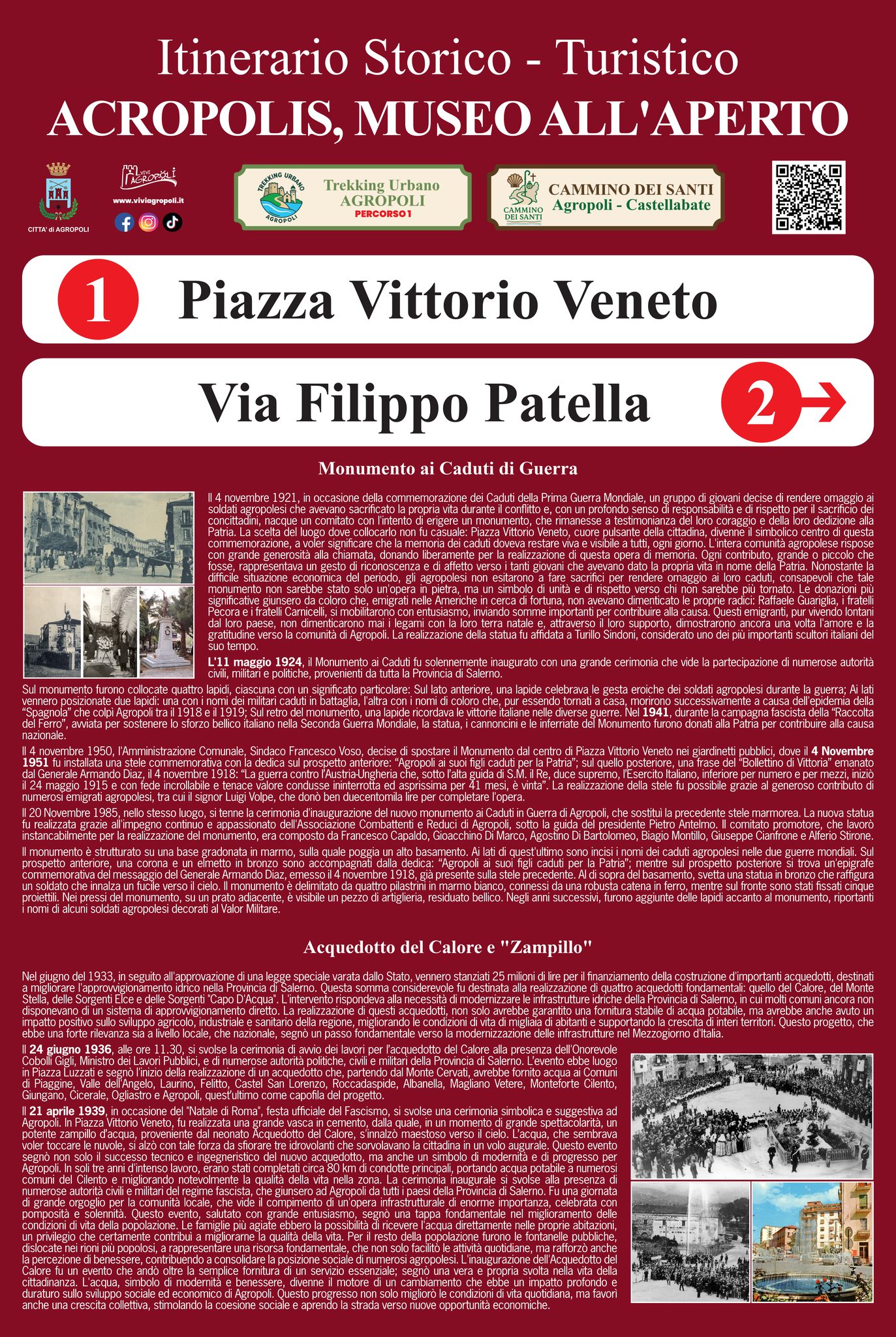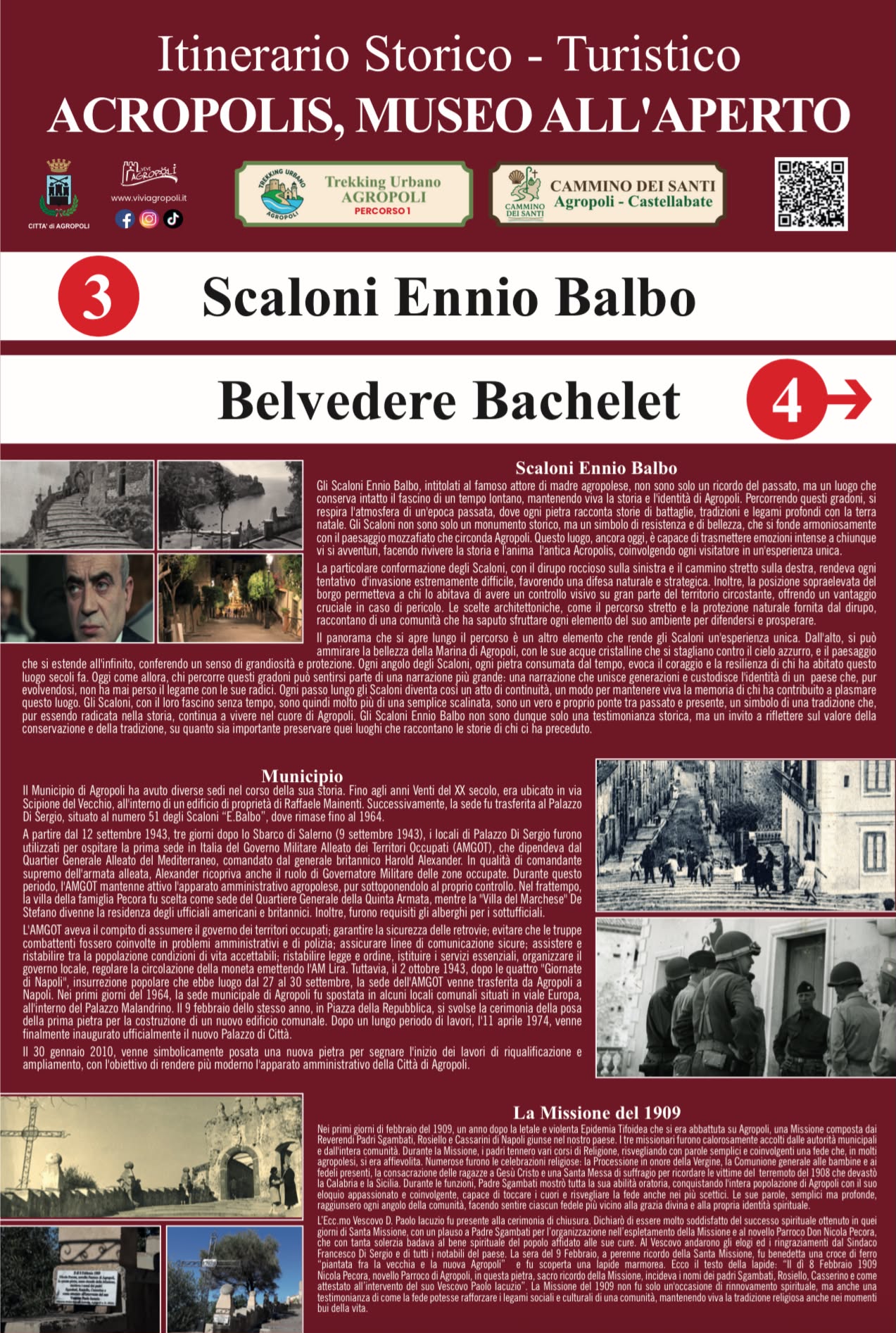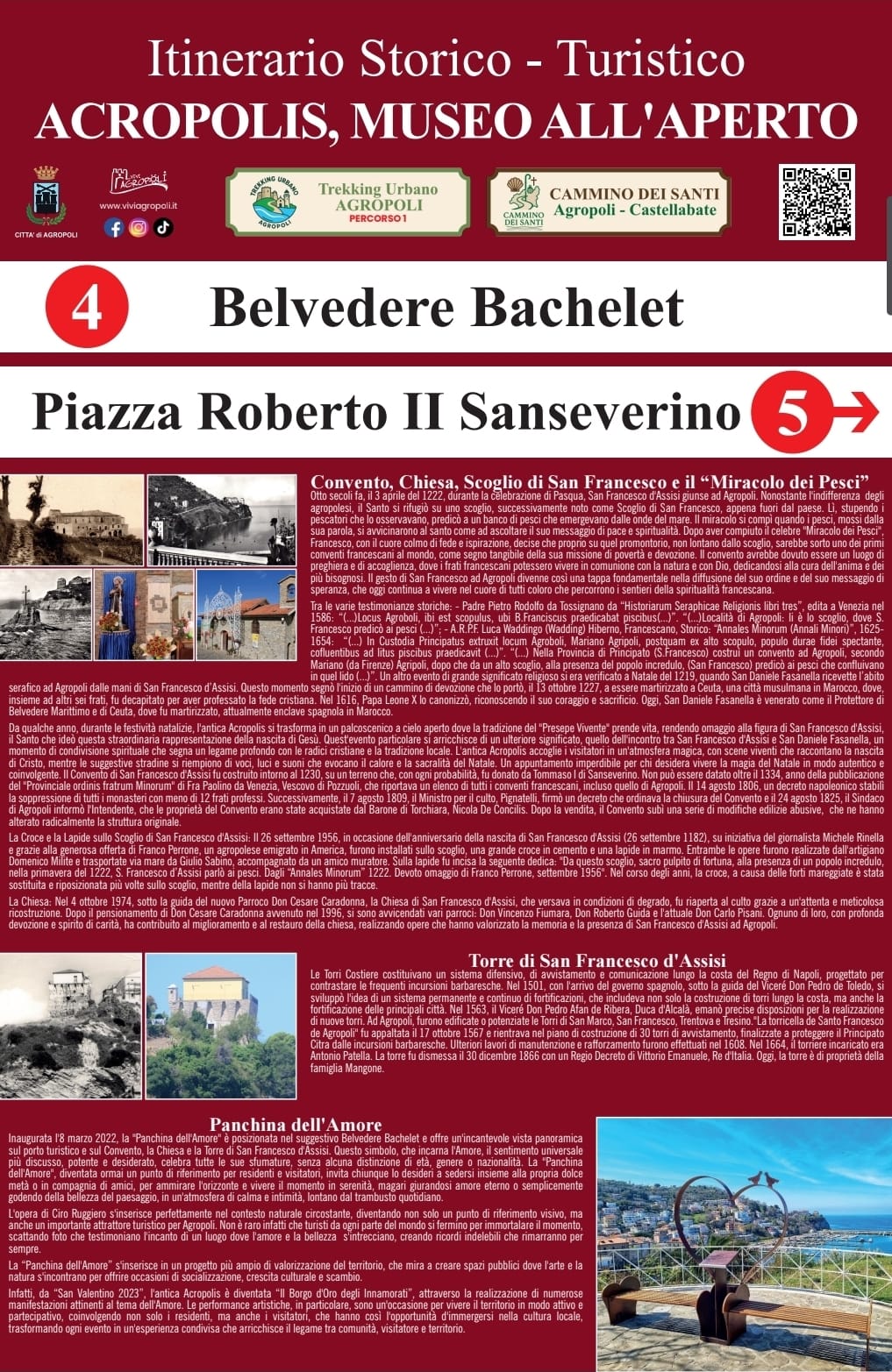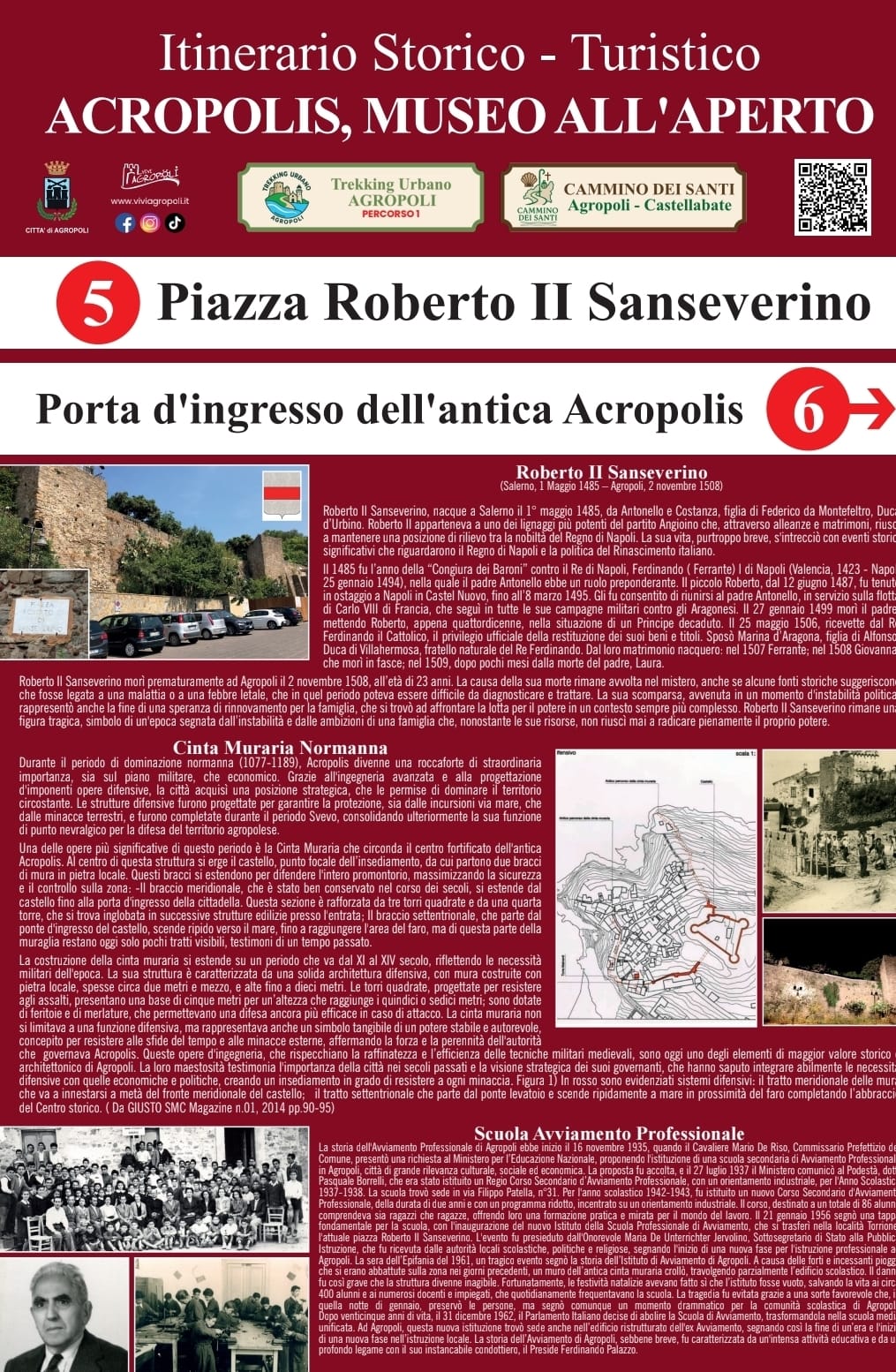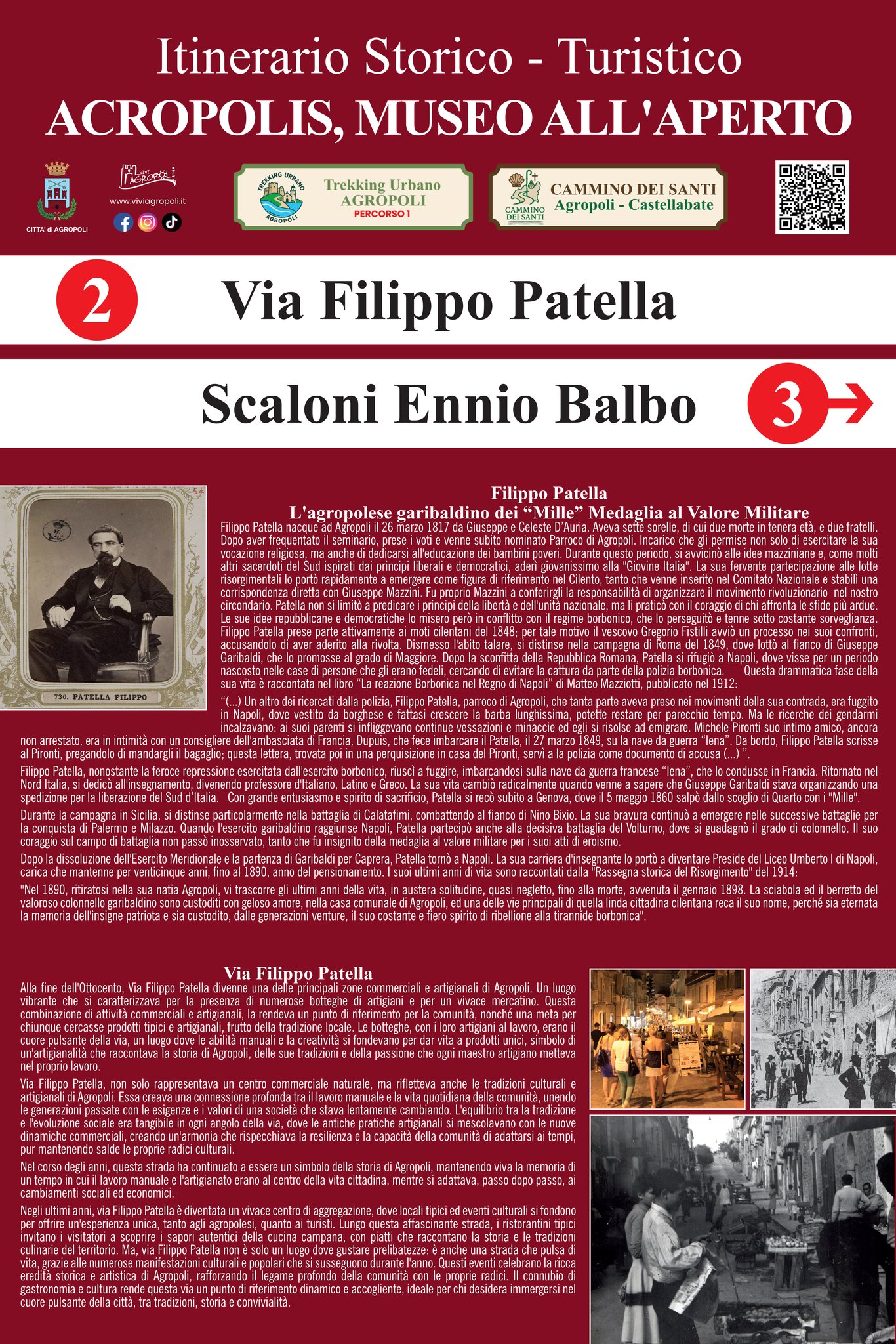
🇬🇧 Filippo Patella
The Garibaldian from Agropoli among the “Thousand” – Medal of Military Valor
Filippo Patella was born in Agropoli on March 26, 1817, to Giuseppe and Celeste D’Auria. He had seven sisters, two of whom died at a young age, and two brothers.
After attending the seminary, he took his vows and was soon appointed Parish Priest of Agropoli. This role allowed him not only to pursue his religious vocation but also to dedicate himself to the education of poor children. During this period, he became close to the ideas of Mazzini and, like many other priests in Southern Italy inspired by liberal and democratic principles, he joined the “Young Italy” movement at a very young age.
His fervent participation in the struggles of the Italian Risorgimento quickly made him a leading figure in the Cilento area, so much so that he was included in the National Committee and established direct correspondence with Giuseppe Mazzini. It was Mazzini himself who entrusted him with the responsibility of organizing the revolutionary movement in our district. Patella did not limit himself to preaching the principles of freedom and national unity; he practiced them with the courage of someone willing to face the greatest challenges.
However, his republican and democratic ideas brought him into conflict with the Bourbon regime, which persecuted him and kept him under constant surveillance.
Filippo Patella actively took part in the Cilento uprisings of 1848. For this reason, Bishop Gregorio Fistilli initiated a trial against him, accusing him of participating in the revolt. After abandoning his priestly robes, he distinguished himself in the Roman campaign of 1849, where he fought alongside Giuseppe Garibaldi, who promoted him to the rank of Major.
After the defeat of the Roman Republic, Patella took refuge in Naples, where he lived for a time in hiding in the homes of loyal supporters, trying to avoid capture by the Bourbon police. This dramatic phase of his life is recounted in the book “La reazione Borbonica nel Regno di Napoli” by Matteo Mazziotti, published in 1912:
“(…) Another of those sought by the police, Filippo Patella, parish priest of Agropoli, who had played such an important role in the movements of his district, had fled to Naples, where, dressed as a civilian and having grown a very long beard, he managed to remain for quite some time. But the searches by the gendarmes intensified: his relatives were subjected to constant harassment and threats, and he decided to emigrate. Michele Pironti, his close friend, who had not yet been arrested, was on good terms with a counselor at the French embassy, Dupuis, who arranged for Patella to embark on March 27, 1849, on the warship “Iena”. From the ship, Filippo Patella wrote to Pironti asking him to send his luggage; this letter, later found during a search of Pironti’s house, served the police as evidence for the accusation (…)”.
Despite the harsh repression carried out by the Bourbon army, Filippo Patella managed to escape by boarding the French warship Iena, which took him to France. After returning to Northern Italy, he devoted himself to teaching, becoming a professor of Italian, Latin, and Greek.
His life changed dramatically when he learned that Giuseppe Garibaldi was organizing an expedition to liberate Southern Italy. With great enthusiasm and a spirit of sacrifice, Patella immediately traveled to Genoa, where on May 5, 1860, he sailed from the rock of Quarto with the “Thousand”.
During the Sicilian campaign, he particularly distinguished himself in the Battle of Calatafimi, fighting alongside Nino Bixio. His bravery continued to stand out in the subsequent battles for the conquest of Palermo and Milazzo. When the Garibaldian army reached Naples, Patella also took part in the decisive Battle of the Volturno, where he earned the rank of colonel. His courage on the battlefield did not go unnoticed, and he was awarded the Medal of Military Valor for his acts of heroism.
After the dissolution of the Southern Army and Garibaldi’s departure for Caprera, Patella returned to Naples. His teaching career led him to become headmaster of the Umberto I High School in Naples, a position he held for twenty-five years, until his retirement in 1890.
The final years of his life are described in the Rassegna Storica del Risorgimento of 1914:
“In 1890, having retired to his native Agropoli, he spent the last years of his life there in austere solitude, almost forgotten, until his death in January 1898. The sword and the cap of the brave Garibaldian colonel are preserved with great care in the town hall of Agropoli, and one of the main streets of that neat Cilento town bears his name, so that the memory of the distinguished patriot may be eternal and his constant and proud spirit of rebellion against Bourbon tyranny may be preserved by future generations.”
Via Filippo Patella
At the end of the nineteenth century, Via Filippo Patella became one of the main commercial and artisan areas of Agropoli. It was a vibrant place characterized by the presence of numerous artisan workshops and a lively market. This combination of commercial and craft activities made it a reference point for the community, as well as a destination for anyone seeking typical and handmade products rooted in local tradition.
The workshops, with artisans at work, were the beating heart of the street—a place where manual skills and creativity merged to create unique products, symbols of a craftsmanship that told the story of Agropoli, its traditions, and the passion that every master artisan put into their work.
Via Filippo Patella not only represented a natural commercial center but also reflected the cultural and artisanal traditions of Agropoli. It created a deep connection between manual labor and the daily life of the community, linking past generations with the needs and values of a society that was slowly changing.
The balance between tradition and social evolution could be felt in every corner of the street, where ancient artisanal practices blended with new commercial dynamics, creating a harmony that reflected the resilience and the ability of the community to adapt to the times while maintaining strong cultural roots.
Over the years, this street has continued to be a symbol of Agropoli’s history, keeping alive the memory of a time when manual labor and craftsmanship were at the center of city life, while gradually adapting to social and economic changes.
In recent years, Via Filippo Patella has become a lively gathering place where traditional venues and cultural events come together to offer a unique experience for both the residents of Agropoli and tourists. Along this charming street, small traditional restaurants invite visitors to discover the authentic flavors of Campanian cuisine, with dishes that tell the story and culinary traditions of the area.
But Via Filippo Patella is not only a place to enjoy delicious food; it is also a street full of life, thanks to the many cultural and popular events that take place throughout the year. These events celebrate the rich historical and artistic heritage of Agropoli, strengthening the deep bond between the community and its roots.
The combination of gastronomy and culture makes this street a dynamic and welcoming landmark, ideal for anyone who wishes to immerse themselves in the vibrant heart of the city, among traditions, history, and conviviality.
🇩🇪 Filippo Patella
Der Garibaldiner aus Agropoli der „Tausend“ – Träger der Medaille für militärische Tapferkeit
Filippo Patella wurde am 26. März 1817 in Agropoli als Sohn von Giuseppe und Celeste D’Auria geboren. Er hatte sieben Schwestern, von denen zwei im frühen Kindesalter starben, sowie zwei Brüder.
Nach dem Besuch des Seminars legte er seine Gelübde ab und wurde bald zum Pfarrer von Agropoli ernannt. Dieses Amt ermöglichte es ihm nicht nur, seine religiöse Berufung auszuüben, sondern sich auch der Erziehung armer Kinder zu widmen. In dieser Zeit näherte er sich den Ideen von Mazzini und trat – wie viele andere Priester Süditaliens, die von liberalen und demokratischen Prinzipien inspiriert waren – schon in jungen Jahren der Bewegung „Giovine Italia“ bei.
Seine leidenschaftliche Teilnahme an den Kämpfen des Risorgimento machte ihn bald zu einer führenden Persönlichkeit im Cilento. Er wurde in das Nationale Komitee aufgenommen und begann eine direkte Korrespondenz mit Giuseppe Mazzini. Gerade Mazzini übertrug ihm die Verantwortung, die revolutionäre Bewegung in unserem Bezirk zu organisieren. Patella beschränkte sich nicht darauf, die Prinzipien von Freiheit und nationaler Einheit zu predigen, sondern lebte sie mit dem Mut eines Menschen, der bereit ist, auch die schwierigsten Herausforderungen anzunehmen.
Seine republikanischen und demokratischen Ideen brachten ihn jedoch in Konflikt mit dem bourbonischen Regime, das ihn verfolgte und ständig überwachen ließ.
Filippo Patella nahm aktiv an den cilentanischen Aufständen von 1848 teil. Aus diesem Grund leitete Bischof Gregorio Fistilli ein Verfahren gegen ihn ein und beschuldigte ihn, an der Revolte teilgenommen zu haben. Nachdem er das Priestergewand abgelegt hatte, zeichnete er sich im Feldzug von Rom im Jahr 1849 aus, wo er an der Seite von Giuseppe Garibaldi kämpfte, der ihn zum Major beförderte.
Nach der Niederlage der Römischen Republik floh Patella nach Neapel, wo er einige Zeit versteckt in den Häusern treuer Unterstützer lebte, um der Verhaftung durch die bourbonische Polizei zu entgehen. Diese dramatische Phase seines Lebens wird im Buch „La reazione Borbonica nel Regno di Napoli“ von Matteo Mazziotti (1912) beschrieben:
„(…) Ein weiterer von der Polizei Gesuchter, Filippo Patella, Pfarrer von Agropoli, der eine bedeutende Rolle in den Bewegungen seiner Gegend gespielt hatte, war nach Neapel geflohen. Dort blieb er, als Zivilist gekleidet und mit einem sehr langen Bart, längere Zeit verborgen. Doch die Nachforschungen der Gendarmen wurden immer intensiver: Seine Verwandten wurden ständig schikaniert und bedroht, sodass er beschloss auszuwandern. Michele Pironti, sein enger Freund, der noch nicht verhaftet worden war, stand in Verbindung mit einem Berater der französischen Botschaft, Dupuis, der Patella am 27. März 1849 auf das Kriegsschiff „Iena“ einschiffen ließ. Von Bord aus schrieb Filippo Patella an Pironti und bat ihn, ihm sein Gepäck zu schicken; dieser Brief, der später bei einer Hausdurchsuchung bei Pironti gefunden wurde, diente der Polizei als belastendes Beweisstück (…)“.
Trotz der harten Repression durch die bourbonische Armee gelang es Filippo Patella zu fliehen, indem er sich auf das französische Kriegsschiff Iena einschiffte, das ihn nach Frankreich brachte. Nachdem er nach Norditalien zurückgekehrt war, widmete er sich dem Unterricht und wurde Professor für Italienisch, Latein und Griechisch.
Sein Leben änderte sich grundlegend, als er erfuhr, dass Giuseppe Garibaldi eine Expedition zur Befreiung Süditaliens organisierte. Mit großer Begeisterung und Opferbereitschaft reiste Patella sofort nach Genua, wo er am 5. Mai 1860 vom Felsen von Quarto mit den „Tausend“ in See stach.
Während des Feldzugs in Sizilien zeichnete er sich besonders in der Schlacht von Calatafimi aus, wo er an der Seite von Nino Bixio kämpfte. Sein Mut zeigte sich auch in den folgenden Schlachten um die Eroberung von Palermo und Milazzo. Als die garibaldinische Armee Neapel erreichte, nahm Patella auch an der entscheidenden Schlacht am Volturno teil, wo er den Rang eines Obersts erhielt. Sein Mut auf dem Schlachtfeld blieb nicht unbeachtet, und für seine heldenhaften Taten wurde er mit der Medaille für militärische Tapferkeit ausgezeichnet.
Nach der Auflösung der Süditalienischen Armee und Garibaldis Abreise nach Caprera kehrte Patella nach Neapel zurück. Seine Lehrtätigkeit führte ihn zum Direktor des Liceo Umberto I in Neapel, ein Amt, das er fünfundzwanzig Jahre lang innehatte, bis zu seiner Pensionierung im Jahr 1890.
Die letzten Jahre seines Lebens werden in der Rassegna Storica del Risorgimento von 1914 beschrieben:
„Im Jahr 1890 zog er sich in sein Heimatdorf Agropoli zurück, wo er die letzten Jahre seines Lebens in strenger Einsamkeit, fast vergessen, bis zu seinem Tod im Januar 1898 verbrachte. Der Säbel und die Mütze des tapferen garibaldinischen Obersts werden mit großer Sorgfalt im Rathaus von Agropoli aufbewahrt, und eine der Hauptstraßen dieser gepflegten cilentanischen Stadt trägt seinen Namen, damit die Erinnerung an den bedeutenden Patrioten bewahrt bleibt und sein stolzer und unermüdlicher Geist des Widerstands gegen die bourbonische Tyrannei von zukünftigen Generationen weitergetragen wird.“
Via Filippo Patella
Am Ende des 19. Jahrhunderts wurde die Via Filippo Patella zu einer der wichtigsten Handels- und Handwerksstraßen von Agropoli. Es war ein lebendiger Ort, der sich durch zahlreiche Handwerksbetriebe und einen regen Markt auszeichnete. Diese Kombination aus Handels- und Handwerkstätigkeiten machte sie zu einem wichtigen Bezugspunkt für die Gemeinschaft sowie zu einem Ziel für alle, die typische und handgefertigte Produkte aus der lokalen Tradition suchten.
Die Werkstätten mit ihren arbeitenden Handwerkern bildeten das pulsierende Herz der Straße – ein Ort, an dem handwerkliches Können und Kreativität zusammenkamen, um einzigartige Produkte hervorzubringen, die die Geschichte von Agropoli, seine Traditionen und die Leidenschaft jedes einzelnen Meisters widerspiegelten.
Die Via Filippo Patella war nicht nur ein natürliches Handelszentrum, sondern spiegelte auch die kulturellen und handwerklichen Traditionen der Stadt wider. Sie schuf eine tiefe Verbindung zwischen handwerklicher Arbeit und dem täglichen Leben der Gemeinschaft und verband vergangene Generationen mit den Bedürfnissen und Werten einer Gesellschaft, die sich langsam veränderte.
Das Gleichgewicht zwischen Tradition und sozialer Entwicklung war in jeder Ecke der Straße spürbar, wo sich alte handwerkliche Praktiken mit neuen wirtschaftlichen Dynamiken vermischten und eine Harmonie schufen, die die Widerstandskraft und Anpassungsfähigkeit der Gemeinschaft widerspiegelte, ohne ihre kulturellen Wurzeln zu verlieren.
Im Laufe der Jahre ist diese Straße weiterhin ein Symbol der Geschichte von Agropoli geblieben. Sie bewahrt die Erinnerung an eine Zeit, in der Handarbeit und Handwerk im Mittelpunkt des städtischen Lebens standen, während sie sich gleichzeitig Schritt für Schritt an soziale und wirtschaftliche Veränderungen anpasste.
In den letzten Jahren hat sich die Via Filippo Patella zu einem lebendigen Treffpunkt entwickelt, an dem traditionelle Lokale und kulturelle Veranstaltungen zusammenkommen und sowohl den Einwohnern von Agropoli als auch den Touristen ein einzigartiges Erlebnis bieten. Entlang dieser charmanten Straße laden kleine typische Restaurants die Besucher dazu ein, die authentischen Aromen der kampanischen Küche zu entdecken – mit Gerichten, die die Geschichte und kulinarischen Traditionen des Gebiets erzählen.
Doch die Via Filippo Patella ist nicht nur ein Ort, um köstliche Speisen zu genießen: Sie ist auch eine Straße voller Leben, dank der zahlreichen kulturellen und volkstümlichen Veranstaltungen, die im Laufe des Jahres stattfinden. Diese Ereignisse feiern das reiche historische und künstlerische Erbe von Agropoli und stärken die tiefe Verbundenheit der Gemeinschaft mit ihren Wurzeln.
Die Verbindung von Gastronomie und Kultur macht diese Straße zu einem dynamischen und einladenden Treffpunkt – ideal für alle, die in das pulsierende Herz der Stadt eintauchen möchten, zwischen Tradition, Geschichte und Geselligkeit.
🇫🇷 Filippo Patella
L’Agropolese garibaldien des « Mille » – Médaille de la Valeur Militaire
Filippo Patella naquit à Agropoli le 26 mars 1817, de Giuseppe et Celeste D’Auria. Il avait sept sœurs, dont deux moururent en bas âge, et deux frères.
Après avoir fréquenté le séminaire, il prononça ses vœux et fut rapidement nommé curé d’Agropoli. Cette fonction lui permit non seulement d’exercer sa vocation religieuse, mais aussi de se consacrer à l’éducation des enfants pauvres. Durant cette période, il se rapprocha des idées de Mazzini et, comme beaucoup d’autres prêtres du Sud inspirés par les principes libéraux et démocratiques, il adhéra très jeune à la « Giovine Italia ».
Sa participation fervente aux luttes du Risorgimento le conduisit rapidement à devenir une figure de référence dans le Cilento, au point d’être intégré au Comité national et d’établir une correspondance directe avec Giuseppe Mazzini. Ce fut précisément Mazzini qui lui confia la responsabilité d’organiser le mouvement révolutionnaire dans notre circonscription. Patella ne se limita pas à prêcher les principes de liberté et d’unité nationale : il les mit en pratique avec le courage de ceux qui affrontent les défis les plus difficiles.
Ses idées républicaines et démocratiques l’opposèrent cependant au régime bourbonien, qui le persécuta et le plaça sous surveillance constante.
Filippo Patella participa activement aux soulèvements du Cilento en 1848 ; pour cette raison, l’évêque Gregorio Fistilli ouvrit un procès contre lui, l’accusant d’avoir adhéré à la révolte. Après avoir abandonné l’habit ecclésiastique, il se distingua dans la campagne de Rome de 1849, où il combattit aux côtés de Giuseppe Garibaldi, qui le promut au grade de major.
Après la défaite de la République romaine, Patella se réfugia à Naples, où il vécut pendant un certain temps caché dans les maisons de personnes qui lui étaient fidèles, cherchant à éviter la capture par la police bourbonienne. Cette phase dramatique de sa vie est racontée dans le livre « La reazione Borbonica nel Regno di Napoli » de Matteo Mazziotti, publié en 1912 :
« (…) Un autre des hommes recherchés par la police, Filippo Patella, curé d’Agropoli, qui avait pris une part importante aux mouvements de sa région, s’était enfui à Naples où, vêtu en civil et ayant laissé pousser une très longue barbe, il put rester caché pendant un certain temps. Mais les recherches des gendarmes s’intensifiaient : ses proches subissaient continuellement vexations et menaces, et il décida d’émigrer. Michele Pironti, son ami intime, encore non arrêté, était en relation avec un conseiller de l’ambassade de France, Dupuis, qui fit embarquer Patella, le 27 mars 1849, sur le navire de guerre “Iena”. Depuis le bord, Filippo Patella écrivit à Pironti pour lui demander de lui envoyer ses bagages ; cette lettre, retrouvée plus tard lors d’une perquisition au domicile de Pironti, servit à la police comme pièce à conviction (…) ».
Malgré la féroce répression exercée par l’armée bourbonienne, Filippo Patella réussit à s’échapper en embarquant sur le navire de guerre français Iena, qui le conduisit en France. De retour en Italie du Nord, il se consacra à l’enseignement et devint professeur d’italien, de latin et de grec.
Sa vie changea radicalement lorsqu’il apprit que Giuseppe Garibaldi organisait une expédition pour la libération du sud de l’Italie. Avec un grand enthousiasme et un esprit de sacrifice, Patella se rendit immédiatement à Gênes où, le 5 mai 1860, il partit du rocher de Quarto avec les « Mille ».
Pendant la campagne de Sicile, il se distingua particulièrement lors de la bataille de Calatafimi, combattant aux côtés de Nino Bixio. Sa bravoure continua de se manifester dans les batailles suivantes pour la conquête de Palerme et de Milazzo. Lorsque l’armée garibaldienne atteignit Naples, Patella participa également à la décisive bataille du Volturno, où il obtint le grade de colonel. Son courage sur le champ de bataille ne passa pas inaperçu, et il fut décoré de la Médaille de la Valeur Militaire pour ses actes d’héroïsme.
Après la dissolution de l’Armée méridionale et le départ de Garibaldi pour Caprera, Patella retourna à Naples. Sa carrière d’enseignant le conduisit à devenir proviseur du Lycée Umberto I de Naples, fonction qu’il occupa pendant vingt-cinq ans, jusqu’à sa retraite en 1890.
Les dernières années de sa vie sont racontées dans la Rassegna Storica del Risorgimento de 1914 :
« En 1890, retiré dans sa ville natale d’Agropoli, il y passa les dernières années de sa vie dans une austère solitude, presque oublié, jusqu’à sa mort en janvier 1898. Le sabre et le béret du valeureux colonel garibaldien sont conservés avec un soin jaloux à la mairie d’Agropoli, et l’une des principales rues de cette élégante ville du Cilento porte son nom, afin que la mémoire de l’illustre patriote soit perpétuée et que son esprit constant et fier de rébellion contre la tyrannie bourbonienne soit conservé par les générations futures. »
Via Filippo Patella
À la fin du XIXᵉ siècle, la Via Filippo Patella devint l’une des principales zones commerciales et artisanales d’Agropoli. C’était un lieu animé caractérisé par la présence de nombreuses boutiques d’artisans et d’un marché très vivant. Cette combinaison d’activités commerciales et artisanales en faisait un point de référence pour la communauté, ainsi qu’une destination pour tous ceux qui recherchaient des produits typiques et artisanaux issus de la tradition locale.
Les ateliers, avec les artisans à l’œuvre, constituaient le cœur battant de la rue : un lieu où les compétences manuelles et la créativité se rejoignaient pour donner naissance à des produits uniques, symboles d’un artisanat qui racontait l’histoire d’Agropoli, de ses traditions et de la passion que chaque maître artisan mettait dans son travail.
La Via Filippo Patella ne représentait pas seulement un centre commercial naturel, mais reflétait également les traditions culturelles et artisanales d’Agropoli. Elle créait un lien profond entre le travail manuel et la vie quotidienne de la communauté, reliant les générations passées aux besoins et aux valeurs d’une société en lente transformation.
L’équilibre entre tradition et évolution sociale était perceptible à chaque coin de la rue, où les anciennes pratiques artisanales se mêlaient aux nouvelles dynamiques commerciales, créant une harmonie qui reflétait la résilience et la capacité de la communauté à s’adapter aux temps tout en conservant solidement ses racines culturelles.
Au fil des années, cette rue est restée un symbole de l’histoire d’Agropoli, gardant vivante la mémoire d’une époque où le travail manuel et l’artisanat étaient au centre de la vie de la ville, tout en s’adaptant progressivement aux changements sociaux et économiques.
Ces dernières années, la Via Filippo Patella est devenue un lieu de rencontre animé, où établissements typiques et événements culturels se combinent pour offrir une expérience unique aussi bien aux habitants d’Agropoli qu’aux touristes. Le long de cette charmante rue, de petits restaurants typiques invitent les visiteurs à découvrir les saveurs authentiques de la cuisine campanienne, avec des plats qui racontent l’histoire et les traditions culinaires du territoire.
Mais la Via Filippo Patella n’est pas seulement un lieu où savourer de délicieuses spécialités : c’est aussi une rue pleine de vie, grâce aux nombreuses manifestations culturelles et populaires qui s’y succèdent tout au long de l’année. Ces événements célèbrent le riche patrimoine historique et artistique d’Agropoli et renforcent le lien profond de la communauté avec ses racines.
L’union de la gastronomie et de la culture fait de cette rue un point de référence dynamique et accueillant, idéal pour ceux qui souhaitent s’immerger dans le cœur vibrant de la ville, entre traditions, histoire et convivialité.