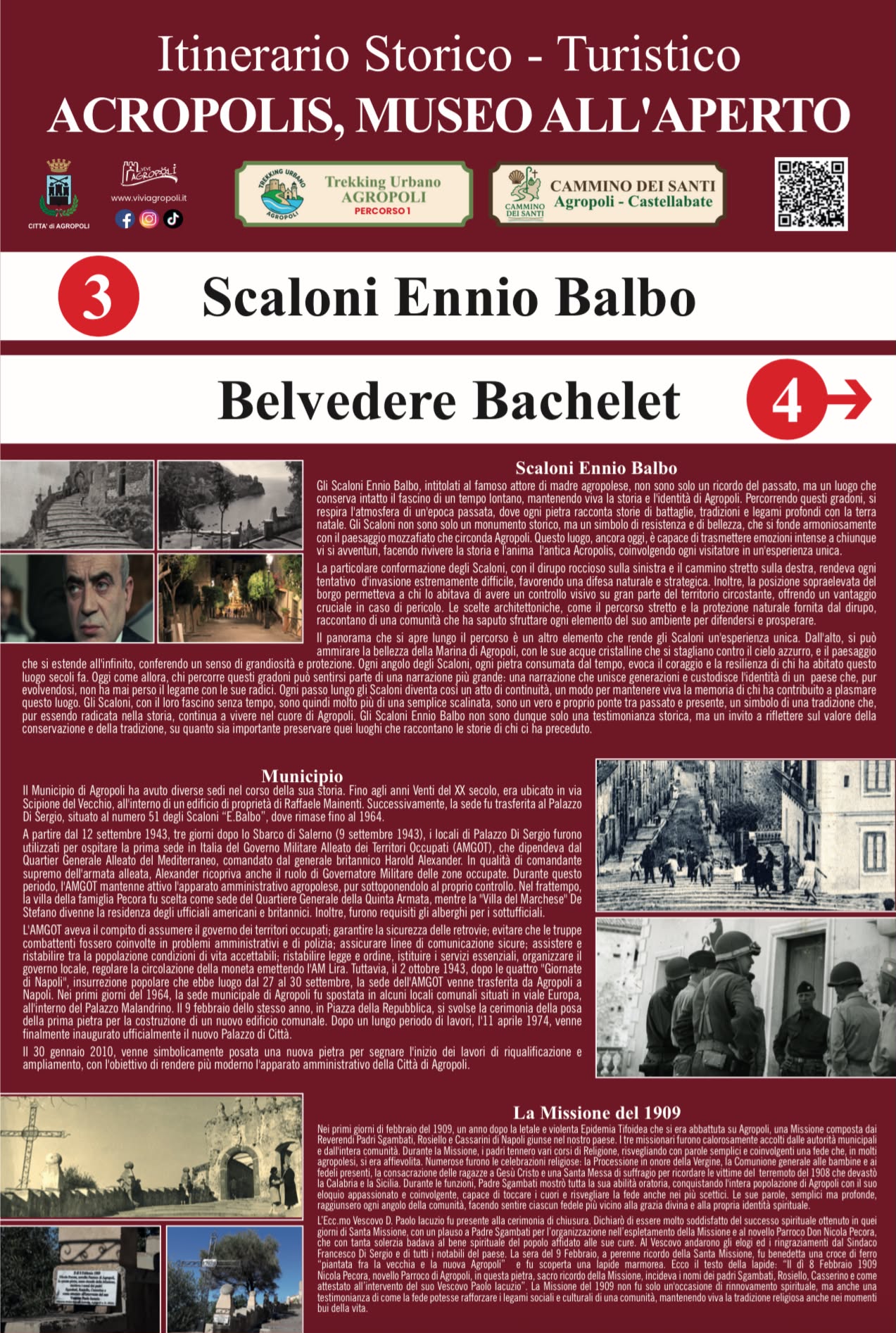
🇬🇧 Ennio Balbo Stairway
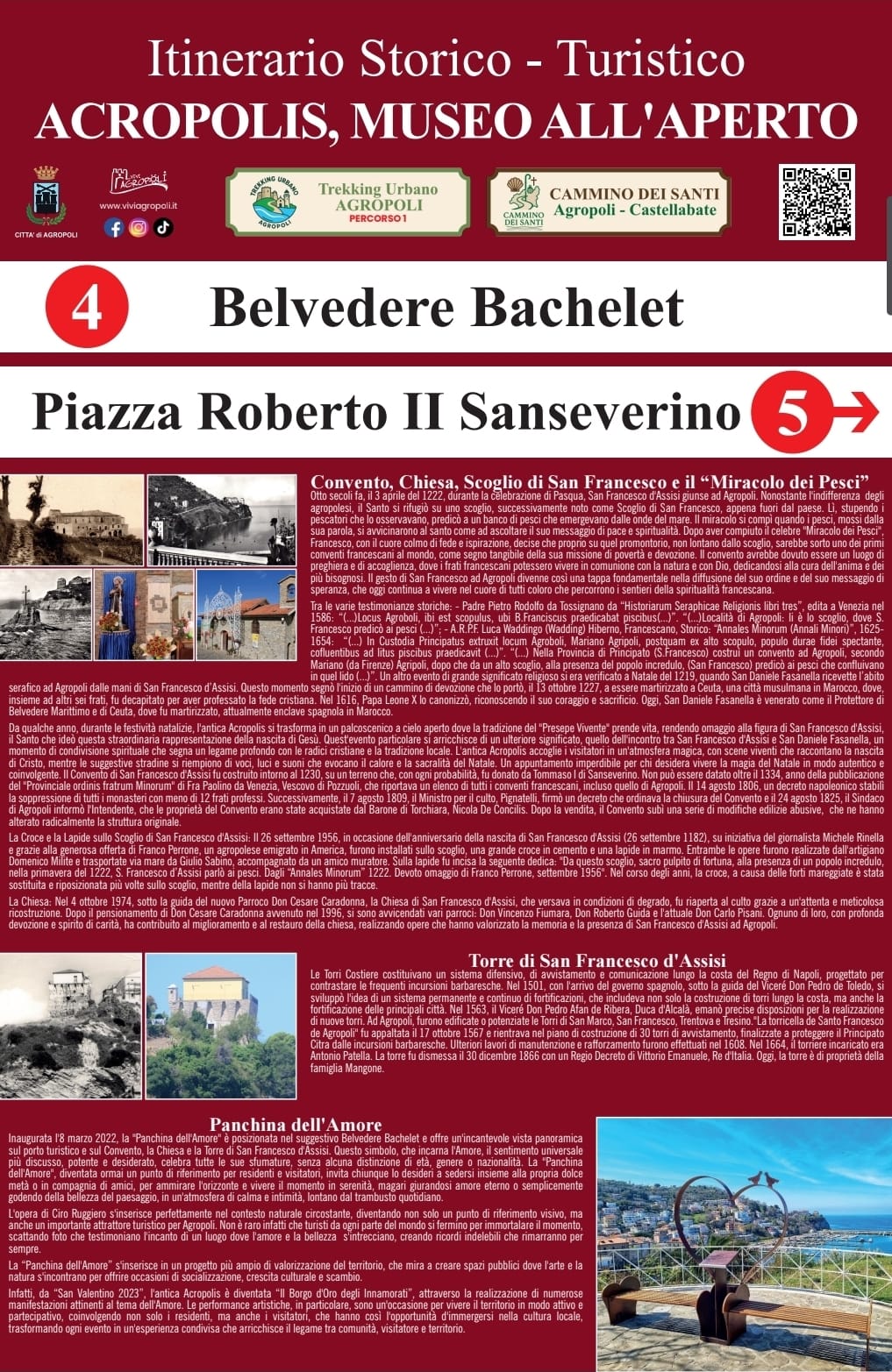
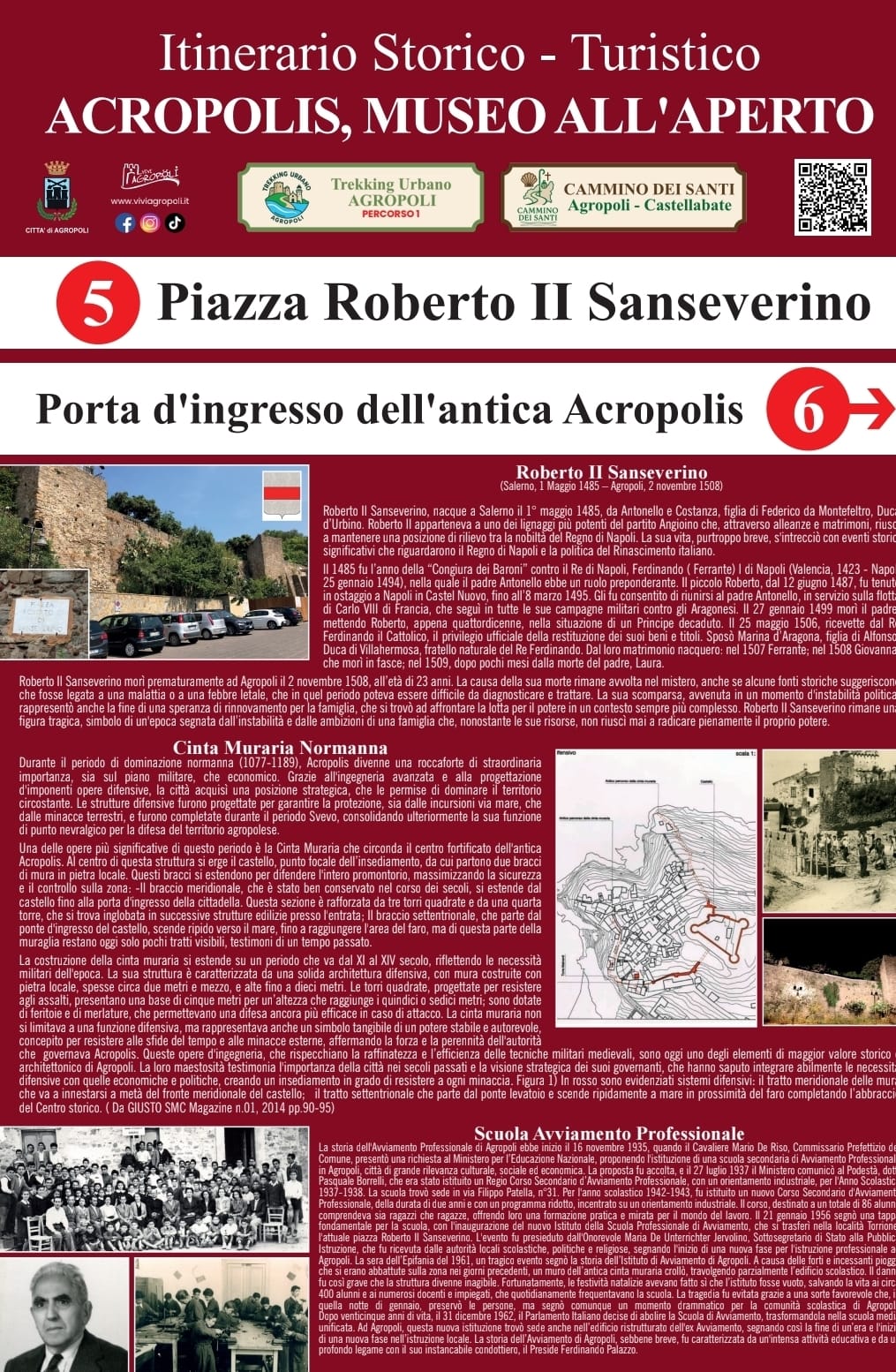
The Ennio Balbo Stairway, named after the famous actor of Agropoli descent, is not only a reminder of the past but also a place that preserves the charm of a distant era, keeping alive the history and identity of Agropoli. Walking along these steps, one can breathe the atmosphere of a bygone age, where every stone tells stories of battles, traditions, and deep connections with the native land. The stairway is not only a historical monument but also a symbol of resilience and beauty, harmoniously blending with the breathtaking landscape that surrounds Agropoli. Even today, this place is capable of conveying strong emotions to anyone who ventures along it, bringing back to life the history and soul of the ancient Acropolis and engaging every visitor in a unique experience.
The particular structure of the stairway, with the rocky cliff on the left and the narrow path on the right, made any attempt at invasion extremely difficult, providing a natural and strategic defense. Moreover, the elevated position of the village allowed its inhabitants to have a visual control over much of the surrounding territory, offering a crucial advantage in times of danger. Architectural choices such as the narrow route and the natural protection provided by the cliff reveal a community that knew how to use every element of its environment to defend itself and prosper.
The panorama that opens along the path is another element that makes the stairway a unique experience. From above, one can admire the beauty of the Marina of Agropoli, with its crystal-clear waters standing out against the blue sky, and the landscape stretching endlessly, giving a sense of grandeur and protection.
Every corner of the stairway, every stone worn by time, evokes the courage and resilience of those who lived in this place centuries ago. Today, as in the past, anyone who walks these steps can feel part of a greater narrative: a story that unites generations and preserves the identity of a town that, while evolving, has never lost its connection with its roots.
Each step along the stairway thus becomes an act of continuity, a way of keeping alive the memory of those who helped shape this place. With their timeless charm, the steps are much more than a simple staircase—they are a true bridge between past and present, a symbol of a tradition that, although deeply rooted in history, continues to live in the heart of Agropoli.
The Ennio Balbo Stairway is therefore not only a historical testimony but also an invitation to reflect on the value of preservation and tradition, and on how important it is to safeguard those places that tell the stories of those who came before us.
Municipality
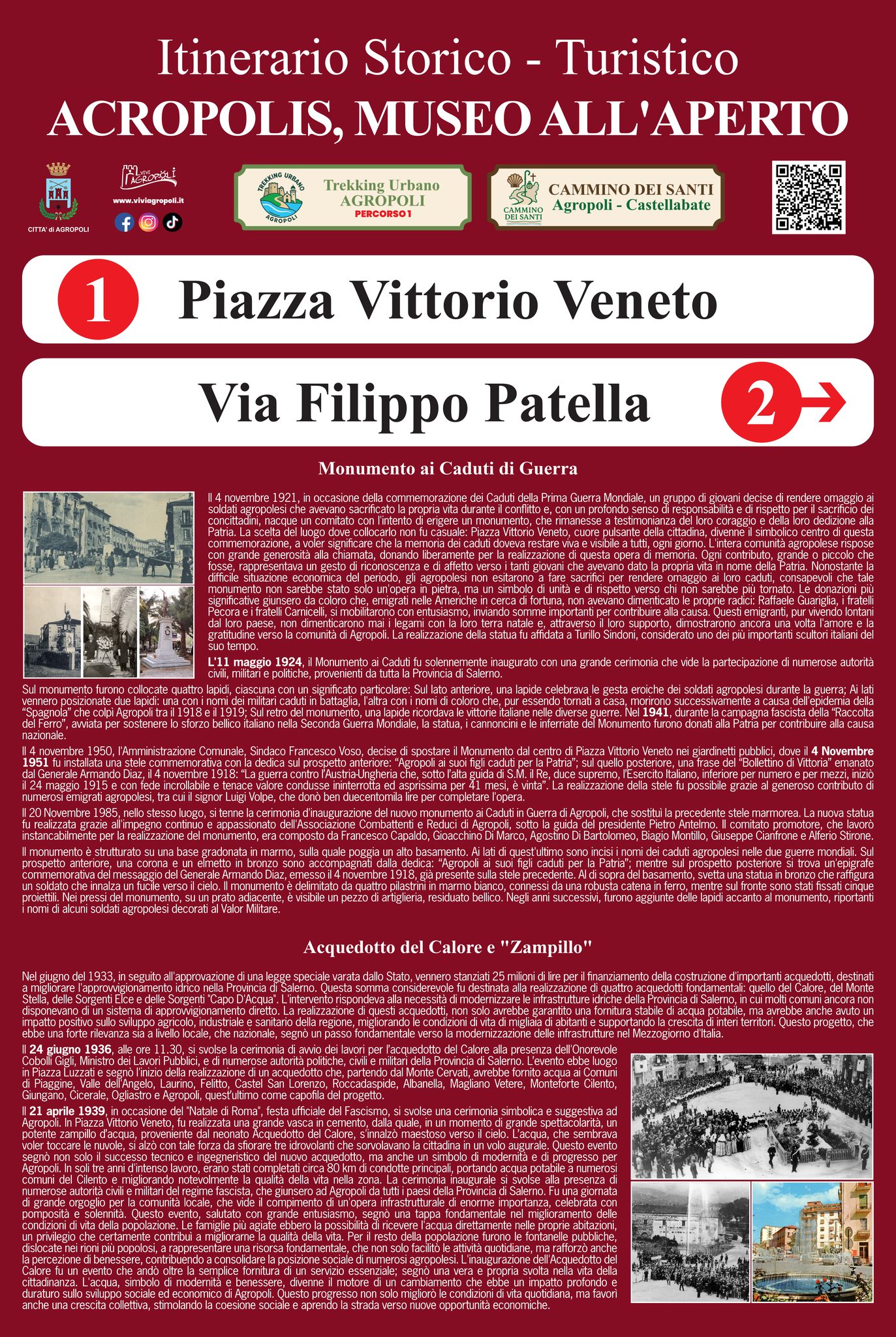
The Municipality of Agropoli has had several locations throughout its history. Until the 1920s, it was located on Via Scipione del Vecchio, inside a building owned by Raffaele Mainenti. Later, the municipal offices were transferred to Palazzo Di Sergio, located at number 51 of the Scaloni “E. Balbo”, where they remained until 1964.
Starting from September 12, 1943, three days after the Salerno Landings (September 9, 1943), the premises of Palazzo Di Sergio were used to host the first headquarters in Italy of the Allied Military Government of Occupied Territories (AMGOT), which depended on the Allied Mediterranean Headquarters commanded by the British General Harold Alexander. As Supreme Commander of the Allied Army, Alexander also held the position of Military Governor of the occupied areas. During this period, AMGOT kept the Agropoli administrative system active while placing it under its own control. Meanwhile, the Pecora family villa was chosen as the headquarters of the Fifth Army, while the “Villa del Marchese” De Stefano became the residence of American and British officers. Additionally, local hotels were requisitioned for non-commissioned officers.
AMGOT was responsible for governing the occupied territories, ensuring rear-area security, preventing combat troops from being involved in administrative and police matters, guaranteeing secure communication lines, assisting the population and restoring acceptable living conditions, reestablishing law and order, restoring essential services, organizing local government, and regulating currency circulation by issuing the AM-Lira. However, on October 2, 1943, after the Four Days of Naples — a popular uprising that took place from September 27 to 30 — the AMGOT headquarters was moved from Agropoli to Naples.
In the early days of 1964, the municipal headquarters of Agropoli was moved to some municipal offices located on Viale Europa inside Palazzo Malandrino. On February 9 of the same year, in Piazza della Repubblica, the ceremony for laying the foundation stone of a new municipal building took place. After a long period of construction, on April 11, 1974, the new City Hall was finally officially inaugurated.
On January 30, 2010, a new symbolic stone was laid to mark the beginning of renovation and expansion works aimed at modernizing the administrative structure of the City of Agropoli.
The Mission of 1909
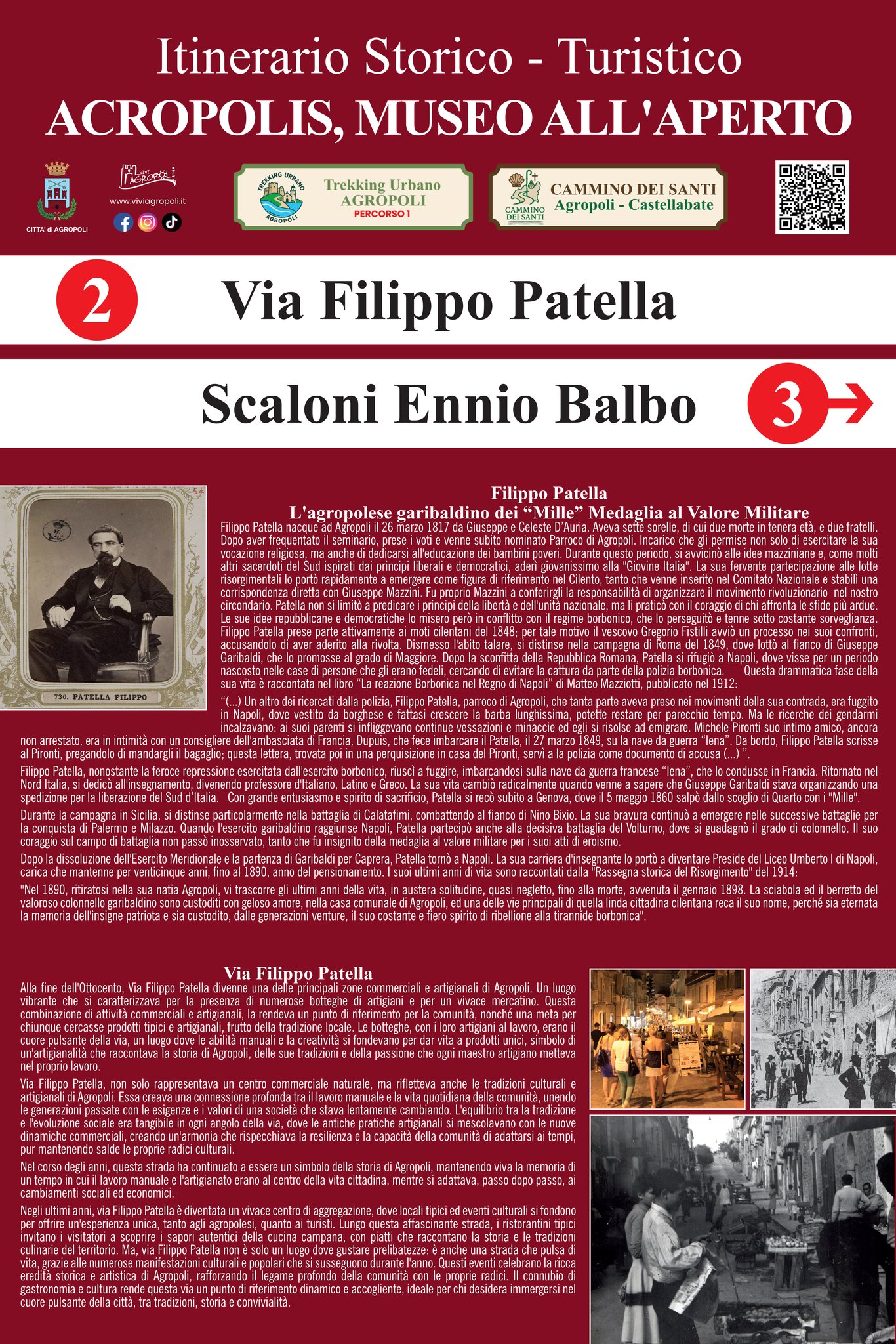
In the early days of February 1909, one year after the deadly and violent typhoid epidemic that had struck Agropoli, a Mission composed of the Reverend Fathers Sgambati, Rosiello, and Cassarini from Naples arrived in the town. The three missionaries were warmly welcomed by the municipal authorities and the entire community.
During the Mission, the priests held several religious courses, reviving with simple and engaging words a faith that, in many Agropoli residents, had grown weak. Numerous religious celebrations took place: the Procession in honor of the Virgin, the general Communion for young girls and the faithful present, the consecration of the girls to Jesus Christ, and a Holy Mass offered in memory of the victims of the 1908 earthquake that devastated Calabria and Sicily.
During the ceremonies, Father Sgambati demonstrated his remarkable oratorical ability, captivating the entire population of Agropoli with his passionate and engaging speech, capable of touching hearts and rekindling faith even among the most skeptical. His words, simple yet profound, reached every corner of the community, making each believer feel closer to divine grace and to their own spiritual identity.
His Excellency Bishop Don Paolo Iacuzio attended the closing ceremony. He declared himself very satisfied with the spiritual success achieved during those days of the Holy Mission, praising Father Sgambati for the organization of the Mission and the newly appointed parish priest Don Nicola Pecora, who diligently cared for the spiritual well-being of the people entrusted to him. The Bishop also received praise and thanks from the Mayor Francesco Di Sergio and from the notable figures of the town.
On the evening of February 9, as a lasting memory of the Holy Mission, an iron cross was blessed, “planted between the old and the new Agropoli,” and a marble plaque was unveiled. The inscription reads:
“On February 8, 1909, Nicola Pecora, the new parish priest of Agropoli, engraved on this stone, sacred memory of the Mission, the names of the fathers Sgambati, Rosiello, Casserino, and as testimony to the presence of his Bishop Paolo Iacuzio.”
The Mission of 1909 was not only an opportunity for spiritual renewal, but also a testimony to how faith could strengthen the social and cultural bonds of a community, keeping religious tradition alive even during the darkest moments of life.
🇩🇪 Ennio-Balbo-Treppe
Die Ennio-Balbo-Treppe, benannt nach dem berühmten Schauspieler agropolesischer Herkunft, ist nicht nur eine Erinnerung an die Vergangenheit, sondern auch ein Ort, der den Charme einer fernen Epoche bewahrt und die Geschichte und Identität von Agropoli lebendig hält. Beim Hinaufgehen dieser Stufen spürt man die Atmosphäre einer vergangenen Zeit, in der jeder Stein Geschichten von Schlachten, Traditionen und tiefen Verbindungen zur Heimat erzählt. Die Treppe ist nicht nur ein historisches Denkmal, sondern auch ein Symbol für Widerstandskraft und Schönheit, das sich harmonisch in die atemberaubende Landschaft einfügt, die Agropoli umgibt. Auch heute noch ist dieser Ort in der Lage, bei allen, die ihn betreten, starke Emotionen hervorzurufen und die Geschichte und Seele der alten Akropolis wieder lebendig werden zu lassen, sodass jeder Besucher ein einzigartiges Erlebnis erfährt.
Die besondere Struktur der Treppe, mit dem Felsabgrund auf der linken Seite und dem schmalen Weg auf der rechten Seite, machte jeden Invasionsversuch äußerst schwierig und bot eine natürliche und strategische Verteidigung. Zudem ermöglichte die erhöhte Lage des Dorfes seinen Bewohnern eine visuelle Kontrolle über einen großen Teil des umliegenden Gebietes und bot damit einen entscheidenden Vorteil in Zeiten der Gefahr. Architektonische Entscheidungen wie der schmale Weg und der natürliche Schutz durch den Felsabhang zeigen eine Gemeinschaft, die es verstand, jedes Element ihrer Umgebung zu nutzen, um sich zu verteidigen und zu gedeihen.
Das Panorama entlang des Weges ist ein weiteres Element, das die Treppe zu einem einzigartigen Erlebnis macht. Von oben kann man die Schönheit der Marina von Agropoli bewundern, mit ihrem kristallklaren Wasser, das sich vom blauen Himmel abhebt, sowie die Landschaft, die sich scheinbar endlos ausdehnt und ein Gefühl von Größe und Schutz vermittelt.
Jede Ecke der Treppe, jeder vom Lauf der Zeit abgenutzte Stein, erinnert an den Mut und die Widerstandskraft der Menschen, die diesen Ort vor Jahrhunderten bewohnten. Heute wie damals kann jeder, der diese Stufen hinaufgeht, sich als Teil einer größeren Erzählung fühlen: einer Geschichte, die Generationen verbindet und die Identität einer Stadt bewahrt, die sich zwar weiterentwickelt, aber niemals die Verbindung zu ihren Wurzeln verloren hat.
Jeder Schritt auf dieser Treppe wird so zu einem Akt der Kontinuität, zu einer Möglichkeit, die Erinnerung an jene lebendig zu halten, die diesen Ort geprägt haben. Mit ihrem zeitlosen Charme sind die Stufen weit mehr als nur eine einfache Treppe – sie sind eine echte Brücke zwischen Vergangenheit und Gegenwart, ein Symbol einer Tradition, die zwar tief in der Geschichte verwurzelt ist, aber weiterhin im Herzen von Agropoli lebt.
Die Ennio-Balbo-Treppe ist daher nicht nur ein historisches Zeugnis, sondern auch eine Einladung, über den Wert der Bewahrung und der Tradition nachzudenken und darüber, wie wichtig es ist, jene Orte zu schützen, die die Geschichten der Menschen erzählen, die vor uns hier gelebt haben.
Rathaus
Das Rathaus von Agropoli hatte im Laufe seiner Geschichte mehrere Standorte. Bis in die 1920er Jahre befand es sich in der Via Scipione del Vecchio in einem Gebäude, das Raffaele Mainenti gehörte. Später wurden die Gemeindebüros in den Palazzo Di Sergio verlegt, der sich an der Hausnummer 51 der Scaloni „E. Balbo“ befindet, wo sie bis 1964 blieben.
Ab dem 12. September 1943, drei Tage nach der Landung von Salerno (9. September 1943), wurden die Räume des Palazzo Di Sergio als erster Sitz in Italien der Alliierten Militärregierung der besetzten Gebiete (AMGOT) genutzt, die dem Alliierten Mittelmeerhauptquartier unterstand, das vom britischen General Harold Alexander kommandiert wurde. Als Oberbefehlshaber der alliierten Armee übernahm Alexander auch die Rolle des Militärgouverneurs der besetzten Gebiete. Während dieser Zeit hielt die AMGOT die Verwaltung von Agropoli aufrecht, stellte sie jedoch unter ihre Kontrolle. Gleichzeitig wurde die Villa der Familie Pecora als Hauptquartier der Fünften Armee ausgewählt, während die „Villa del Marchese“ De Stefano zur Residenz amerikanischer und britischer Offiziere wurde. Außerdem wurden Hotels für Unteroffiziere beschlagnahmt.
Die AMGOT hatte die Aufgabe, die besetzten Gebiete zu verwalten, die Sicherheit im Hinterland zu gewährleisten, zu verhindern, dass kämpfende Truppen in Verwaltungs- und Polizeiprobleme verwickelt wurden, sichere Kommunikationslinien zu garantieren, der Bevölkerung zu helfen und akzeptable Lebensbedingungen wiederherzustellen, Recht und Ordnung wiederherzustellen, wesentliche Dienste zu organisieren, die lokale Regierung zu strukturieren und den Geldumlauf durch die Ausgabe der AM-Lira zu regeln. Am 2. Oktober 1943, nach den „Vier Tagen von Neapel“ – einem Volksaufstand vom 27. bis 30. September – wurde der Sitz der AMGOT jedoch von Agropoli nach Neapel verlegt.
In den ersten Tagen des Jahres 1964 wurde der Gemeindesitz von Agropoli in einige kommunale Räume in der Viale Europa im Palazzo Malandrino verlegt. Am 9. Februar desselben Jahres fand auf der Piazza della Repubblica die Zeremonie zur Grundsteinlegung für ein neues Gemeindegebäude statt. Nach einer langen Bauzeit wurde am 11. April 1974 schließlich das neue Rathaus offiziell eingeweiht.
Am 30. Januar 2010 wurde symbolisch ein neuer Grundstein gelegt, um den Beginn der Renovierungs- und Erweiterungsarbeiten zu markieren, mit dem Ziel, die Verwaltungsstruktur der Stadt Agropoli zu modernisieren.
Die Mission von 1909
In den ersten Februartagen des Jahres 1909, ein Jahr nach der tödlichen und heftigen Typhusepidemie, die Agropoli heimgesucht hatte, kam eine Mission, bestehend aus den Hochwürdigen Vätern Sgambati, Rosiello und Cassarini aus Neapel, in die Stadt. Die drei Missionare wurden von den kommunalen Behörden und der gesamten Bevölkerung herzlich empfangen.
Während der Mission hielten die Priester verschiedene Religionskurse ab und belebten mit einfachen und mitreißenden Worten einen Glauben neu, der bei vielen Einwohnern von Agropoli schwächer geworden war. Zahlreiche religiöse Feierlichkeiten fanden statt: die Prozession zu Ehren der Jungfrau Maria, die allgemeine Kommunion für Mädchen und die anwesenden Gläubigen, die Weihe der Mädchen an Jesus Christus sowie eine Heilige Messe zum Gedenken an die Opfer des Erdbebens von 1908, das Kalabrien und Sizilien verwüstete.
Während der Feierlichkeiten zeigte Pater Sgambati seine außergewöhnliche Redekunst und gewann mit seiner leidenschaftlichen und eindrucksvollen Ansprache die gesamte Bevölkerung von Agropoli für sich. Seine Worte waren in der Lage, die Herzen zu berühren und selbst bei den Skeptischsten den Glauben neu zu entfachen. Seine einfachen, aber tiefgründigen Worte erreichten jede Ecke der Gemeinschaft und ließen jeden Gläubigen sich der göttlichen Gnade und seiner eigenen spirituellen Identität näher fühlen.
Seine Exzellenz, Bischof Don Paolo Iacuzio, war bei der Abschlusszeremonie anwesend. Er erklärte sich sehr zufrieden mit dem spirituellen Erfolg dieser Tage der Heiligen Mission und lobte Pater Sgambati für die Organisation der Mission sowie den neu ernannten Pfarrer Don Nicola Pecora, der sich mit großem Eifer um das geistliche Wohl der ihm anvertrauten Gläubigen kümmerte. Dem Bischof wurden auch vom Bürgermeister Francesco Di Sergio und von den bedeutenden Persönlichkeiten des Ortes Lob und Dank ausgesprochen.
Am Abend des 9. Februar wurde zum dauerhaften Gedenken an die Heilige Mission ein eisernes Kreuz gesegnet, das „zwischen dem alten und dem neuen Agropoli“ aufgestellt wurde, und eine Marmortafel wurde enthüllt. Die Inschrift lautet:
„Am 8. Februar 1909 ließ Nicola Pecora, neuer Pfarrer von Agropoli, auf diesem Stein – heilige Erinnerung an die Mission – die Namen der Väter Sgambati, Rosiello und Casserino eingravieren, als Zeugnis der Anwesenheit seines Bischofs Paolo Iacuzio.“
Die Mission von 1909 war nicht nur eine Gelegenheit zur spirituellen Erneuerung, sondern auch ein Zeugnis dafür, wie der Glaube die sozialen und kulturellen Bindungen einer Gemeinschaft stärken konnte und die religiöse Tradition selbst in den dunkelsten Momenten des Lebens lebendig hielt.
🇫🇷 Escalier Ennio Balbo
L’escalier Ennio Balbo, nommé en l’honneur du célèbre acteur d’origine agropolitaine, n’est pas seulement un souvenir du passé, mais aussi un lieu qui conserve le charme d’une époque lointaine, en maintenant vivantes l’histoire et l’identité d’Agropoli. En parcourant ces marches, on ressent l’atmosphère d’un temps révolu, où chaque pierre raconte des histoires de batailles, de traditions et de liens profonds avec la terre natale. L’escalier n’est pas seulement un monument historique, mais aussi un symbole de résilience et de beauté qui se fond harmonieusement dans le paysage à couper le souffle qui entoure Agropoli. Encore aujourd’hui, ce lieu est capable de transmettre de fortes émotions à tous ceux qui s’y aventurent, faisant revivre l’histoire et l’âme de l’ancienne Acropole et offrant à chaque visiteur une expérience unique.
La structure particulière de l’escalier, avec la falaise rocheuse sur la gauche et le passage étroit sur la droite, rendait toute tentative d’invasion extrêmement difficile, offrant une défense naturelle et stratégique. De plus, la position surélevée du village permettait à ses habitants d’avoir un contrôle visuel sur une grande partie du territoire environnant, offrant ainsi un avantage crucial en cas de danger. Les choix architecturaux, comme le chemin étroit et la protection naturelle offerte par la falaise, révèlent une communauté qui a su exploiter chaque élément de son environnement pour se défendre et prospérer.
Le panorama qui s’ouvre tout au long du parcours est un autre élément qui rend cet escalier unique. D’en haut, on peut admirer la beauté de la Marina d’Agropoli, avec ses eaux cristallines qui se détachent sur le ciel bleu, ainsi que le paysage qui semble s’étendre à l’infini, donnant une sensation de grandeur et de protection.
Chaque recoin de l’escalier, chaque pierre usée par le temps, évoque le courage et la résilience de ceux qui ont habité ce lieu il y a des siècles. Aujourd’hui comme autrefois, toute personne qui gravit ces marches peut se sentir partie d’un récit plus vaste : une histoire qui unit les générations et préserve l’identité d’une ville qui, tout en évoluant, n’a jamais perdu le lien avec ses racines.
Chaque pas sur cet escalier devient ainsi un acte de continuité, une manière de garder vivante la mémoire de ceux qui ont contribué à façonner ce lieu. Avec leur charme intemporel, ces marches sont bien plus qu’un simple escalier : elles constituent un véritable pont entre le passé et le présent, un symbole d’une tradition profondément enracinée dans l’histoire et qui continue de vivre dans le cœur d’Agropoli.
L’escalier Ennio Balbo n’est donc pas seulement un témoignage historique, mais aussi une invitation à réfléchir à la valeur de la préservation et de la tradition, ainsi qu’à l’importance de protéger les lieux qui racontent l’histoire de ceux qui nous ont précédés.
Mairie
La mairie d’Agropoli a connu plusieurs sièges au cours de son histoire. Jusqu’aux années 1920, elle se trouvait dans la Via Scipione del Vecchio, dans un bâtiment appartenant à Raffaele Mainenti. Par la suite, les bureaux municipaux furent transférés au Palazzo Di Sergio, situé au numéro 51 des Scaloni « E. Balbo », où ils restèrent jusqu’en 1964.
À partir du 12 septembre 1943, trois jours après le débarquement de Salerne (9 septembre 1943), les locaux du Palazzo Di Sergio furent utilisés pour accueillir le premier siège en Italie du Gouvernement Militaire Allié des Territoires Occupés (AMGOT), dépendant du Quartier Général Alliée de la Méditerranée, commandé par le général britannique Harold Alexander. En tant que commandant suprême de l’armée alliée, Alexander occupait également la fonction de gouverneur militaire des zones occupées. Pendant cette période, l’AMGOT maintint en activité l’administration d’Agropoli tout en la plaçant sous son contrôle. Entre-temps, la villa de la famille Pecora fut choisie comme quartier général de la Cinquième Armée, tandis que la « Villa del Marchese » De Stefano devint la résidence des officiers américains et britanniques. En outre, les hôtels furent réquisitionnés pour les sous-officiers.
L’AMGOT avait pour mission d’assumer le gouvernement des territoires occupés, de garantir la sécurité de l’arrière, d’éviter que les troupes combattantes ne soient impliquées dans des problèmes administratifs et de police, d’assurer des lignes de communication sûres, d’aider la population et de rétablir des conditions de vie acceptables, de rétablir la loi et l’ordre, d’organiser les services essentiels, de structurer le gouvernement local et de réguler la circulation monétaire en émettant la lire AM. Cependant, le 2 octobre 1943, après les « Quatre Journées de Naples » — une insurrection populaire qui eut lieu du 27 au 30 septembre — le siège de l’AMGOT fut transféré d’Agropoli à Naples.
Au début de l’année 1964, le siège municipal d’Agropoli fut transféré dans certains locaux communaux situés sur la Viale Europa, dans le Palazzo Malandrino. Le 9 février de la même année, sur la Piazza della Repubblica, eut lieu la cérémonie de la pose de la première pierre pour la construction d’un nouveau bâtiment municipal. Après une longue période de travaux, le 11 avril 1974, le nouveau palais municipal fut finalement inauguré officiellement.
Le 30 janvier 2010, une nouvelle pierre symbolique fut posée pour marquer le début des travaux de réhabilitation et d’agrandissement, dans le but de moderniser la structure administrative de la ville d’Agropoli.
La Mission de 1909
Dans les premiers jours de février 1909, un an après la violente et mortelle épidémie de typhoïde qui avait frappé Agropoli, une mission composée des Révérends Pères Sgambati, Rosiello et Cassarini de Naples arriva dans la ville. Les trois missionnaires furent chaleureusement accueillis par les autorités municipales et par toute la communauté.
Au cours de la mission, les prêtres organisèrent plusieurs cours de religion, ravivant par des paroles simples et engageantes une foi qui, chez de nombreux habitants d’Agropoli, s’était affaiblie. De nombreuses célébrations religieuses eurent lieu : la procession en l’honneur de la Vierge, la communion générale pour les jeunes filles et les fidèles présents, la consécration des jeunes filles à Jésus-Christ ainsi qu’une messe de suffrage en mémoire des victimes du tremblement de terre de 1908 qui dévasta la Calabre et la Sicile.
Pendant les célébrations, le Père Sgambati démontra toute son éloquence, conquérant la population d’Agropoli par son discours passionné et captivant, capable de toucher les cœurs et de raviver la foi même chez les plus sceptiques. Ses paroles, simples mais profondes, atteignirent chaque coin de la communauté, faisant sentir chaque fidèle plus proche de la grâce divine et de sa propre identité spirituelle.
Son Excellence l’Évêque Don Paolo Iacuzio assista à la cérémonie de clôture. Il déclara être très satisfait du succès spirituel obtenu durant ces jours de Sainte Mission, adressant ses éloges au Père Sgambati pour l’organisation de la mission ainsi qu’au nouveau curé Don Nicola Pecora, qui veillait avec grand zèle au bien spirituel du peuple confié à ses soins. L’évêque reçut également les remerciements et les louanges du maire Francesco Di Sergio et des notables de la ville.
Le soir du 9 février, en souvenir permanent de la Sainte Mission, une croix de fer fut bénie, « plantée entre l’ancienne et la nouvelle Agropoli », et une plaque de marbre fut dévoilée. L’inscription indique :
« Le 8 février 1909, Nicola Pecora, nouveau curé d’Agropoli, grava sur cette pierre — souvenir sacré de la Mission — les noms des pères Sgambati, Rosiello et Casserino, en témoignage de la présence de son évêque Paolo Iacuzio. »
La mission de 1909 ne fut pas seulement une occasion de renouveau spirituel, mais aussi un témoignage de la manière dont la foi pouvait renforcer les liens sociaux et culturels d’une communauté, en maintenant vivante la tradition religieuse même dans les moments les plus sombres de la vie.