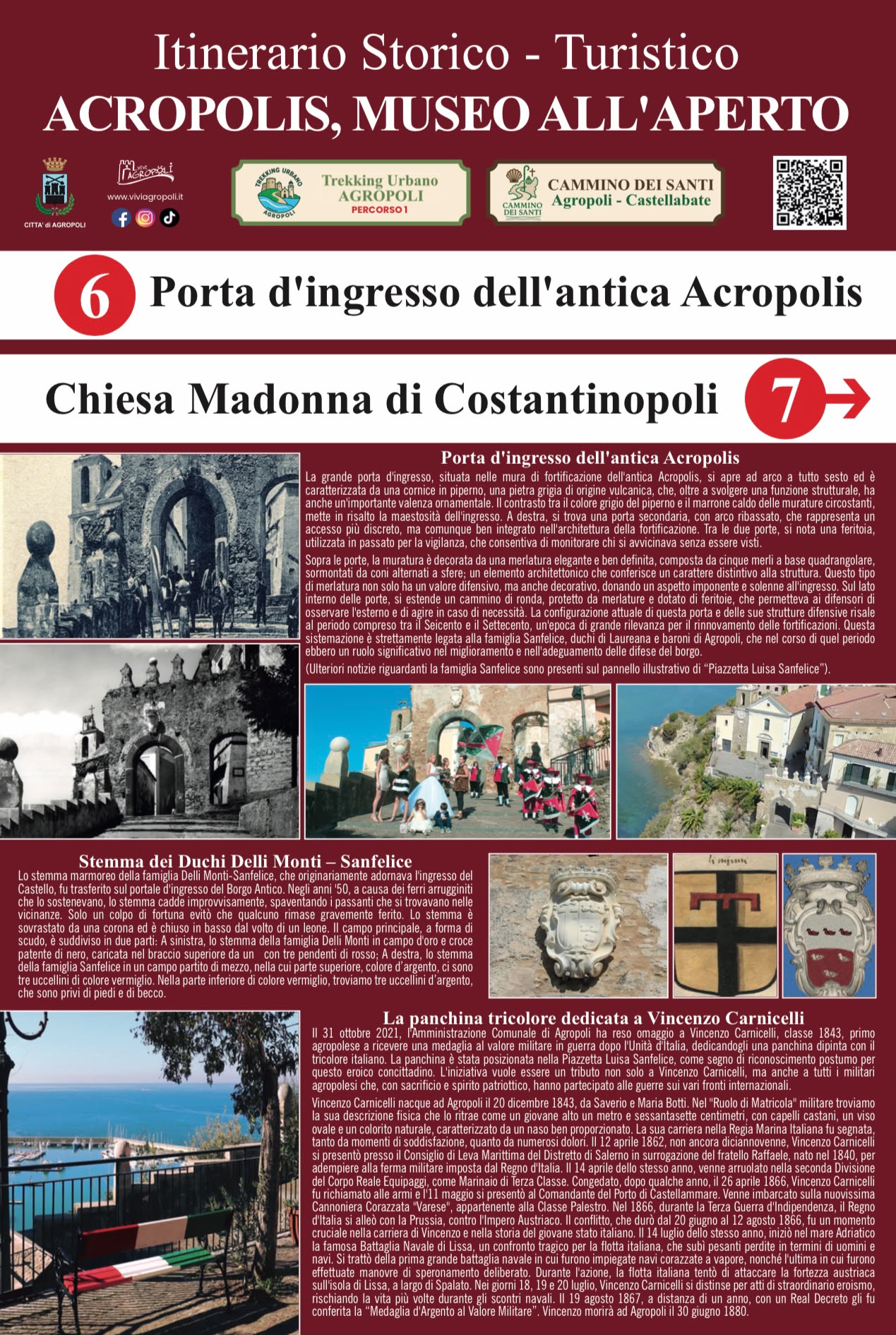
Main Gate of the Ancient Acropolis (inglese)
The large entrance gate, located in the fortification walls of the ancient Acropolis, features a full-round arch and is framed with piperno, a gray volcanic stone. This stone serves not only a structural purpose but also an important decorative function. The contrast between the gray piperno and the warm brown of the surrounding masonry highlights the grandeur of the entrance. On the right, there is a secondary gate with a lowered arch, providing a more discreet access point that is still well integrated into the fortification’s architecture. Between the two gates, a loophole can be seen, formerly used for surveillance, allowing guards to monitor approaching people without being seen.
Above the gates, the masonry is decorated with elegant and well-defined battlements, consisting of five square-based merlons topped alternately with cones and spheres—a distinctive architectural feature. This type of battlement had both defensive and decorative value, giving the entrance a majestic and solemn appearance. On the interior side of the gates, a walkway extends along the wall, protected by battlements and equipped with loopholes, allowing defenders to observe the outside and take action if necessary.
The current configuration of this gate and its defensive structures dates back to the 17th–18th centuries, a period of significant renovation of fortifications. This arrangement is closely linked to the Sanfelice family, Dukes of Laureana and Barons of Agropoli, who played a significant role in improving and updating the village’s defenses during that period.
(Further information on the Sanfelice family is available on the informational panel at “Piazzetta Luisa Sanfelice”).
Coat of Arms of the Dukes Delli Monti – Sanfelice
The marble coat of arms of the Delli Monti-Sanfelice family, originally adorning the castle entrance, was later moved to the entrance portal of the old town. In the 1950s, due to the rusty iron supports holding it, the coat of arms suddenly fell, frightening passersby nearby. Only a stroke of luck prevented serious injuries.
The coat of arms is topped with a crown and has a lion’s face at the bottom. The main shield is divided into two parts: on the left, the Delli Monti family coat of arms on a gold field with a black cross patée, charged in the upper arm with three red pendants; on the right, the Sanfelice family coat of arms on a partitioned field, with three red birds in the upper silver portion and three silver birds without feet or beak in the lower red portion.
Tricolor Bench Dedicated to Vincenzo Carnicelli
On October 31, 2021, the Municipal Administration of Agropoli paid tribute to Vincenzo Carnicelli, born in 1843, the first citizen of Agropoli to receive a military medal for valor in war after the Unification of Italy, by dedicating a bench painted in the Italian tricolor in his honor. The bench was placed in Piazzetta Luisa Sanfelice as a posthumous recognition of this heroic citizen. The initiative also honors all soldiers from Agropoli who, with sacrifice and patriotic spirit, participated in wars on various international fronts.
Vincenzo Carnicelli was born in Agropoli on December 20, 1843, to Saverio and Maria Botti. His military registration (“Ruolo di Matricola”) describes him as a young man, 1.67 meters tall, with brown hair, an oval face, a natural complexion, and a well-proportioned nose. His career in the Royal Italian Navy was marked by both moments of pride and many hardships.
On April 12, 1862, not yet nineteen, Vincenzo Carnicelli reported to the Maritime Draft Board of the Salerno District as a substitute for his brother Raffaele (born 1840) to fulfill the military service required by the Kingdom of Italy. On April 14, he was enlisted in the second division of the Royal Crew Corps as a Third-Class Sailor. After being discharged a few years later, on April 26, 1866, he was recalled to service and reported on May 11 to the Commander of the Port of Castellammare. He was assigned to the new armored gunboat Varese, part of the Palestro class.
In 1866, during the Third War of Independence, the Kingdom of Italy allied with Prussia against the Austrian Empire. The conflict, from June 20 to August 12, 1866, was a crucial moment in Vincenzo’s career and in the history of the young Italian state. On July 14, the famous Naval Battle of Lissa began in the Adriatic Sea, a tragic engagement for the Italian fleet, which suffered heavy losses in both men and ships. This was the first major naval battle involving steam-powered armored ships and the last in which deliberate ramming maneuvers were carried out. During the action, the Italian fleet attempted to attack the Austrian fortress on the island of Lissa, off the coast of Split.
On July 18, 19, and 20, Vincenzo Carnicelli distinguished himself through acts of extraordinary heroism, repeatedly risking his life during the naval engagements. On August 19, 1867, one year later, he was awarded the Silver Medal of Military Valor by Royal Decree. Vincenzo Carnicelli died in Agropoli on June 30, 1880.
Haupteingang der antiken Akropolis (tedesco)
Das große Eingangstor, das sich in den Befestigungsmauern der antiken Akropolis befindet, hat einen Rundbogen und ist mit Piperno, einem grauen Vulkangestein, eingefasst. Dieser Stein dient nicht nur einer strukturellen Funktion, sondern hat auch eine wichtige dekorative Bedeutung. Der Kontrast zwischen dem grauen Piperno und dem warmen Braun des umliegenden Mauerwerks betont die Majestät des Eingangs. Rechts befindet sich ein Nebentor mit einem flacheren Bogen, das einen diskreteren Zugang ermöglicht, aber dennoch gut in die Architektur der Befestigung integriert ist. Zwischen den beiden Toren befindet sich ein Schießschlitz, der früher zur Überwachung genutzt wurde und es erlaubte, herannahende Personen zu beobachten, ohne gesehen zu werden.
Über den Toren ist das Mauerwerk mit eleganten und gut definierten Zinnen geschmückt, bestehend aus fünf quadratischen Merlons, die abwechselnd mit Kegeln und Kugeln gekrönt sind – ein charakteristisches architektonisches Element. Diese Art von Zinnen hatte sowohl einen defensiven als auch einen dekorativen Zweck und verlieh dem Eingang ein imposantes und feierliches Erscheinungsbild. Auf der Innenseite der Tore erstreckt sich ein Wehrgang, geschützt durch Zinnen und ausgestattet mit Schießscharten, der es den Verteidigern ermöglichte, die Umgebung zu beobachten und bei Bedarf einzugreifen.
Die heutige Konfiguration dieses Tores und seiner Verteidigungsanlagen stammt aus dem 17.–18. Jahrhundert, einer Zeit bedeutender Erneuerungen der Befestigungsanlagen. Diese Anlage steht in engem Zusammenhang mit der Familie Sanfelice, Herzöge von Laureana und Barone von Agropoli, die in dieser Zeit eine bedeutende Rolle bei der Verbesserung und Anpassung der Dorfverteidigung spielten.
(Weitere Informationen zur Familie Sanfelice finden sich auf der Informationstafel der „Piazzetta Luisa Sanfelice“).
Wappen der Herzöge Delli Monti – Sanfelice
Das Marmorwaffen der Familie Delli Monti-Sanfelice, das ursprünglich den Eingang der Burg schmückte, wurde später zum Eingangsportal der Altstadt versetzt. In den 1950er Jahren fiel das Wappen aufgrund rostiger Eisenhalterungen plötzlich herunter und erschreckte die Passanten in der Nähe. Nur ein Glücksfall verhinderte schwere Verletzungen.
Das Wappen ist von einer Krone überragt und unten mit einem Löwenkopf versehen. Das Hauptschild ist in zwei Teile geteilt: links das Wappen der Familie Delli Monti auf goldenem Feld mit schwarzem Tatzenkreuz, im oberen Arm mit drei roten Pendants; rechts das Wappen der Familie Sanfelice auf einem geteilten Feld, oben silbern mit drei roten Vögeln und unten rot mit drei silbernen Vögeln ohne Füße und Schnabel.
Tricolore-Bank zu Ehren von Vincenzo Carnicelli
Am 31. Oktober 2021 ehrte die Gemeindeverwaltung von Agropoli Vincenzo Carnicelli, geboren 1843, den ersten Bürger von Agropoli, der nach der Einigung Italiens eine militärische Tapferkeitsmedaille erhielt, indem sie ihm eine in den italienischen Nationalfarben gestrichene Bank widmete. Die Bank wurde in der Piazzetta Luisa Sanfelice aufgestellt, als posthume Anerkennung dieses heldenhaften Mitbürgers. Die Initiative soll auch allen Soldaten aus Agropoli Tribut zollen, die mit Opferbereitschaft und patriotischem Geist an internationalen Kriegsschauplätzen teilnahmen.
Vincenzo Carnicelli wurde am 20. Dezember 1843 in Agropoli als Sohn von Saverio und Maria Botti geboren. In seinem militärischen „Matrikelbuch“ wird er als junger Mann von 1,67 m Größe, braunem Haar, ovalem Gesicht, natürlichem Teint und wohlproportionierter Nase beschrieben. Seine Karriere in der königlichen italienischen Marine war von Momenten des Stolzes, aber auch von vielen Härten geprägt.
Am 12. April 1862, noch nicht neunzehn Jahre alt, meldete sich Vincenzo Carnicelli beim Maritimen Einberufungsausschuss des Bezirks Salerno als Ersatz für seinen Bruder Raffaele (geb. 1840), um den Militärdienst des Königreichs Italien zu leisten. Am 14. April wurde er in die zweite Division des königlichen Schiffsbesatzungskorps als Matrose dritter Klasse aufgenommen. Nach einigen Jahren wurde er am 26. April 1866 erneut einberufen und meldete sich am 11. Mai beim Hafenkommandanten von Castellammare. Er wurde auf das neue gepanzerte Kanonenboot Varese der Palestro-Klasse versetzt.
Im Jahr 1866, während des Dritten Unabhängigkeitskriegs, verbündete sich das Königreich Italien mit Preußen gegen das österreichische Kaiserreich. Der Konflikt dauerte vom 20. Juni bis 12. August 1866 und war ein entscheidender Moment in Vincenzos Karriere und der Geschichte des jungen italienischen Staates. Am 14. Juli begann in der Adria die berühmte Seeschlacht von Lissa, eine tragische Auseinandersetzung für die italienische Flotte, die schwere Verluste an Menschen und Schiffen erlitt. Dies war die erste große Seeschlacht mit dampfgetriebenen Panzerschiffen und die letzte, bei der absichtliche Rammanöver durchgeführt wurden. Während der Aktion versuchte die italienische Flotte, die österreichische Festung auf der Insel Lissa vor Split anzugreifen.
Am 18., 19. und 20. Juli zeichnete sich Vincenzo Carnicelli durch außergewöhnlichen Mut aus und riskierte mehrfach sein Leben während der Seeschlachten. Am 19. August 1867, ein Jahr später, wurde ihm per Königlichem Dekret die Silbermedaille für militärische Tapferkeit verliehen. Vincenzo Carnicelli starb am 30. Juni 1880 in Agropoli.
Porte d’entrée de l’ancienne Acropole (francese)
La grande porte d’entrée, située dans les murailles de fortification de l’ancienne Acropole, est un arc en plein cintre et est encadrée de piperno, une pierre volcanique grise. Cette pierre joue non seulement un rôle structurel, mais a également une grande valeur décorative. Le contraste entre le gris du piperno et le brun chaud des murs environnants met en valeur la majesté de l’entrée.
À droite se trouve une porte secondaire avec un arc plus bas, qui représente un accès plus discret, mais qui reste parfaitement intégré à l’architecture de la fortification. Entre les deux portes, on remarque une meurtrière, utilisée autrefois pour la surveillance, permettant de contrôler l’approche de visiteurs sans être vus.
Au-dessus des portes, le mur est décoré d’un élégant parapet composé de cinq créneaux carrés surmontés de cônes alternant avec des sphères, un élément architectural qui confère un caractère distinctif à la structure. Ce type de créneau avait une fonction défensive mais également décorative, donnant à l’entrée un aspect imposant et solennel. À l’intérieur des portes, un chemin de ronde protégé par des créneaux et doté de meurtrières permettait aux défenseurs d’observer l’extérieur et d’agir si nécessaire.
La configuration actuelle de cette porte et de ses structures défensives remonte aux XVIIe et XVIIIe siècles, une période de rénovation importante des fortifications. Cette disposition est étroitement liée à la famille Sanfelice, ducs de Laureana et barons d’Agropoli, qui ont joué un rôle important à cette époque dans l’amélioration et l’adaptation des défenses du village.
(D’autres informations sur la famille Sanfelice sont disponibles sur le panneau explicatif de la « Piazzetta Luisa Sanfelice »).
Blason des ducs Delli Monti – Sanfelice
Le blason en marbre de la famille Delli Monti-Sanfelice, qui ornait à l’origine l’entrée du château, a été transféré sur le portail de l’ancienne ville. Dans les années 1950, en raison des supports métalliques rouillés, le blason est tombé soudainement, effrayant les passants à proximité. Heureusement, personne n’a été gravement blessé.
Le blason est surmonté d’une couronne et fermé en bas par une tête de lion. Le champ principal, en forme d’écu, est divisé en deux parties : à gauche, le blason de la famille Delli Monti sur fond d’or avec une croix pattée noire, et dans le bras supérieur trois pendants rouges ; à droite, le blason de la famille Sanfelice sur un champ parti, dans la partie supérieure argentée avec trois oiseaux rouges, et dans la partie inférieure rouge trois oiseaux argentés sans pattes ni bec.
Banc tricolore dédié à Vincenzo Carnicelli
Le 31 octobre 2021, l’administration municipale d’Agropoli a rendu hommage à Vincenzo Carnicelli, né en 1843, premier habitant d’Agropoli à recevoir une médaille militaire pour bravoure après l’unification de l’Italie, en lui dédiant un banc peint aux couleurs du drapeau italien. Le banc a été installé sur la Piazzetta Luisa Sanfelice, en reconnaissance posthume de ce citoyen héroïque. Cette initiative rend également hommage à tous les militaires d’Agropoli qui ont participé aux guerres sur différents fronts internationaux avec courage et esprit patriotique.
Vincenzo Carnicelli est né à Agropoli le 20 décembre 1843, fils de Saverio et Maria Botti. Dans son registre militaire, il est décrit comme un jeune homme mesurant 1,67 m, cheveux bruns, visage ovale, teint naturel, et un nez bien proportionné. Sa carrière dans la Marine royale italienne a été marquée par des moments de satisfaction mais aussi par de nombreuses difficultés.
Le 12 avril 1862, âgé de moins de dix-neuf ans, Vincenzo Carnicelli se présenta au Conseil de recrutement maritime du district de Salerne en remplacement de son frère Raffaele (né en 1840), pour accomplir le service militaire imposé par le Royaume d’Italie. Le 14 avril, il fut enrôlé dans la deuxième division du Corps royal des équipages en tant que marin de troisième classe.
Après quelques années, le 26 avril 1866, Vincenzo Carnicelli fut rappelé sous les drapeaux et se présenta le 11 mai au commandant du port de Castellammare. Il fut embarqué sur la toute nouvelle canonnière cuirassée Varese de la classe Palestro.
En 1866, pendant la Troisième guerre d’indépendance, le Royaume d’Italie s’allia avec la Prusse contre l’Empire d’Autriche. Le conflit, qui dura du 20 juin au 12 août 1866, fut un moment crucial dans la carrière de Vincenzo et dans l’histoire du jeune État italien. Le 14 juillet, commença dans l’Adriatique la célèbre bataille navale de Lissa, un affrontement tragique pour la flotte italienne qui subit de lourdes pertes en hommes et en navires. Il s’agissait de la première grande bataille navale avec des navires cuirassés à vapeur et de la dernière utilisant des manœuvres de ramming délibérées. Pendant l’action, la flotte italienne tenta d’attaquer la forteresse autrichienne sur l’île de Lissa, au large de Split.
Les 18, 19 et 20 juillet, Vincenzo Carnicelli se distingua par des actes de courage exceptionnel, risquant plusieurs fois sa vie pendant les combats navals. Le 19 août 1867, un an plus tard, il reçut par décret royal la « Médaille d’argent pour bravoure militaire ». Vincenzo Carnicelli est décédé à Agropoli le 30 juin 1880.