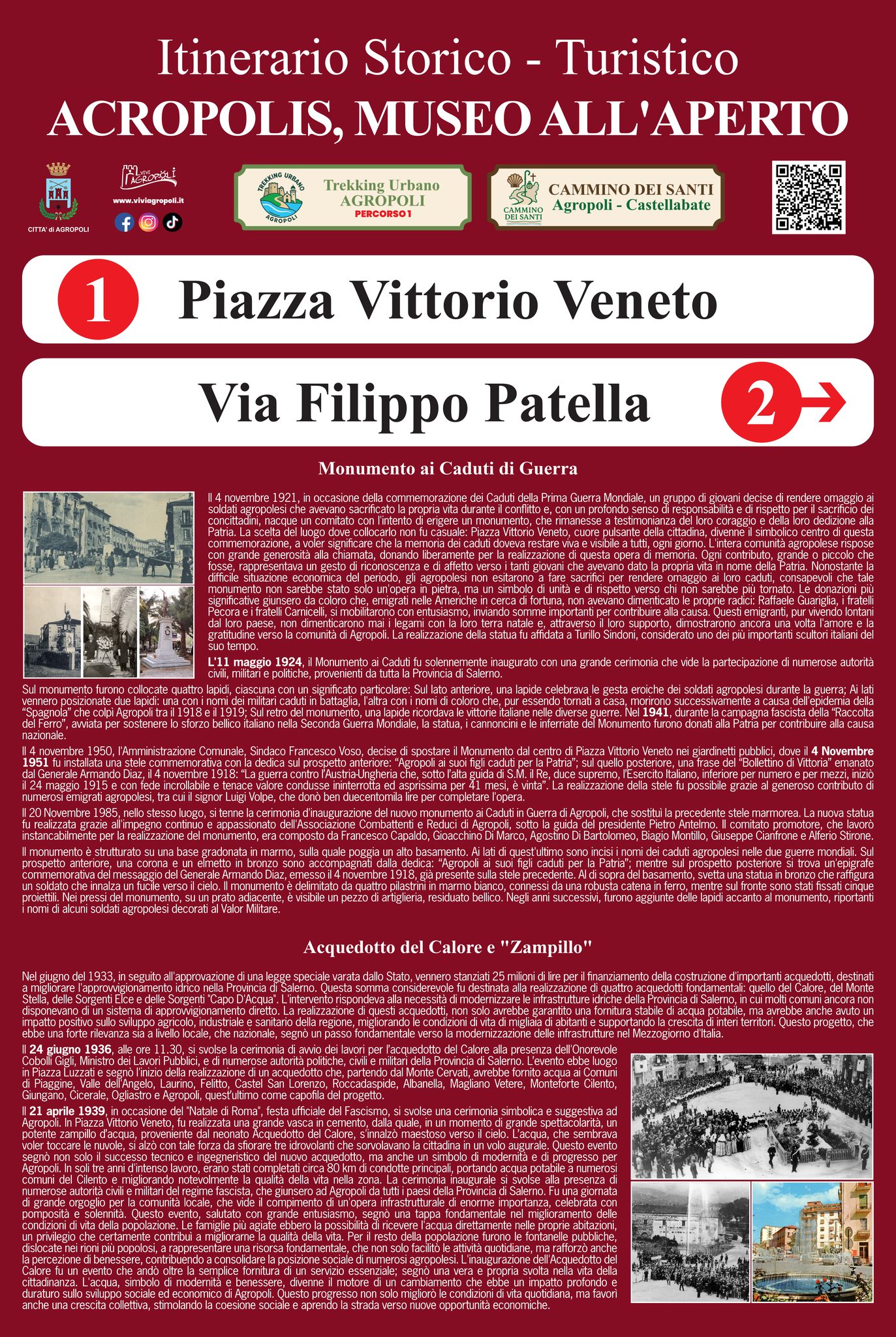
🇬🇧 MONUMENTO AI CADUTI DI GUERRA – War Memorial
On November 4, 1921, on the occasion of the commemoration of those who had fallen in the First World War, a group of young people decided to pay tribute to the soldiers from Agropoli who had sacrificed their lives during the conflict. With a deep sense of responsibility and respect for the sacrifice of their fellow citizens, a committee was formed with the aim of erecting a monument that would stand as a lasting testimony to their courage and dedication to the Fatherland.
The choice of location was not accidental: Piazza Vittorio Veneto, the beating heart of the town, became the symbolic center of this commemoration, signifying that the memory of the fallen should remain alive and visible to everyone, every day.
The entire community of Agropoli responded with great generosity to the appeal, freely donating funds for the realization of this memorial work. Every contribution, whether large or small, represented a gesture of gratitude and affection toward the many young men who had given their lives in the name of the Fatherland. Despite the difficult economic situation of the time, the people of Agropoli did not hesitate to make sacrifices to honor their fallen, aware that this monument would not merely be a stone structure, but a symbol of unity and respect for those who would never return.
The most significant donations came from those who had emigrated to the Americas in search of fortune but had not forgotten their roots: Raffaele Guariglia, the Pecora brothers, and the Carnicelli brothers mobilized enthusiastically, sending substantial sums to contribute to the cause. Though living far from their homeland, these emigrants never forgot their ties to their native town and, through their support, once again demonstrated their love and gratitude toward the community of Agropoli.
The creation of the statue was entrusted to Turillo Sindoni, considered one of the most important Italian sculptors of his time.
On May 11, 1924, the Monument to the Fallen was solemnly inaugurated with a grand ceremony attended by numerous civil, military, and political authorities from across the Province of Salerno. Four plaques were placed on the monument, each with a specific meaning:
- On the front side, a plaque celebrated the heroic deeds of the soldiers from Agropoli during the war;
- On the sides were two plaques: one bearing the names of the soldiers who fell in battle, the other listing the names of those who, although they had returned home, later died due to the “Spanish Flu” epidemic that struck Agropoli between 1918 and 1919;
- On the back of the monument, a plaque commemorated the Italian victories in various wars.
In 1941, during the Fascist campaign known as the “Iron Collection,” launched to support the Italian war effort in the Second World War, the statue, the small cannons, and the railings of the monument were donated to the Fatherland to contribute to the national cause.
On November 4, 1950, the Municipal Administration, under Mayor Francesco Voso, decided to move the monument from the center of Piazza Vittorio Veneto to the public gardens, where on November 4, 1951, a commemorative stele was installed. On its front was the dedication: “Agropoli to her sons fallen for the Fatherland”; on the back, a phrase from the “Victory Bulletin” issued by General Armando Diaz on November 4, 1918:
“The war against Austria-Hungary which, under the high guidance of His Majesty the King, Supreme Commander, the Italian Army, inferior in number and means, began on May 24, 1915, and with unshakable faith and tenacious valor conducted uninterrupted and very bitter for 41 months, is won.”
The realization of the stele was made possible thanks to the generous contribution of numerous emigrants from Agropoli, including Mr. Luigi Volpe, who donated as much as two hundred thousand lire to complete the work.
On November 20, 1985, in the same location, the inauguration ceremony of the new Monument to the War Fallen of Agropoli took place, replacing the previous marble stele. The new statue was created thanks to the continuous and passionate commitment of the Agropoli Association of Veterans and Combatants, under the leadership of President Pietro Antelmo. The promoting committee, which worked tirelessly for the realization of the monument, consisted of Francesco Capaldo, Gioacchino Di Marco, Agostino Di Bartolomeo, Biagio Montillo, Giuseppe Cianfrone, and Alferio Stirone.
The monument stands on a stepped marble base supporting a tall pedestal. On its sides are engraved the names of the fallen from Agropoli in the two World Wars. On the front, a bronze wreath and helmet accompany the dedication: “Agropoli to her sons fallen for the Fatherland”; on the back, there is a commemorative inscription of General Armando Diaz’s message issued on November 4, 1918, already present on the previous stele. Above the pedestal rises a bronze statue depicting a soldier raising a rifle toward the sky.
The monument is bordered by four white marble posts connected by a sturdy iron chain, while five projectiles have been fixed at the front. Near the monument, on an adjacent lawn, a piece of artillery, a war relic, can be seen.
L’ACQUEDOTTO DEL CALORE E LO “ZAMPILLO” -The Calore Aqueduct and the “Zampillo”
In June 1933, following the approval of a special law enacted by the State, 25 million lire were allocated to finance the construction of major aqueducts aimed at improving water supply in the Province of Salerno. This considerable sum was intended for the construction of four fundamental aqueducts: the Calore, Monte Stella, Sorgenti Elce, and “Capo D’Acqua” aqueducts.
The intervention responded to the need to modernize the water infrastructure of the Province of Salerno, where many municipalities still lacked a direct supply system. The construction of these aqueducts would not only guarantee a stable supply of drinking water but would also have a positive impact on agricultural, industrial, and public health development in the region, improving the living conditions of thousands of inhabitants and supporting the growth of entire territories. This project, which held strong significance both locally and nationally, marked a fundamental step toward the modernization of infrastructure in Southern Italy.
On June 24, 1936, at 11:30 a.m., the ceremony marking the beginning of the works for the Calore Aqueduct took place in Piazza Luzzati in the presence of Honorable Cobolli Gigli, Minister of Public Works, and numerous political, civil, and military authorities from the Province of Salerno. The aqueduct, starting from Mount Cervati, would supply water to the municipalities of Piaggine, Valle dell’Angelo, Laurino, Felitto, Castel San Lorenzo, Roccadaspide, Albanella, Magliano Vetere, Monteforte Cilento, Giungano, Cicerale, Ogliastro, and Agropoli, the latter acting as the lead municipality of the project.
On April 21, 1939, on the occasion of the “Birthday of Rome,” an official Fascist celebration, a symbolic and striking ceremony took place in Agropoli. In Piazza Vittorio Veneto, a large concrete basin was constructed from which, in a moment of great spectacle, a powerful jet of water from the newly completed Calore Aqueduct rose majestically into the sky. The water, seemingly reaching toward the clouds, shot up with such force that it nearly brushed three seaplanes flying over the town in an auspicious flyover.
This event marked not only the technical and engineering success of the new aqueduct but also a symbol of modernity and progress for Agropoli. In just three years of intensive work, approximately 80 kilometers of main pipelines had been completed, bringing drinking water to numerous municipalities in the Cilento area and significantly improving the quality of life in the region.
The inauguration ceremony was attended by numerous civil and military authorities of the Fascist regime who arrived in Agropoli from across the Province of Salerno. It was a day of great pride for the local community, witnessing the completion of an infrastructure project of enormous importance, celebrated with pomp and solemnity.
The inauguration of the Calore Aqueduct went beyond the mere provision of an essential service; it marked a true turning point in the life of the community. Water, a symbol of modernity and well-being, became the driving force of change, profoundly and durably impacting the social and economic development of Agropoli. This progress not only improved daily living conditions but also fostered collective growth, strengthening social cohesion and paving the way for new economic opportunities.
🇩🇪 Kriegerdenkmal (Monumento ai Caduti di Guerra)
Am 4. November 1921, anlässlich der Gedenkfeier für die Gefallenen des Ersten Weltkriegs, beschloss eine Gruppe junger Menschen, den Soldaten aus Agropoli zu ehren, die im Krieg ihr Leben geopfert hatten. Aus einem tiefen Verantwortungs- und Respektgefühl gegenüber dem Opfer ihrer Mitbürger entstand ein Komitee mit dem Ziel, ein Denkmal zu errichten, das dauerhaft Zeugnis von ihrem Mut und ihrer Hingabe an das Vaterland ablegen sollte.
Die Wahl des Standortes war kein Zufall: Die Piazza Vittorio Veneto, das pulsierende Herz der Stadt, wurde zum symbolischen Mittelpunkt des Gedenkens, um zu verdeutlichen, dass die Erinnerung an die Gefallenen täglich lebendig und für alle sichtbar bleiben sollte.
Die gesamte Bevölkerung von Agropoli reagierte mit großer Großzügigkeit auf den Aufruf und spendete freiwillig für die Verwirklichung dieses Erinnerungswerks. Jeder Beitrag, ob groß oder klein, stellte eine Geste der Dankbarkeit und Zuneigung gegenüber den vielen jungen Männern dar, die im Namen des Vaterlandes ihr Leben gegeben hatten. Trotz der schwierigen wirtschaftlichen Lage jener Zeit zögerten die Bürger nicht, Opfer zu bringen, um ihre Gefallenen zu ehren – im Bewusstsein, dass dieses Denkmal nicht nur ein Werk aus Stein sein würde, sondern ein Symbol der Einheit und des Respekts für jene, die nicht zurückkehren sollten.
Bedeutende Spenden kamen auch von Auswanderern in Amerika, die ihre Wurzeln nicht vergessen hatten: Raffaele Guariglia, die Brüder Pecora und die Brüder Carnicelli engagierten sich mit Begeisterung und sandten beträchtliche Geldsummen. Trotz der Entfernung bewiesen sie ihre Liebe und Dankbarkeit gegenüber ihrer Heimatgemeinde Agropoli.
Die Ausführung der Statue wurde Turillo Sindoni anvertraut, einem der bedeutendsten italienischen Bildhauer seiner Zeit.
Am 11. Mai 1924 wurde das Denkmal feierlich eingeweiht. An der Zeremonie nahmen zahlreiche zivile, militärische und politische Autoritäten aus der gesamten Provinz Salerno teil. Am Denkmal wurden vier Gedenktafeln angebracht:
- Auf der Vorderseite ehrte eine Tafel die heldenhaften Taten der Soldaten aus Agropoli.
- An den Seiten befanden sich zwei Tafeln: eine mit den Namen der im Kampf Gefallenen, die andere mit den Namen jener, die zwar heimgekehrt waren, jedoch später an der „Spanischen Grippe“ (1918–1919) starben.
- Auf der Rückseite erinnerte eine Tafel an die italienischen Siege in verschiedenen Kriegen.
Im Jahr 1941, während der faschistischen Kampagne der „Eisensammlung“ zur Unterstützung der italienischen Kriegsanstrengungen im Zweiten Weltkrieg, wurden die Statue, die Kanonen und die Eisengitter des Denkmals dem Vaterland gespendet.
Am 4. November 1950 beschloss die Gemeindeverwaltung unter Bürgermeister Francesco Voso, das Denkmal von der Piazza Vittorio Veneto in die öffentlichen Gärten zu verlegen. Am 4. November 1951 wurde dort eine Gedenkstele errichtet. Auf der Vorderseite stand die Widmung: „Agropoli seinen für das Vaterland gefallenen Söhnen“; auf der Rückseite ein Auszug aus dem „Siegesbulletin“ von General Armando Diaz vom 4. November 1918.
Am 20. November 1985 wurde am selben Ort das neue Kriegerdenkmal von Agropoli eingeweiht, das die vorherige Marmorstelen ersetzte. Es entstand dank des engagierten Einsatzes der Vereinigung der Kriegsteilnehmer und Veteranen von Agropoli unter dem Vorsitz von Pietro Antelmo.
Das Denkmal besteht aus einem gestuften Marmorsockel mit hohem Unterbau. An den Seiten sind die Namen der Gefallenen der beiden Weltkriege eingraviert. Auf der Vorderseite befinden sich ein bronzener Kranz und ein Helm mit der Widmung „Agropoli seinen für das Vaterland gefallenen Söhnen“, während auf der Rückseite erneut die Botschaft von General Diaz eingraviert ist. Über dem Sockel erhebt sich eine Bronzestatue eines Soldaten, der sein Gewehr in den Himmel streckt. Vier Marmorpfeiler mit einer Eisenkette umgeben das Denkmal, an der Vorderseite sind fünf Geschosse angebracht. In der Nähe befindet sich auf einer angrenzenden Wiese ein Artilleriegeschütz als Kriegsrelikt.
Die Calore-Wasserleitung und der “Zampillo” – L’Acquedotto del Calore e lo “Zampillo”
Im Juni 1933 wurden nach der Verabschiedung eines Sondergesetzes 25 Millionen Lire für den Bau wichtiger Wasserleitungen in der Provinz Salerno bereitgestellt. Diese beträchtliche Summe diente der Realisierung von vier zentralen Aquädukten: Calore, Monte Stella, Sorgenti Elce und Sorgenti Capo d’Acqua“. Ziel war die Modernisierung der Wasserinfrastruktur in einer Provinz, in der viele Gemeinden noch keine direkte Wasserversorgung besaßen.
Am 24 Juni 1936 um 11:30 Uhr fand auf der Piazza Luzzati die feierliche Eröffnung der Bauarbeiten für die Calore-Wasserleitung statt, im Beisein des Ministers für öffentliche Arbeiten, Cobolli Gigli, sowie zahlreicher politischer, ziviler und militärischer Autoritäten. Die Leitung sollte vom Monte Cervati ausgehen und zahlreiche Gemeinden des Cilento mit Trinkwasser versorgen, darunter Agropoli als federführende Gemeinde.
Am 21 April 1939, anlässlich des „Natale di Roma“, wurde in Agropoli eine eindrucksvolle Zeremonie abgehalten. Auf der Piazza Vittorio Veneto wurde ein großes Betonbecken errichtet, aus dem sich ein gewaltiger Wasserstrahl – der „Zampillo“ – aus der neuen Calore-Wasserleitung majestätisch in den Himmel erhob. Der Wasserstrahl stieg so hoch, dass er beinahe drei über die Stadt fliegende Wasserflugzeuge berührte.
In nur drei Jahren intensiver Arbeit waren rund 80 Kilometer Hauptleitungen fertiggestellt worden, wodurch zahlreiche Gemeinden des Cilento mit Trinkwasser versorgt wurden. Die Einweihung war ein bedeutendes Ereignis und symbolisierte Modernität und Fortschritt.
Die wohlhabenderen Familien konnten das Wasser direkt in ihre Häuser leiten lassen, während für die übrige Bevölkerung öffentliche Brunnen in den Stadtvierteln eine grundlegende Ressource darstellten.
Die Einweihung der Calore-Wasserleitung bedeutete weit mehr als die Bereitstellung eines lebenswichtigen Dienstes: Sie stellte einen Wendepunkt im Leben der Bürger dar. Das Wasser, Symbol für Modernität und Wohlstand, wurde zum Motor eines tiefgreifenden sozialen und wirtschaftlichen Wandels in Agropoli und ebnete den Weg für neue Entwicklungsmöglichkeiten.
🇫🇷 Monument aux Morts de Guerre
Le 4 novembre 1921, à l’occasion de la commémoration des morts de la Première Guerre mondiale, un groupe de jeunes décida de rendre hommage aux soldats d’Agropoli qui avaient sacrifié leur vie pendant le conflit. Animé par un profond sens de responsabilité et de respect pour le sacrifice de leurs concitoyens, un comité fut créé avec l’intention d’ériger un monument qui resterait un témoignage de leur courage et de leur dévouement à la Patrie.
Le choix de l’emplacement ne fut pas dû au hasard : la Piazza Vittorio Veneto, cœur battant de la ville, devint le centre symbolique de cette commémoration, afin de signifier que la mémoire des morts devait rester vivante et visible pour tous, chaque jour.
Toute la communauté d’Agropoli répondit avec une grande générosité à cet appel, en contribuant librement à la réalisation de cette œuvre de mémoire. Chaque contribution, grande ou petite, représentait un geste de reconnaissance et d’affection envers les nombreux jeunes qui avaient donné leur vie au nom de la Patrie. Malgré la situation économique difficile de l’époque, les habitants d’Agropoli n’hésitèrent pas à faire des sacrifices pour rendre hommage à leurs morts, conscients que ce monument ne serait pas seulement une œuvre de pierre, mais un symbole d’unité et de respect envers ceux qui ne reviendraient plus.
Les dons les plus importants vinrent de ceux qui, émigrés en Amérique à la recherche de fortune, n’avaient pas oublié leurs racines : Raffaele Guariglia, les frères Pecora et les frères Carnicelli se mobilisèrent avec enthousiasme, envoyant des sommes importantes pour soutenir l’initiative. Ces émigrants, bien que vivant loin de leur pays natal, n’oublièrent jamais leurs liens avec leur terre et, à travers leur soutien, démontrèrent une fois de plus leur amour et leur gratitude envers la communauté d’Agropoli.
La réalisation de la statue fut confiée à Turillo Sindoni, considéré comme l’un des plus importants sculpteurs italiens de son époque.
Le 11 mai 1924, le Monument aux Morts fut solennellement inauguré lors d’une grande cérémonie à laquelle participèrent de nombreuses autorités civiles, militaires et politiques provenant de toute la province de Salerne.
Quatre plaques commémoratives furent placées sur le monument, chacune ayant une signification particulière :
- Sur la face avant, une plaque célébrait les exploits héroïques des soldats d’Agropoli pendant la guerre.
- Sur les côtés furent placées deux plaques : l’une avec les noms des soldats tombés au combat, l’autre avec les noms de ceux qui, bien que revenus chez eux, moururent plus tard à cause de l’épidémie de « grippe espagnole » qui frappa Agropoli entre 1918 et 1919.
- À l’arrière du monument, une plaque rappelait les victoires italiennes dans les différentes guerres.
En 1941, pendant la campagne fasciste de la « Collecte du fer », lancée pour soutenir l’effort de guerre italien durant la Seconde Guerre mondiale, la statue, les petits canons et les grilles du monument furent donnés à la Patrie pour contribuer à la cause nationale.
Le 4 novembre 1950, l’administration communale, sous le maire Francesco Voso, décida de déplacer le monument du centre de la Piazza Vittorio Veneto vers les jardins publics. Le 4 novembre 1951, une stèle commémorative y fut installée avec la dédicace sur la face avant :
« Agropoli à ses fils tombés pour la Patrie ».
Sur la face arrière fut gravée une phrase du « Bulletin de la Victoire » publié par le général Armando Diaz le 4 novembre 1918 :
« La guerre contre l’Autriche-Hongrie que, sous la haute direction de S.M. le Roi, chef suprême, l’Armée italienne, inférieure en nombre et en moyens, commença le 24 mai 1915 et mena avec une foi inébranlable et une valeur tenace, sans interruption et avec une extrême dureté pendant 41 mois, est gagnée. »
La réalisation de la stèle fut rendue possible grâce au généreux soutien de nombreux émigrants d’Agropoli, parmi lesquels Luigi Volpe, qui donna deux cent mille lires pour compléter l’œuvre.
Le 20 novembre 1985, au même endroit, eut lieu la cérémonie d’inauguration du nouveau monument aux morts de guerre d’Agropoli, qui remplaça la précédente stèle en marbre. La nouvelle statue fut réalisée grâce à l’engagement constant et passionné de l’Association des Combattants et Anciens Combattants d’Agropoli, sous la direction du président Pietro Antelmo. Le comité promoteur, qui travailla sans relâche à la réalisation du monument, était composé de Francesco Capaldo, Gioacchino Di Marco, Agostino Di Bartolomeo, Biagio Montillo, Giuseppe Cianfrone et Alferio Stirone.
Le monument est structuré sur une base en marbre à gradins sur laquelle repose un haut socle. Sur les côtés de celui-ci sont gravés les noms des habitants d’Agropoli tombés lors des deux guerres mondiales. Sur la face avant, une couronne et un casque en bronze accompagnent la dédicace :
« Agropoli à ses fils tombés pour la Patrie ».
Sur la face arrière se trouve une épigraphe commémorative reprenant le message du général Armando Diaz du 4 novembre 1918, déjà présent sur la stèle précédente.
Au-dessus du socle s’élève une statue en bronze représentant un soldat qui lève un fusil vers le ciel. Le monument est délimité par quatre petits piliers en marbre blanc reliés par une solide chaîne en fer, tandis que cinq projectiles sont fixés sur la partie frontale. À proximité du monument, sur une pelouse adjacente, est visible une pièce d’artillerie, vestige de guerre.
L’Aqueduc du Calore et le « Zampillo »
En juin 1933, à la suite de l’approbation d’une loi spéciale adoptée par l’État, 25 millions de lires furent alloués pour financer la construction d’importants aqueducs destinés à améliorer l’approvisionnement en eau dans la province de Salerne. Cette somme considérable fut destinée à la réalisation de quatre aqueducs fondamentaux : celui du Calore, du Monte Stella, des sources d’Elce et des sources de « Capo d’Acqua ».
Cette intervention répondait à la nécessité de moderniser les infrastructures hydrauliques de la province de Salerne, où de nombreuses communes ne disposaient pas encore d’un système d’approvisionnement direct en eau. La construction de ces aqueducs devait non seulement garantir un approvisionnement stable en eau potable, mais aussi avoir un impact positif sur le développement agricole, industriel et sanitaire de la région, en améliorant les conditions de vie de milliers d’habitants et en soutenant la croissance de nombreux territoires. Ce projet, d’une grande importance tant au niveau local que national, marqua une étape fondamentale vers la modernisation des infrastructures dans le sud de l’Italie.
Le 24 juin 1936, à 11 h 30, eut lieu la cérémonie de lancement des travaux de l’aqueduc du Calore en présence de l’honorable Cobolli Gigli, ministre des Travaux publics, ainsi que de nombreuses autorités politiques, civiles et militaires de la province de Salerne. L’événement se déroula sur la Piazza Luzzati et marqua le début de la réalisation d’un aqueduc qui, partant du mont Cervati, fournirait de l’eau aux communes de Piaggine, Valle dell’Angelo, Laurino, Felitto, Castel San Lorenzo, Roccadaspide, Albanella, Magliano Vetere, Monteforte Cilento, Giungano, Cicerale, Ogliastro et Agropoli, cette dernière étant la commune chef de file du projet.
Le 21 avril 1939, à l’occasion du « Natale di Roma », fête officielle du fascisme, une cérémonie symbolique et spectaculaire eut lieu à Agropoli. Sur la Piazza Vittorio Veneto fut construite une grande vasque en ciment, d’où jaillit, dans un moment d’une grande mise en scène, un puissant jet d’eau provenant du nouvel aqueduc du Calore, s’élevant majestueusement vers le ciel.
L’eau, qui semblait vouloir toucher les nuages, monta avec une telle force qu’elle frôla trois hydravions qui survolaient la ville lors d’un vol augural. Cet événement marqua non seulement le succès technique et ingénierique du nouvel aqueduc, mais aussi un symbole de modernité et de progrès pour Agropoli.
En seulement trois années de travail intensif, environ 80 kilomètres de conduites principales avaient été achevés, apportant de l’eau potable à de nombreuses communes du Cilento et améliorant considérablement la qualité de vie dans la région.
La cérémonie inaugurale se déroula en présence de nombreuses autorités civiles et militaires du régime fasciste, venues à Agropoli de tous les villages de la province de Salerne. Ce fut une journée de grande fierté pour la communauté locale, qui vit l’aboutissement d’une œuvre d’infrastructure d’une importance énorme, célébrée avec pompe et solennité.
Cet événement, accueilli avec un grand enthousiasme, marqua une étape fondamentale dans l’amélioration des conditions de vie de la population. Les familles les plus aisées purent recevoir l’eau directement dans leurs habitations, un privilège qui contribua certainement à améliorer leur qualité de vie. Pour le reste de la population, les fontaines publiques, installées dans les quartiers les plus peuplés, représentèrent une ressource essentielle qui facilita les activités quotidiennes et renforça également la perception du bien-être, contribuant à consolider la position sociale de nombreux habitants d’Agropoli.
L’inauguration de l’aqueduc du Calore fut un événement qui alla bien au-delà de la simple fourniture d’un service essentiel ; elle marqua un véritable tournant dans la vie de la population. L’eau, symbole de modernité et de bien-être, devint le moteur d’un changement qui eut un impact profond et durable sur le développement social et économique d’Agropoli. Ce progrès améliora non seulement les conditions de vie quotidiennes, mais favorisa également une croissance collective, stimulant la cohésion sociale et ouvrant la voie à de nouvelles opportunités économiques.