🇬🇧 Agropoli – Acropolis
Agropoli stands on a promontory that was already inhabited during the Late Bronze Age (11th–10th century BC) and later hosted a trading post–sanctuary during the Greek-Lucanian period (7th–4th century BC) (see panel no. 17).
Agropoli takes its name from the Greek word Acropolis, meaning “city set on high.” Its origins most likely date back to the Byzantine period in the 6th century AD, when the word polis began to acquire a stronger military meaning, indicating a fortified center. Following the Gothic War, the summit of the promontory was fortified for defensive purposes, and the surrounding populations sought refuge there, giving rise to the first urban nucleus.
Around the castle and the Church of Saints Peter and Paul, the patron saints, the first permanent settlement developed, destined to grow in the centuries that followed.
MEDIEVAL PERIOD
Byzantine Period
The fortified center built on the promontory perfectly met the military and strategic criteria of the Byzantine era. Its elevated position, naturally protected on three sides by steep cliffs, reduced the need for complex defensive works. The commanding view over both the sea and the hinterland, reaching as far as Mount Stella, the highest peak of ancient Cilento, made it a highly valuable tactical outpost.
The first urban nucleus of Agropoli developed in a roughly elliptical shape, with houses arranged in a continuous line along the western side, consistent with the urban planning typical of 11th-century Byzantine cities.
The road network was simple but functional: a single main street crossed the center, accompanied by secondary roads branching out radially. At this stage, the settlement also included the districts known as “Pietra del Pesce” and “Pietra del Sale”, covering an estimated area of about 8,000 square meters.
The first official mention of Agropoli appears in a letter from July 592, sent by Pope Gregory the Great to Felix, bishop of Agropoli (Gregorius Felici Episcopo de Acropoli). Felix, actually bishop of the Diocese of Paestum, had taken refuge in Agropoli to escape the incursions of the Lombards. The Pope entrusted him with the task of visiting and caring for the churches of Velia, Bussento, and Blanda, which were at the time without pastoral leadership.
Saracen Period
Between the 9th and 10th centuries, Agropoli hosted a permanent Saracen fortification, known as a ribat, a kind of Islamic military and religious outpost.
The Saracens initially arrived in Campania as mercenaries in the service of the Byzantine dukes of Naples, settling in nearby Licosa as early as 846. In 882, however, they established themselves permanently in Agropoli, fortifying the position and transforming it into a real stronghold.
Their presence was so large that the city walls could not contain all the troops. A considerable portion was stationed outside the town in the area now known as Piano della Madonna, then called Campo Saraceno.
The exact date of the Saracens’ departure from Agropoli is still debated among scholars. According to historian Piero Cantalupo, the withdrawal occurred in 915, after the decisive defeat inflicted on the Muslim forces at the Battle of the Garigliano by Pope John X and his allied troops.
More recent research, however, suggests a different chronology. In 889 AD, following the death of Bishop-Duke Athanasius II, an influential political figure and protector of the Saracens of Agropoli, the support of the Neapolitan army ended. Isolated and facing a siege by Byzantine forces both by land and sea, the Muslims resisted for months. Eventually, weakened by losses and lack of supplies, they were forced to withdraw by the end of 889, retreating to the ribat of the Garigliano.
Their departure left Agropoli in a state of deep hardship, marked by destruction, loss of life, and a lingering sense of insecurity.
Lombard and Norman Period
After the Saracen period, Agropoli returned under the jurisdiction of the Diocese of Capaccio. Although formally still linked to the Byzantine Empire, the city was annexed to the Principality of Salerno thanks to the diplomatic efforts of Guaimar II, who managed to consolidate control over the Cilento territory.
During Norman rule, Agropoli remained an ecclesiastical fief entrusted to the bishop of Capaccio. A notarial document dated 1100 mentions an act drawn up “intra castellum quod Agropoli dicitur” (“within the castle called Agropoli”), testifying to the presence of an organized community and a recognized defensive structure.
In 1116, Giovanni di San Paolo, representing the count of the Principality, was placed in command of the castle garrison.
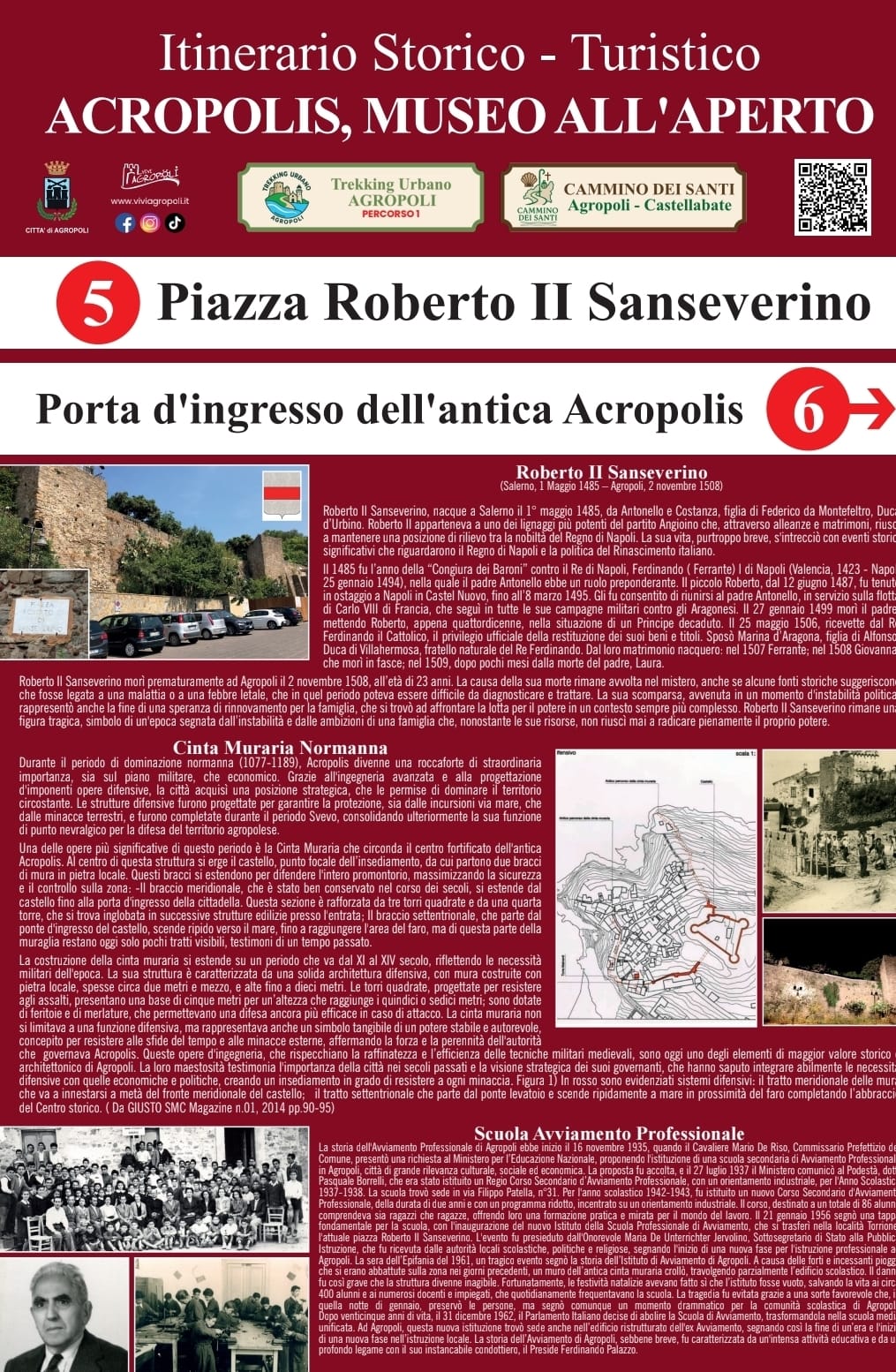
It was during the Norman period that the town began a significant urban expansion. A pre-artillery defensive wall with square towers was built, enclosing an area of about 28,000 square meters (almost 3 hectares).
New settlements were added to the original districts of Pietra del Pesce and Pietra del Sale, including Piedi Agropoli and Casale Nuovo.
In 1240, Emperor Frederick II claimed direct control of the castle of Agropoli, removing it from the diocese in order to strengthen the strategic defenses of the imperial territory.
During the War of the Sicilian Vespers, in 1294, King Charles II of Anjou informed the castle servants that their commander was Giovanni de Challis and ordered payment for the “castellano et serventiis castri Agropolis” (the castellan and the guards of the military garrison).
Angevin and Aragonese Period
With the end of Angevin rule (1268–1442), Agropoli passed to the Aragonese dynasty in 1443.
At that time the town was part of the vast possessions of the Sanseverino family, princes of Salerno and powerful barons of Cilento, whose seat was located in the castle of Rocca Cilento.
Under their rule, Agropoli obtained important privileges:
- the right to organize the annual fair in honor of Saint Peter
- authorization to open a salt warehouse (fondaco) at the Marina
In 1485, however, the baron Antonello Sanseverino participated in the famous Conspiracy of the Barons, a revolt of the aristocracy against Aragonese central power. After the rebellion was suppressed, the government of the Kingdom of Naples launched a major program to strengthen defensive structures against both Turkish raids and northern threats, particularly following the descent into Italy of Charles VIII of France.
To finance these works, a tax of one tarì was imposed in the Principato Citra, intended for restoring the castles of Agropoli, Castellabate, and Rocca Cilento.
Confirming the strategic importance of the city, Alfonso, Duke of Calabria and heir to the throne, personally visited Agropoli in 1487 and 1489 to inspect the progress of the works.
A visible testimony of this period still survives today: a stone stele carved with the coat of arms of the Duke of Calabria, located on the northern ramparts of the castle.
The Aragonese interventions profoundly shaped the defensive architecture of the city, giving the castle the appearance it largely retains today.
MODERN PERIOD
Spanish Period
Between 1515 and 1630, Agropoli was repeatedly threatened by Turkish pirate raids, which were widespread along the Mediterranean coasts during that time.
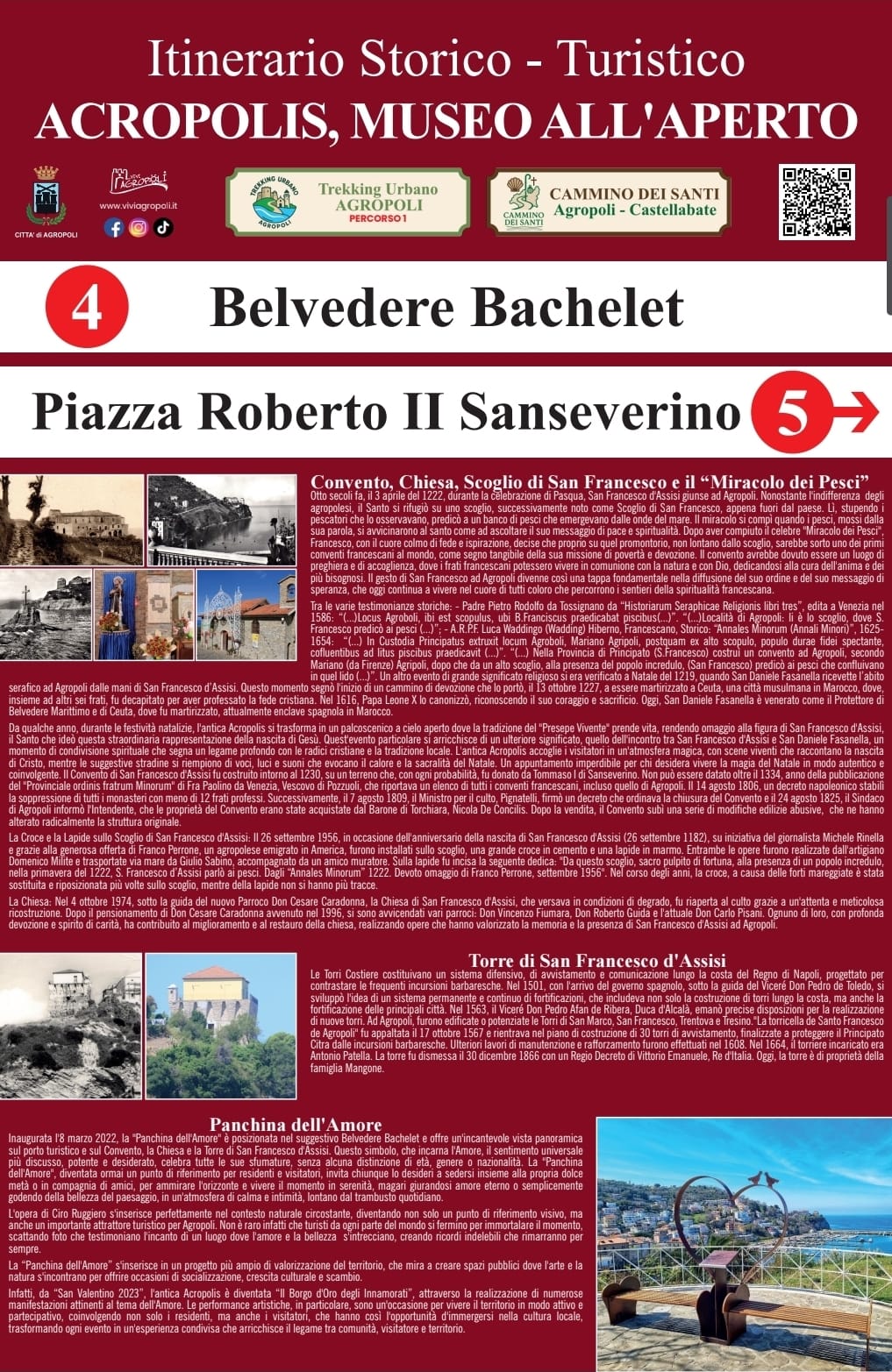
To counter this threat, the Spanish viceroyal government initiated a large coastal defense program throughout the Kingdom of Naples, building watchtowers at strategic points to monitor the sea and signal approaching enemy ships.
On the coast of Agropoli two important defensive structures were built:
- Torre di San Marco (to the north)
- Torre di San Francesco (to the south)
Within the town itself, additional control points were established, including Torre Mainenti, incorporated into the architectural complex of Casa Rotolo.
17th and 18th Centuries
In the mid-17th century, Agropoli was struck by a devastating plague epidemic, reducing its population to only 300 inhabitants.
Despite this tragedy, the town experienced a period of rebirth and development from the late 1600s through the 1700s, under the rule of the Sanfelice family, who governed from 1662 to 1806.
During this time:
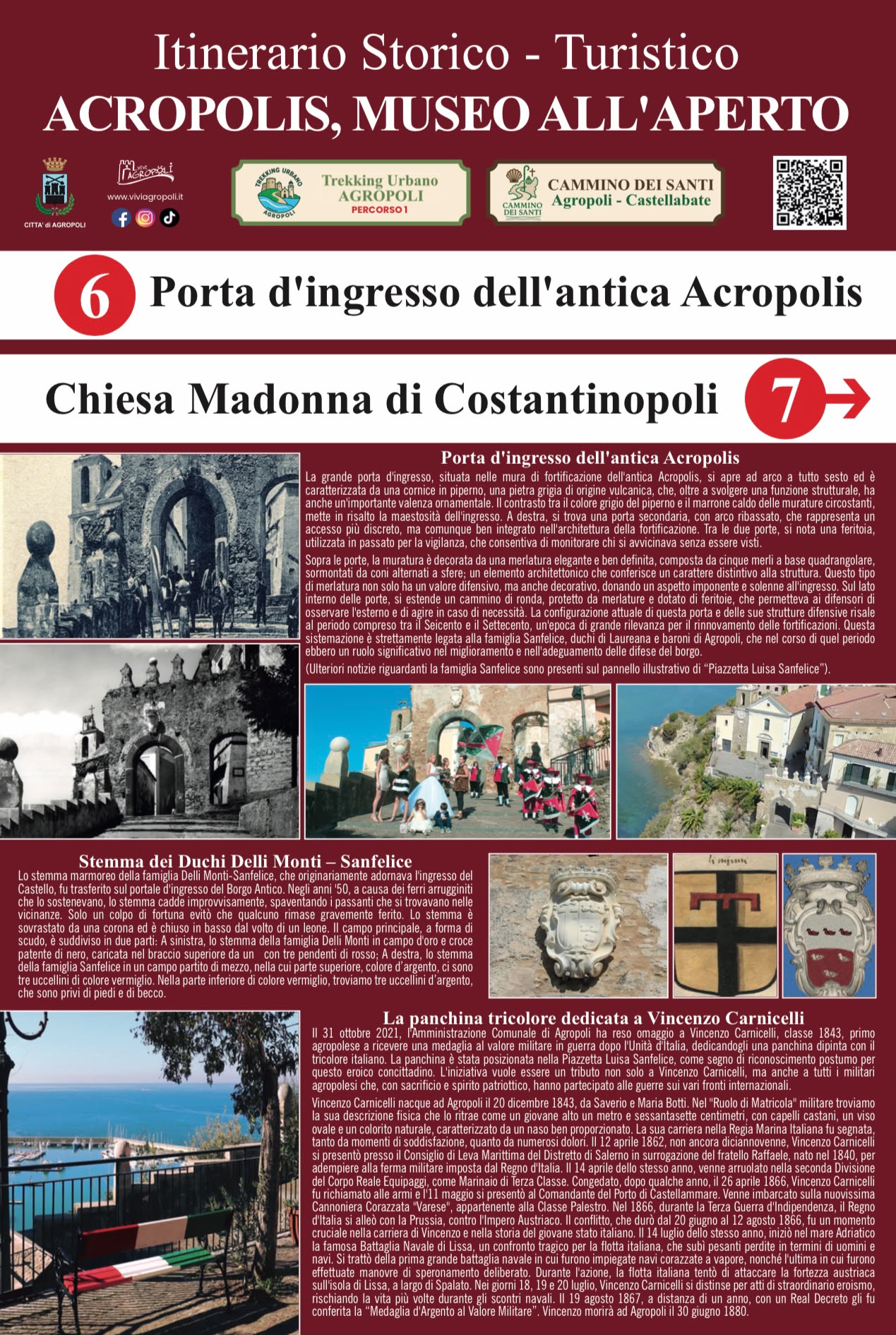
- the city gate was restored to its current appearance
- the castle was embellished with two elegant arcaded porticoes along its north and south sides
- two new districts were created: Amendola and Fortino
Amendola developed in an area formerly occupied by orchards and gardens, and its name likely derives from the almond trees (amendole) once present there.
Fortino grew between the Fortino gate and the Chapel of Our Lady of the Seven Sorrows, built in the mid-18th century.
Another notable example of the architectural vitality of the period is the portal of Palazzo Mainenti, dated 1744, in the square of Saints Peter and Paul.
CONTEMPORARY PERIOD
French Decade
In 1808, according to the Murattian cadastre, Agropoli had 560 inhabitants.
During the naval war against the British, the French strengthened coastal defenses by building two new towers:
- Torre Tauriello (in the Fortino area)
- Torre Elicina (near the present lighthouse)
These towers, together with the towers of San Marco, San Francesco, and Tresino, were decommissioned on 30 December 1866 by decree of the newly established Kingdom of Italy.
Torre Tauriello was dismantled and its stones reused by local residents for house construction.
Torre Elicina, however, continued for some time to serve navigation as a signal beacon for sailors. Its history ended on 7 July 1929, when the modern Agropoli lighthouse was built on its foundations.
19th–20th Century
Over the past centuries, the ancient Acropolis enclosed within the walls gradually ceased to be the urban and social center of the town.
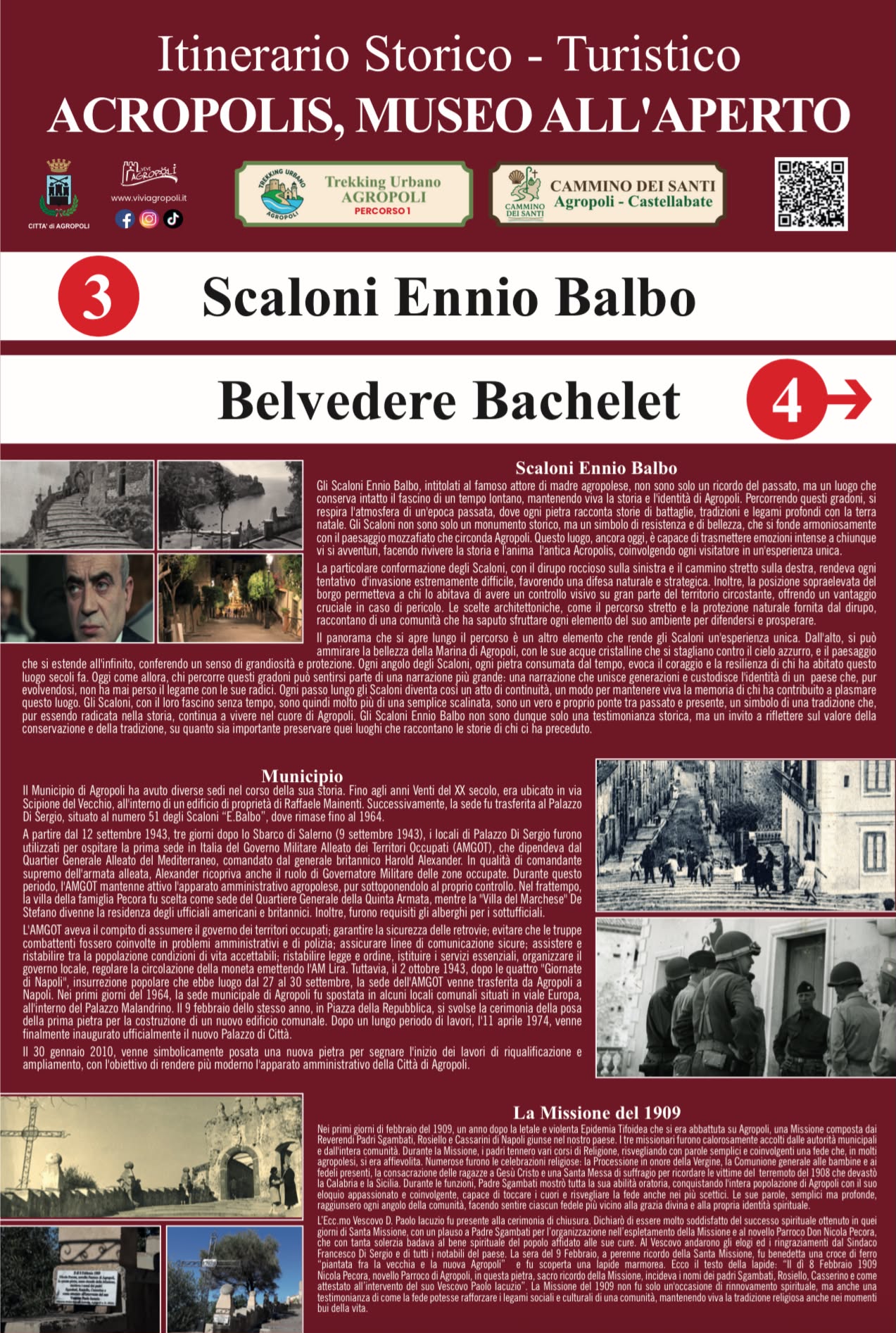
Urban development expanded along Scaloni and Via Patella, where multi-story buildings were constructed, transforming the city’s architectural landscape.
The settlement then expanded further downhill toward the Church of Madonna delle Grazie, once isolated among fields and gardens but now integrated into a growing road network that includes Corso Garibaldi and Via Piave.
This transformation reflects not only a change in the physical layout of the city, but also a new vision of Agropoli: more open, commercial, and modern. While the Old Town (Borgo Antico) retains its cultural and historical significance, daily life gradually moved to the flatter and more accessible areas of the city.
🇩🇪 Agropoli – Akropolis
Agropoli liegt auf einem Vorgebirge, das bereits in der späten Bronzezeit (11.–10. Jh. v. Chr.) bewohnt war und später während der griechisch-lukaanischen Zeit (7.–4. Jh. v. Chr.) als Handelsplatz und Heiligtum diente (siehe Tafel Nr. 17).
Agropoli verdankt seinen Namen dem griechischen Wort Akropolis, das „hochgelegene Stadt“ bedeutet. Seine Ursprünge reichen höchstwahrscheinlich bis in die byzantinische Zeit des 6. Jahrhunderts n. Chr. zurück, als das Wort polis zunehmend eine militärische Bedeutung annahm und ein befestigtes Zentrum bezeichnete. Nach dem Gotenkrieg wurde die Spitze des Vorgebirges aus Verteidigungsgründen befestigt. Die Bevölkerung der umliegenden Gebiete suchte dort Zuflucht und bildete so den ersten städtischen Kern.
Rund um das Schloss und die Kirche der Schutzheiligen Petrus und Paulus entstand die erste dauerhafte Siedlung, die sich in den folgenden Jahrhunderten weiterentwickelte.
MITTELALTER
Byzantinische Zeit
Das auf dem Vorgebirge errichtete befestigte Zentrum entsprach vollkommen den militärischen und strategischen Kriterien der byzantinischen Zeit. Seine erhöhte Lage und der natürliche Schutz durch steile Klippen auf drei Seiten verringerten den Bedarf an komplexen Verteidigungsanlagen. Der weite Blick über das Meer und das Hinterland bis zum Monte Stella, dem höchsten Gipfel des alten Cilento, machte es zu einem strategisch äußerst wertvollen Beobachtungspunkt.
Der erste städtische Kern von Agropoli entwickelte sich in einer ungefähr elliptischen Form, mit Häusern, die entlang der Westseite in geschlossener Reihe angeordnet waren – eine typische städtebauliche Struktur byzantinischer Städte des 11. Jahrhunderts.
Das Straßennetz war einfach, aber funktional: Eine einzige Hauptstraße durchquerte das Zentrum, begleitet von Nebenstraßen, die strahlenförmig davon abzweigten. In dieser Phase umfasste die Siedlung auch die Viertel „Pietra del Pesce“ und „Pietra del Sale“ und erstreckte sich über eine Fläche von etwa 8.000 Quadratmetern.
Die erste offizielle Erwähnung von Agropoli findet sich in einem Brief vom Juli 592, den Papst Gregor der Große an Felix, den Bischof von Agropoli, sandte (Gregorius Felici Episcopo de Acropoli). Felix, eigentlich Bischof der Diözese Paestum, hatte in Agropoli Zuflucht gesucht, um den Einfällen der Langobarden zu entgehen. Der Papst beauftragte ihn, die Kirchen von Velia, Bussento und Blanda zu besuchen und zu betreuen, die damals ohne geistliche Führung waren.
Sarazenische Zeit
Zwischen dem 9. und 10. Jahrhundert befand sich in Agropoli eine dauerhafte sarazenische Festung, ein sogenanntes Ribat, ein militärischer und religiöser Außenposten des Islams.
Die Sarazenen waren zunächst als Söldner im Dienst der byzantinischen Herzöge von Neapel nach Kampanien gekommen und hatten sich bereits 846 im nahegelegenen Licosa niedergelassen. Im Jahr 882 ließen sie sich jedoch dauerhaft in Agropoli nieder, befestigten den Ort und verwandelten ihn in eine echte Festung.
Ihre Präsenz war so stark, dass die Stadtmauern nicht ausreichten, um alle Truppen aufzunehmen. Ein großer Teil wurde außerhalb der Stadt im Gebiet stationiert, das heute Piano della Madonna heißt und damals Campo Saraceno genannt wurde.
Das genaue Datum des Abzugs der Sarazenen aus Agropoli ist unter Historikern noch umstritten. Nach dem Historiker Piero Cantalupo erfolgte der Rückzug im Jahr 915, nach der entscheidenden Niederlage der muslimischen Truppen am Garigliano durch Papst Johannes X und seine Verbündeten.
Neuere Forschungen schlagen jedoch eine andere Chronologie vor. Im Jahr 889 n. Chr., nach dem Tod von Bischof-Herzog Athanasius II., einer einflussreichen politischen Figur und Beschützer der Sarazenen von Agropoli, verloren diese die Unterstützung des neapolitanischen Heeres. Isoliert mussten sie einer Belagerung durch byzantinische Truppen zu Land und zu See standhalten. Nach Monaten des Widerstands, schweren Kämpfen und hohen Verlusten waren sie schließlich gezwungen, sich Ende 889 zurückzuziehen und sich in das Ribat am Garigliano zu flüchten.
Ihr Abzug hinterließ Agropoli in einem Zustand großer Not, geprägt von Zerstörung, menschlichen Verlusten und einem tiefen Gefühl der Unsicherheit.
Langobardische und Normannische Zeit
Nach dem Ende der sarazenischen Präsenz kehrte Agropoli unter die Gerichtsbarkeit der Diözese Capaccio zurück. Obwohl die Stadt formal weiterhin mit dem Byzantinischen Reich verbunden war, wurde sie dank der diplomatischen Bemühungen von Guaimar II. dem Fürstentum Salerno angeschlossen.
Während der normannischen Herrschaft blieb Agropoli ein kirchliches Lehen, das dem Bischof von Capaccio anvertraut war. Ein notarielles Dokument aus dem Jahr 1100 erwähnt ausdrücklich einen Akt, der „intra castellum quod Agropoli dicitur“ („innerhalb der Burg, die Agropoli genannt wird“) abgefasst wurde, was auf das Vorhandensein einer organisierten Gemeinschaft und einer anerkannten Verteidigungsanlage hinweist.
Im Jahr 1116 wurde Giovanni di San Paolo im Namen des Grafen des Fürstentums zum Kommandanten der Burgbesatzung ernannt.
Gerade in dieser normannischen Phase begann eine bedeutende städtische Expansion. Eine vorartilleristische Stadtmauer mit quadratischen Türmen wurde errichtet, die ein Gebiet von etwa 28.000 Quadratmetern (fast 3 Hektar) umschloss.
Zu den ursprünglichen Vierteln Pietra del Pesce und Pietra del Sale kamen neue Siedlungen hinzu: Piedi Agropoli und Casale Nuovo.
Im Jahr 1240 beanspruchte Kaiser Friedrich II. die direkte Kontrolle über die Burg von Agropoli und entzog sie der Diözese, um die strategische Verteidigung seines Reiches zu stärken.
Während des Sizilianischen Vesperkrieges teilte König Karl II. von Anjou im Jahr 1294 den Dienern der Burg mit, dass ihr Kommandant Giovanni de Challis sei, und ordnete die Zahlung für den „castellano et serventiis castri Agropolis“ (den Kastellan und die Wachmannschaft der Festung) an.
Anjou- und Aragonesische Zeit
Mit dem Ende der Anjou-Herrschaft (1268–1442) ging Agropoli im Jahr 1443 an die aragonesische Dynastie über.
In dieser Zeit gehörte die Stadt zu den umfangreichen Besitzungen der Familie Sanseverino, Fürsten von Salerno und mächtige Barone des Cilento, deren Sitz sich in der Burg von Rocca Cilento befand.
Unter ihrer Herrschaft erhielt Agropoli wichtige Privilegien:
- die Erlaubnis, die jährliche Messe zu Ehren des heiligen Petrus zu veranstalten
- die Genehmigung zur Einrichtung eines Salzmagazins (Fondaco) an der Marina
Im Jahr 1485 nahm jedoch der Baron Antonello Sanseverino an der berühmten Verschwörung der Barone teil, einem Aufstand des Adels gegen die aragonesische Zentralmacht. Nach der Niederschlagung der Verschwörung leitete die Regierung des Königreichs Neapel ein umfassendes Programm zur Verstärkung der Verteidigungsanlagen ein.
Zur Finanzierung dieser Arbeiten wurde im Principato Citra eine Steuer von einem Tarì erhoben, die für die Restaurierung der Burgen von Agropoli, Castellabate und Rocca Cilento bestimmt war.
Zur Bestätigung der strategischen Bedeutung der Stadt besuchte Alfonso, Herzog von Kalabrien und Thronfolger, Agropoli 1487 und 1489, um den Fortschritt der Arbeiten persönlich zu überprüfen.
Ein sichtbares Zeugnis dieser Zeit ist noch heute vorhanden: eine Stele mit dem Wappen des Herzogs von Kalabrien, die sich auf den nördlichen Bastionen des Schlosses befindet.
Neuzeit
Spanische Zeit
Zwischen 1515 und 1630 wurde Agropoli wiederholt von türkischen Piratenüberfällen bedroht, die damals entlang der Mittelmeerküsten häufig waren.
Um diese Gefahr zu bekämpfen, begann während der spanischen Vizekönigsherrschaft ein umfassendes Küstenverteidigungsprogramm im gesamten Königreich Neapel. Entlang der Küste wurden zahlreiche Wachtürme errichtet.
An der Küste von Agropoli entstanden zwei wichtige Verteidigungsanlagen:
- Torre di San Marco im Norden
- Torre di San Francesco im Süden
Innerhalb der Stadt wurde außerdem die Torre Mainenti errichtet, die in den Gebäudekomplex der Casa Rotolo integriert war.
- und 18. Jahrhundert
In der Mitte des 17. Jahrhunderts wurde Agropoli von einer verheerenden Pestepidemie heimgesucht, die die Bevölkerung auf nur 300 Einwohner reduzierte.
Trotz dieses tragischen Ereignisses erlebte die Stadt ab der zweiten Hälfte des Jahrhunderts eine Phase der Erneuerung und Entwicklung, die bis ins frühe 19. Jahrhundert andauerte, unter der Herrschaft der Familie Sanfelice (1662–1806).
In dieser Zeit wurden:
- das Stadttor restauriert
- das Schloss mit zwei eleganten Arkadenportiken an der Nord- und Südseite verschönert
- zwei neue Viertel gegründet: Amendola und Fortino
Ein weiteres Zeugnis der architektonischen Entwicklung ist das Portal des Palazzo Mainenti, das die Jahreszahl 1744 trägt.
Zeitgeschichte
Französisches Jahrzehnt
Im Jahr 1808 zählte Agropoli laut dem murattischen Kataster 560 Einwohner.
Während des Seekrieges gegen Großbritannien verstärkten die Franzosen die Küstenverteidigung und errichteten zwei neue Türme:
- Torre Tauriello
- Torre Elicina
Diese Türme wurden zusammen mit den Türmen von San Marco, San Francesco und Tresino am 30. Dezember 1866 durch ein Gesetz des neu gegründeten Königreichs Italien außer Dienst gestellt.
Die Torre Tauriello wurde abgebaut und ihre Steine von den Bewohnern als Baumaterial wiederverwendet. Die Torre Elicina diente dagegen noch einige Zeit als Signallicht für die Schifffahrt. Am 7. Juli 1929 wurde auf ihren Fundamenten der heutige Leuchtturm von Agropoli errichtet.
19.–20. Jahrhundert
In den letzten Jahrhunderten hörte die alte Akropolis innerhalb der Stadtmauern allmählich auf, das städtebauliche und soziale Zentrum der Stadt zu sein.
Die Stadt entwickelte sich entlang der Scaloni und der Via Patella, wo mehrstöckige Gebäude errichtet wurden und das Stadtbild veränderten. Anschließend breitete sich die Bebauung weiter talwärts aus, in Richtung der Kirche Madonna delle Grazie, die einst isoliert zwischen Feldern lag, heute jedoch in das Straßennetz mit Corso Garibaldi und Via Piave eingebunden ist.
Diese städtebauliche Entwicklung spiegelt nicht nur eine Veränderung der räumlichen Struktur der Stadt, sondern auch eine neue Vision von Agropoli wider: eine offenere, kommerziellere und modernere Stadt. Während das historische Zentrum (Borgo Antico) weiterhin seinen kulturellen und identitätsstiftenden Wert bewahrt, verlagerte sich das tägliche Leben zunehmend in die flacheren und leichter zugänglichen Bereiche der Stadt.
🇫🇷 Agropoli – Acropole
Agropoli se situe sur un promontoire déjà habité à la fin de l’âge du Bronze (XIᵉ–Xᵉ siècle av. J.-C.) et qui fut ensuite le siège d’un comptoir-sanctuaire à l’époque gréco-lucanienne (VIIᵉ–IVᵉ siècle av. J.-C.) (voir panneau n° 17).
Agropoli doit son nom au terme grec Acropolis, qui signifie « ville située en hauteur ». Ses origines remontent très probablement à l’époque byzantine, au VIᵉ siècle apr. J.-C., lorsque le mot polis commença à prendre une signification plus nettement militaire, désignant un centre fortifié. À la suite de la guerre gréco-gothique, le sommet du promontoire fut fortifié pour des raisons défensives et les populations des environs y trouvèrent refuge, donnant naissance au premier noyau urbain.
Autour du château et de l’église des saints patrons Pierre et Paul se développa ainsi le premier établissement stable, destiné à croître au fil des siècles.
MOYEN ÂGE
Période byzantine
Le centre fortifié établi sur le promontoire répondait parfaitement aux critères militaires et stratégiques de l’époque byzantine. Sa position élevée, naturellement protégée sur trois côtés par des falaises abruptes, réduisait la nécessité d’importants ouvrages défensifs. La vue dominante sur la mer et sur l’arrière-pays, jusqu’au mont Stella, le sommet le plus élevé du Cilento ancien, en faisait un avant-poste d’une grande valeur stratégique.
Le premier noyau urbain d’Agropoli se développa selon une forme approximativement elliptique, avec des habitations disposées en alignement le long du côté occidental, conformément à l’urbanisme typique des villes byzantines du XIᵉ siècle.
Le réseau viaire était simple mais fonctionnel : une seule rue principale traversait le centre, accompagnée de rues secondaires qui se ramifiaient en éventail. À cette époque, l’habitat comprenait également les quartiers appelés « Pietra del Pesce » et « Pietra del Sale », et s’étendait sur une surface estimée à environ 8 000 mètres carrés.
La première mention officielle d’Agropoli apparaît dans une lettre de juillet 592, envoyée par le pape Grégoire le Grand à Félix, évêque d’Agropoli (Gregorius Felici Episcopo de Acropoli). Félix, en réalité évêque du diocèse de Paestum, s’était réfugié à Agropoli pour échapper aux incursions des Lombards. Le pontife lui confia la mission de visiter et de prendre soin des églises de Velia, Bussento et Blanda, alors privées de direction pastorale.
Période sarrasine
Entre le IXᵉ et le Xᵉ siècle, Agropoli fut le siège d’une forteresse sarrasine permanente, appelée ribat, une sorte d’avant-poste militaire et religieux islamique.
Les Sarrasins étaient arrivés en Campanie comme mercenaires au service des ducs byzantins de Naples et s’étaient déjà installés dans la proche Licosa dès 846. Cependant, ce n’est qu’en 882 qu’ils s’établirent durablement à Agropoli, fortifiant la position et la transformant en véritable place forte.
Leur présence était si importante que les murailles de la ville ne suffisaient pas à contenir toutes les troupes. Une grande partie fut installée à l’extérieur, dans la zone aujourd’hui appelée Piano della Madonna, alors connue sous le nom de Campo Saraceno.
La date précise du départ des Sarrasins d’Agropoli fait encore débat parmi les historiens. Selon l’historien Piero Cantalupo, la retraite aurait eu lieu en 915, après la défaite décisive infligée aux musulmans au Garigliano par le pape Jean X et ses alliés.
Des recherches plus récentes suggèrent toutefois une autre chronologie. En 889 apr. J.-C., à la mort de l’évêque-duc Athanase II, figure politique influente et protecteur des Sarrasins d’Agropoli, le soutien de l’armée napolitaine prit fin. Isolés et assiégés par les forces byzantines par terre et par mer, les musulmans résistèrent pendant plusieurs mois. Finalement, affaiblis par les pertes et le manque de ravitaillement, ils furent contraints de se retirer à la fin de l’année 889, se réfugiant dans le ribat du Garigliano.
Leur départ laissa Agropoli dans un état de profonde souffrance, marqué par les destructions, les pertes humaines et un sentiment durable d’insécurité.
Période lombarde et normande
Après la période sarrasine, Agropoli revint sous la juridiction du diocèse de Capaccio. Bien que formellement encore liée à l’Empire byzantin, la ville fut annexée à la principauté de Salerne grâce à l’action diplomatique de Guaimar II, qui réussit à consolider le contrôle du territoire du Cilento.
Sous la domination normande, Agropoli demeura un fief ecclésiastique confié à l’évêque de Capaccio. Un document notarié daté de 1100 mentionne explicitement un acte rédigé « intra castellum quod Agropoli dicitur » (« à l’intérieur du château appelé Agropoli »), preuve de l’existence d’une communauté organisée et d’une structure défensive reconnue.
En 1116, Giovanni di San Paolo, représentant du comte de la principauté, fut placé à la tête de la garnison du château.
C’est durant cette période normande que le bourg connut une importante expansion urbaine. Une enceinte fortifiée de type pré-artillerie avec des tours carrées fut construite, englobant une superficie d’environ 28 000 mètres carrés (près de 3 hectares).
Aux quartiers originels de Pietra del Pesce et Pietra del Sale s’ajoutèrent de nouveaux noyaux d’habitation : Piedi Agropoli et Casale Nuovo.
En 1240, l’empereur Frédéric II revendiqua le contrôle direct du château d’Agropoli, le retirant à la diocèse afin de renforcer les défenses stratégiques du territoire impérial.
Lors de la guerre des Vêpres siciliennes, en 1294, le roi Charles II d’Anjou informa les serviteurs du château que leur commandant était Giovanni de Challis et ordonna le paiement du « castellano et serventiis castri Agropolis » (le châtelain et les gardes de la forteresse).
Période angevine et aragonaise
Avec la fin de la domination angevine (1268–1442), Agropoli passa sous la dynastie aragonaise en 1443.
À cette époque, la ville faisait partie des vastes possessions de la famille Sanseverino, princes de Salerne et puissants barons du Cilento, qui avaient établi leur siège au château de Rocca Cilento.
Sous leur autorité, Agropoli obtint d’importants privilèges :
- l’autorisation d’organiser la foire annuelle en l’honneur de Saint Pierre
- la concession d’ouvrir un fondaco du sel à la Marina
En 1485, cependant, le baron Antonello Sanseverino participa à la célèbre conjuration des Barons, une révolte de l’aristocratie contre le pouvoir central aragonais. Après l’échec de la révolte, le gouvernement du royaume de Naples lança un vaste programme de renforcement des structures défensives.
Pour financer ces travaux, une taxe d’un tarì fut imposée dans le Principato Citra, destinée à restaurer les châteaux d’Agropoli, Castellabate et Rocca Cilento.
Afin de vérifier l’avancement des travaux, Alphonse, duc de Calabre et héritier du trône, visita personnellement Agropoli en 1487 et 1489.
Un témoignage visible de cette époque subsiste encore aujourd’hui : une stèle sculptée portant les armoiries du duc de Calabre, située sur les remparts nord du château.
Époque moderne
Période espagnole
Entre 1515 et 1630, Agropoli fut à plusieurs reprises menacée par les incursions des pirates turcs, très actifs le long des côtes méditerranéennes.
Pour faire face à cette menace, un vaste programme de défense côtière fut lancé pendant la vice-royauté espagnole dans tout le royaume de Naples. Des tours de guet furent construites à des points stratégiques afin de surveiller la mer et signaler l’approche des navires ennemis.
Sur la côte d’Agropoli furent édifiées deux structures défensives importantes :
- la tour de San Marco, au nord
- la tour de San Francesco, au sud
À l’intérieur de la ville fut également construite la tour Mainenti, intégrée au complexe architectural de Casa Rotolo.
XVIIᵉ et XVIIIᵉ siècles
Au milieu du XVIIᵉ siècle, Agropoli fut frappée par une terrible épidémie de peste, qui réduisit la population à seulement 300 habitants.
Malgré cette tragédie, la ville connut à partir de la seconde moitié du siècle une phase de renaissance et de développement, sous la domination de la famille Sanfelice (1662–1806).
Durant cette période :
- la porte de la ville fut restaurée
- le château fut embelli par deux élégantes arcades au nord et au sud
- deux nouveaux quartiers furent créés : Amendola et Fortino
Un autre témoignage de l’activité architecturale de cette époque est le portail du Palazzo Mainenti, daté 1744.
Époque contemporaine
Décennie française
En 1808, selon le cadastre murattien, Agropoli comptait 560 habitants.
Pendant la guerre navale contre l’Angleterre, les Français renforcèrent les défenses côtières en construisant deux nouvelles tours :
- Torre Tauriello
- Torre Elicina
Ces tours furent désaffectées le 30 décembre 1866, par décret du nouveau royaume d’Italie.
La Torre Tauriello fut démantelée et ses pierres réutilisées par les habitants pour construire leurs maisons. La Torre Elicina, en revanche, continua quelque temps à servir de signal pour la navigation. Le 7 juillet 1929, l’actuel phare maritime d’Agropoli fut construit sur ses fondations.
XIXᵉ–XXᵉ siècles
Au cours des derniers siècles, l’ancienne Acropole enfermée dans les murailles a progressivement cessé d’être le centre urbain et social de la ville.
L’expansion de la ville s’est développée le long des Scaloni et de la Via Patella, avec la construction d’immeubles à plusieurs étages qui ont transformé le paysage urbain. L’habitat s’est ensuite étendu vers la plaine, autour de l’église de la Madonna delle Grazie, autrefois isolée parmi les champs, aujourd’hui intégrée dans un réseau routier plus dynamique comprenant Corso Garibaldi et Via Piave.
Cette transformation urbaine reflète non seulement un changement dans la morphologie du territoire, mais aussi une nouvelle vision de la ville : plus ouverte, commerciale et moderne. Le Borgo Antico conserve sa valeur historique et culturelle, tandis que la vie quotidienne s’est progressivement déplacée vers les zones plus accessibles de la ville.