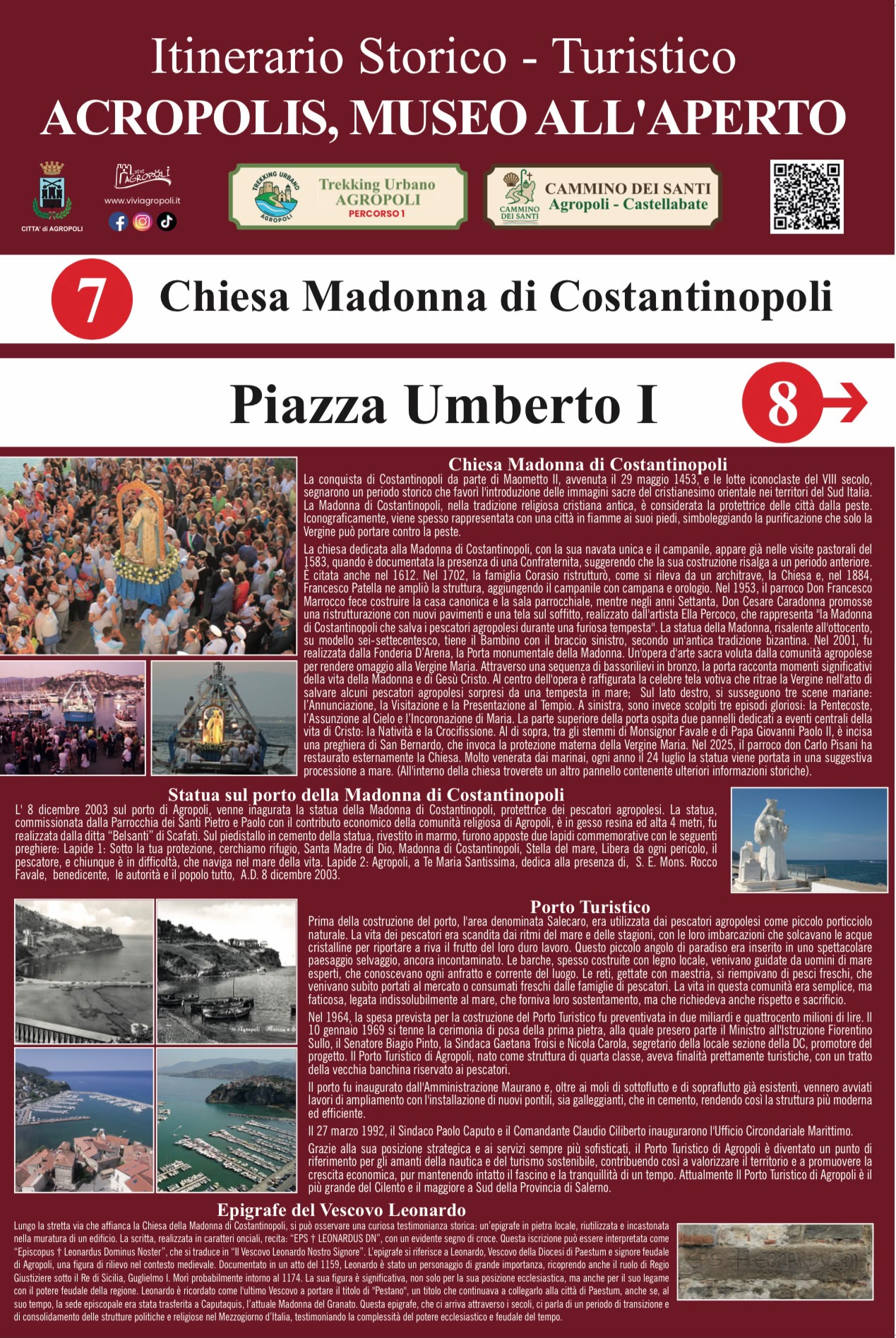
🇬🇧 Church of Madonna of Constantinople
The conquest of Constantinople by Mehmed II on May 29, 1453, and the iconoclastic struggles of the 8th century marked a historical period that favored the introduction of sacred images from Eastern Christianity into southern Italy. In ancient Christian religious tradition, the Madonna of Constantinople is considered the protector of cities from the plague. Iconographically, she is often depicted with a city in flames at her feet, symbolizing the purification that only the Virgin can bring against the plague.
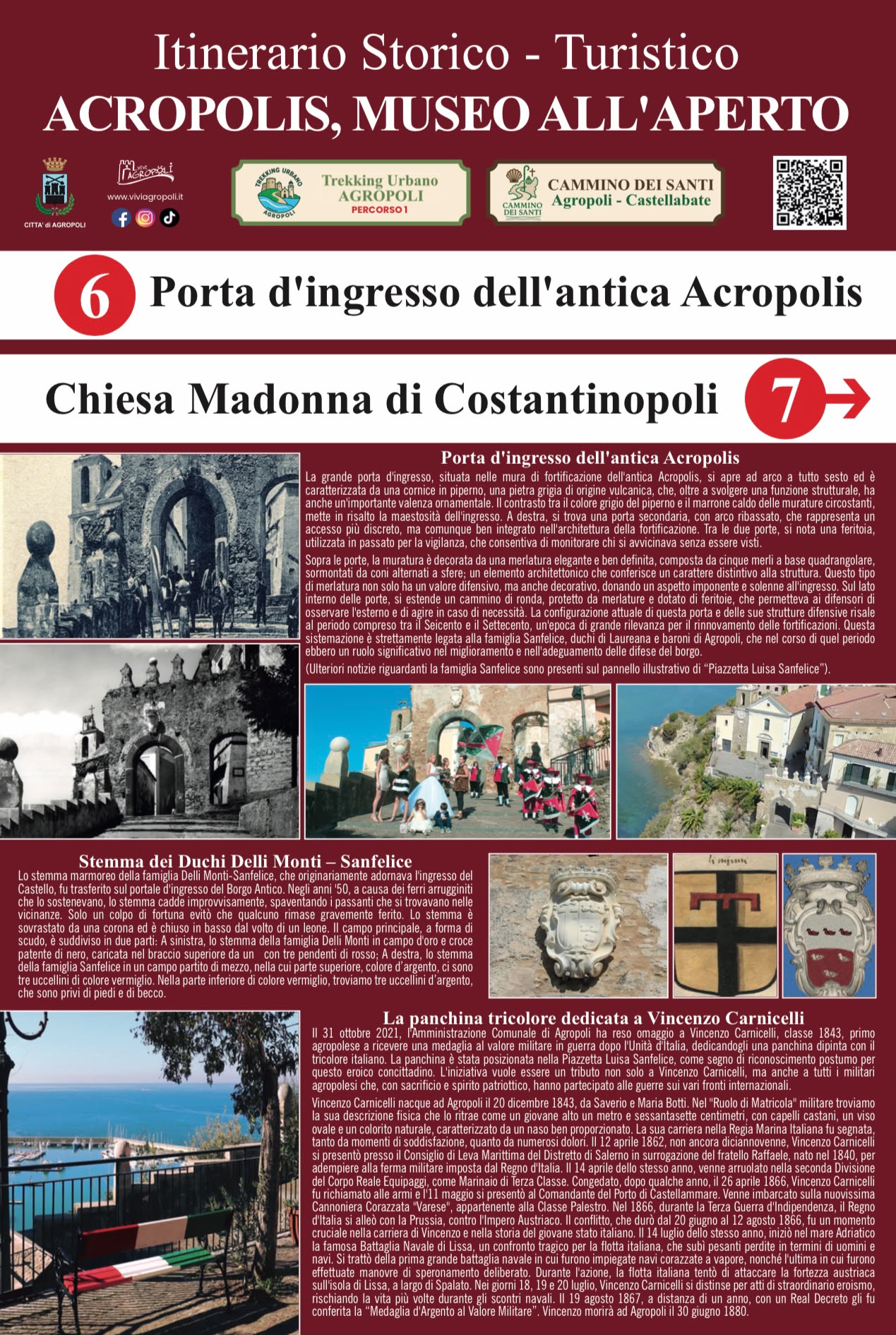
The church dedicated to the Madonna of Constantinople, with its single nave and bell tower, is already mentioned in pastoral visits of 1583, when a confraternity was documented, suggesting that its construction dates back to an earlier period. It is also cited in 1612. In 1702, the Corasio family renovated the church, as indicated by an architrave, and in 1884, Francesco Patella expanded the structure, adding the bell tower with bell and clock.
In 1953, the parish priest Don Francesco Marrocco had the rectory and parish hall built, while in the 1970s, Don Cesare Caradonna promoted a renovation with new flooring and a ceiling painting by the artist Ella Percoco, depicting “the Madonna of Constantinople saving Agropoli fishermen during a fierce storm.” The Madonna statue, dating from the 19th century and modeled on a 17th–18th century design, holds the Child with her left arm, following an ancient Byzantine tradition.
In 2001, the monumental Door of the Madonna was created by Fonderia D’Arena, a sacred artwork commissioned by the Agropoli community to honor the Virgin Mary. Through a sequence of bronze bas-reliefs, the door depicts significant moments from the lives of the Madonna and Jesus Christ. At the center is the famous votive painting showing the Virgin saving some Agropoli fishermen caught in a storm at sea. On the right side, three Marian scenes follow: the Annunciation, the Visitation, and the Presentation in the Temple. On the left are three glorious episodes: Pentecost, the Assumption into Heaven, and the Coronation of Mary. The upper part of the door features two panels dedicated to central events in Christ’s life: the Nativity and the Crucifixion. Above, between the coats of arms of Monsignor Favale and Pope John Paul II, is inscribed a prayer by Saint Bernard invoking the maternal protection of the Virgin Mary.
In 2025, parish priest Don Carlo Pisani restored the exterior of the church. Highly venerated by sailors, every year on July 24, the statue is carried in a dramatic sea procession. (Inside the church, another panel provides additional historical information.)
Statue in the Port of the Madonna of Constantinople
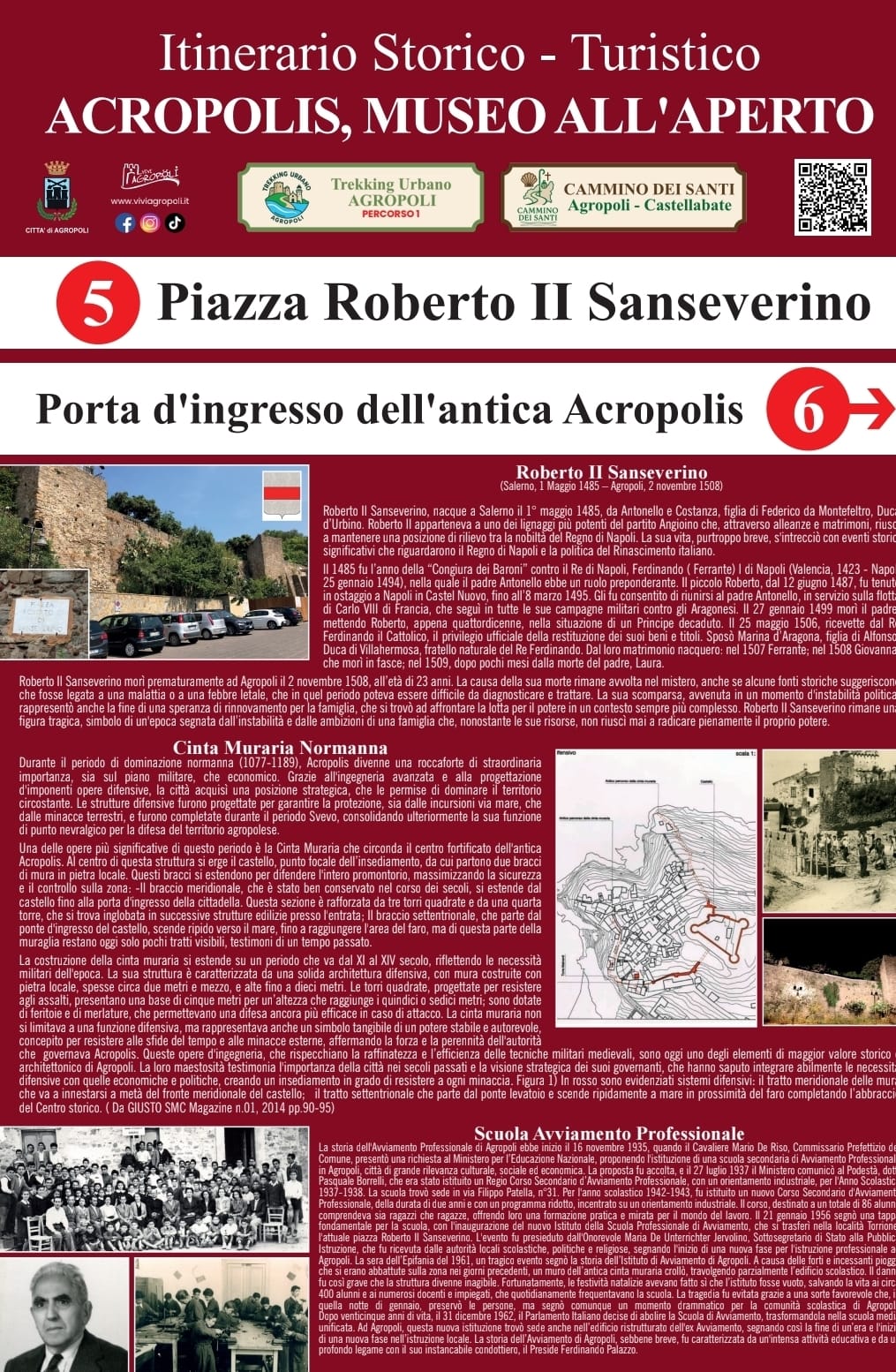
On December 8, 2003, in the port of Agropoli, the statue of the Madonna of Constantinople, protector of Agropoli fishermen, was inaugurated. The statue, commissioned by the Parish of Saints Peter and Paul with financial support from the Agropoli religious community, is made of resin plaster, stands 4 meters tall, and was created by the company “Belsanti” from Scafati. On the cement pedestal, covered in marble, two commemorative plaques were placed with the following prayers:
- Plaque 1: “Under your protection, we seek refuge, Holy Mother of God, Madonna of Constantinople, Star of the Sea, free from all danger the fisherman and anyone in difficulty navigating the sea of life.”
- Plaque 2: “Agropoli dedicates to you, Most Holy Mary, in the presence of H.E. Mons. Rocco Favale, blessing authorities and all the people, on December 8, 2003.”
Tourist Port
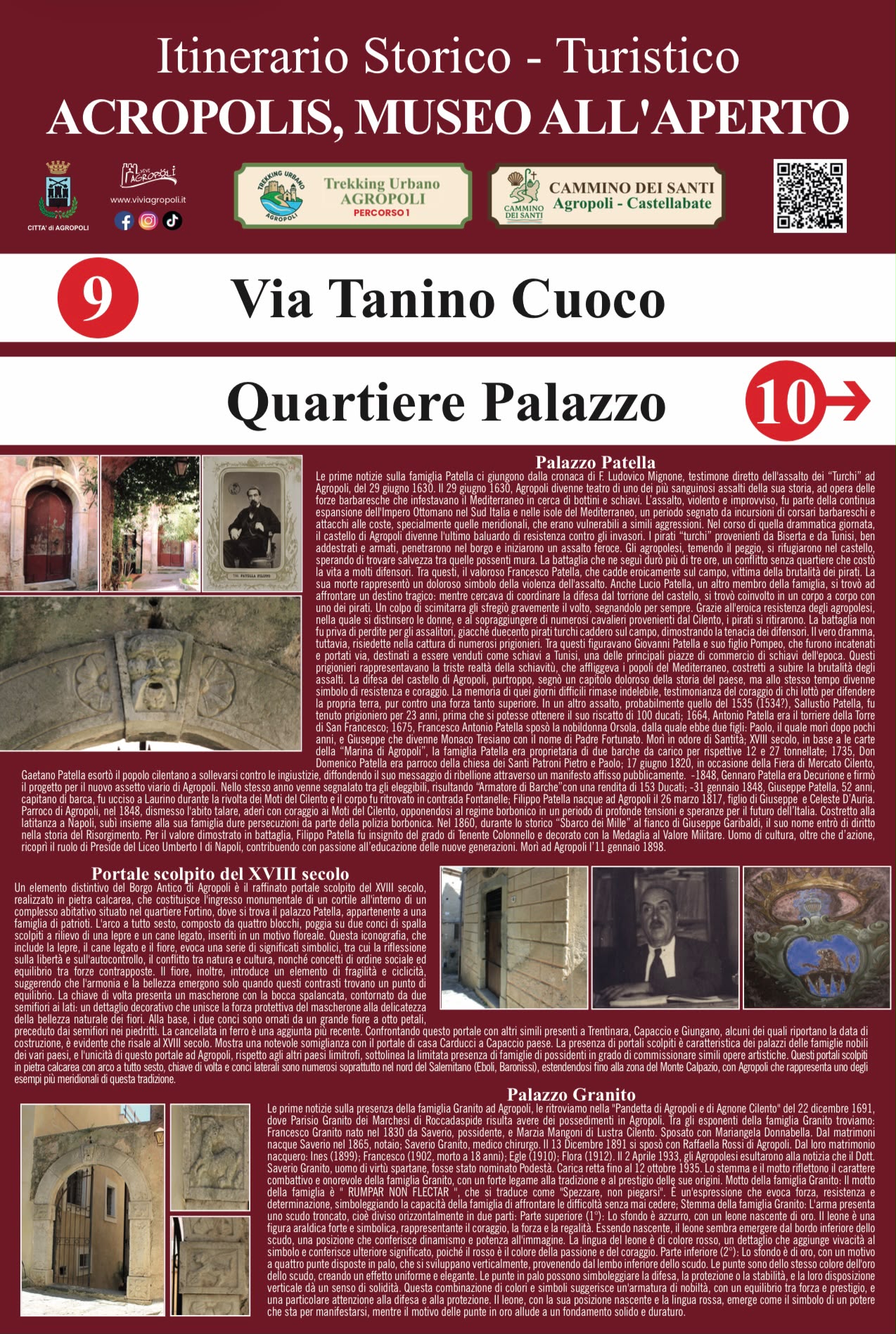
Before the construction of the port, the area called Salecaro was used by Agropoli fishermen as a small natural harbor. The life of the fishermen followed the rhythms of the sea and seasons, with their boats sailing the crystal-clear waters to bring back the fruits of their hard work. This small paradise was set in a spectacular, still-pristine natural landscape. The boats, often made of local wood, were navigated by experienced seamen who knew every inlet and current. The nets, skillfully cast, filled with fresh fish, which were immediately taken to the market or consumed by the fishermen’s families. Life in this community was simple but demanding, closely tied to the sea, which provided sustenance but also required respect and sacrifice.
In 1964, the planned cost for the construction of the Tourist Port was estimated at 2.4 billion lire. On January 10, 1969, the ceremony for laying the first stone took place, attended by Minister of Education Fiorentino Sullo, Senator Biagio Pinto, Mayor Gaetana Troisi, and Nicola Carola, secretary of the local DC section, promoter of the project. The Tourist Port of Agropoli, initially a fourth-class structure, was primarily for tourism, with a section of the old quay reserved for fishermen.
The port was inaugurated by the Maurano administration, and, in addition to the existing breakwater piers, expansion work was undertaken with the installation of new floating and concrete docks, making the structure more modern and efficient. On March 27, 1992, Mayor Paolo Caputo and Commander Claudio Ciliberto inaugurated the Maritime District Office.
Thanks to its strategic location and increasingly sophisticated services, the Tourist Port of Agropoli has become a reference point for boating enthusiasts and sustainable tourism, helping to enhance the area and promote economic growth while preserving its charm and tranquility. Today, the Agropoli Tourist Port is the largest in Cilento and the most important south of the Province of Salerno.
Epigraph of Bishop Leonardo
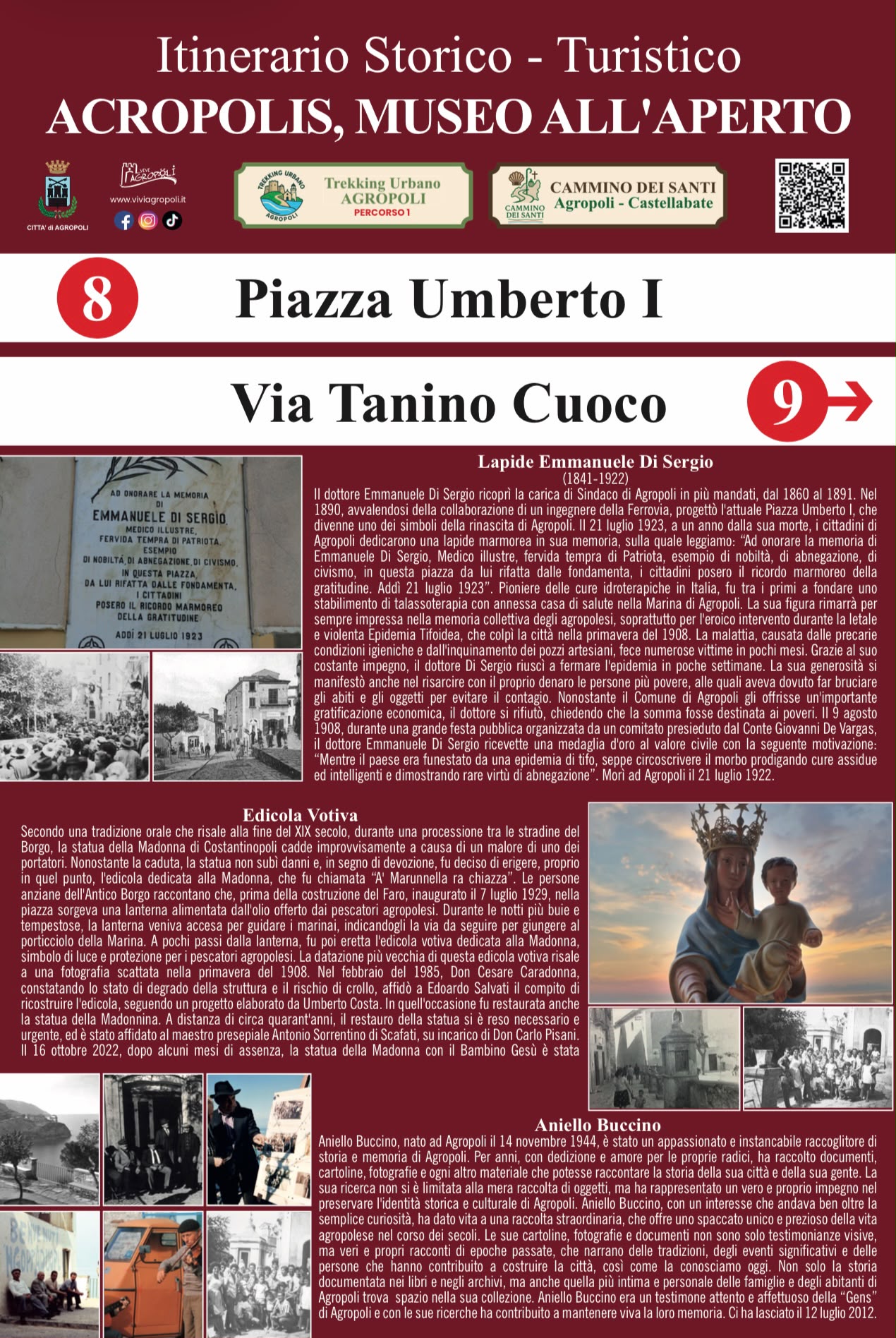
Along the narrow street next to the Church of the Madonna of Constantinople, one can observe a curious historical testimony: an epigraph in local stone, reused and embedded in a building wall. The inscription, in uncial characters, reads: “EPS † LEONARDUS DN,” with a clear cross symbol. This can be interpreted as “Episcopus † Leonardus Dominus Noster,” meaning “Bishop Leonardo Our Lord.”
The epigraph refers to Leonardo, Bishop of the Diocese of Paestum and feudal lord of Agropoli, a prominent figure in the medieval context. Documented in a 1159 act, Leonardo was highly influential, also serving as Royal Justiciar under King William I of Sicily. He probably died around 1174. His figure is significant not only for his ecclesiastical role but also for his connection to regional feudal power. Leonardo is remembered as the last bishop to bear the title “Pestano,” linking him to the city of Paestum, even though the episcopal seat had moved to Caputaquis, today Madonna del Granato.
This epigraph, preserved through the centuries, speaks of a period of transition and consolidation of political and religious structures in southern Italy, demonstrating the complexity of ecclesiastical and feudal power at the time.
🇩🇪 Kirche der Madonna von Konstantinopel
Die Eroberung von Konstantinopel durch Mehmed II. am 29. Mai 1453 und die ikonoklastischen Kämpfe des 8. Jahrhunderts kennzeichneten eine historische Periode, die die Einführung heiliger Bilder des östlichen Christentums in Süditalien begünstigte. In der alten christlichen Tradition gilt die Madonna von Konstantinopel als Schutzpatronin der Städte gegen die Pest. Ikonographisch wird sie oft mit einer brennenden Stadt zu ihren Füßen dargestellt, was die Reinigung symbolisiert, die nur die Jungfrau Maria gegen die Pest bringen kann.
Die Kirche, die der Madonna von Konstantinopel gewidmet ist, mit ihrem einschiffigen Aufbau und Glockenturm, wird bereits in Pastoralbesuchen von 1583 erwähnt, als eine Bruderschaft dokumentiert ist, was darauf hindeutet, dass ihre Errichtung in eine frühere Zeit zurückreicht. Sie wird auch 1612 erwähnt. Im Jahr 1702 renovierte die Familie Corasio die Kirche, wie ein Architrav zeigt, und 1884 erweiterte Francesco Patella das Gebäude, indem er den Glockenturm mit Glocke und Uhr hinzufügte.
1953 ließ der Pfarrer Don Francesco Marrocco das Pfarrhaus und den Gemeindesaal errichten, während in den 1970er Jahren Don Cesare Caradonna eine Renovierung mit neuen Böden und einem Deckenbild durch die Künstlerin Ella Percoco initiierte, das „die Madonna von Konstantinopel zeigt, wie sie Agropoli-Fischer während eines heftigen Sturms rettet“. Die Madonna-Statue aus dem 19. Jahrhundert, nach einem Modell des 17.–18. Jahrhunderts, hält das Kind mit dem linken Arm, gemäß einer alten byzantinischen Tradition.
2001 wurde von der Gießerei D’Arena die monumentale Tür der Madonna geschaffen, ein sakrales Kunstwerk, das von der Gemeinde Agropoli in Auftrag gegeben wurde, um die Jungfrau Maria zu ehren. Durch eine Abfolge von Bronze-Reliefs zeigt die Tür bedeutende Momente aus dem Leben der Madonna und Jesu Christi. Im Zentrum ist das berühmte Votivbild dargestellt, das die Jungfrau zeigt, wie sie einige Agropoli-Fischer rettet, die von einem Sturm überrascht wurden. Auf der rechten Seite folgen drei Marien-Szenen: Verkündigung, Besuch Mariens und Darstellung im Tempel. Auf der linken Seite sind drei glorreiche Episoden dargestellt: Pfingsten, Himmelfahrt Mariens und Krönung Mariens. Der obere Teil der Tür zeigt zwei zentrale Ereignisse aus dem Leben Christi: Geburt und Kreuzigung. Darüber, zwischen den Wappen von Monsignore Favale und Papst Johannes Paul II., ist ein Gebet des heiligen Bernhard eingraviert, das den mütterlichen Schutz der Jungfrau Maria anruft.
2025 restaurierte der Pfarrer Don Carlo Pisani die Außenseite der Kirche. Hoch verehrt von Seeleuten, wird die Statue jedes Jahr am 24. Juli in einer beeindruckenden Prozession über das Meer getragen. (Im Inneren der Kirche befindet sich eine weitere Tafel mit zusätzlichen historischen Informationen.)
Statue im Hafen der Madonna von Konstantinopel
Am 8. Dezember 2003 wurde im Hafen von Agropoli die Statue der Madonna von Konstantinopel, Schutzpatronin der Agropoli-Fischer, eingeweiht. Die Statue, in Auftrag gegeben von der Pfarrei der Heiligen Petrus und Paulus mit finanzieller Unterstützung der religiösen Gemeinde Agropolis, besteht aus Harz-Gips, ist 4 Meter hoch und wurde von der Firma „Belsanti“ aus Scafati gefertigt. Auf dem Zementpodest, das mit Marmor verkleidet ist, wurden zwei Gedenktafeln mit folgenden Gebeten angebracht:
- Tafel 1: „Unter deinem Schutz suchen wir Zuflucht, Heilige Mutter Gottes, Madonna von Konstantinopel, Stern des Meeres, befreie Fischer und alle in Not, die auf dem Meer des Lebens fahren, vor allen Gefahren.“
- Tafel 2: „Agropoli weiht Dir, Heiligste Maria, in Anwesenheit von S.E. Mons. Rocco Favale, den Behörden und dem gesamten Volk, am 8. Dezember 2003.“
Touristenhafen
Vor dem Bau des Hafens wurde das Gebiet Salecaro von den Agropoli-Fischern als kleiner Naturhafen genutzt. Das Leben der Fischer richtete sich nach den Rhythmen des Meeres und der Jahreszeiten, ihre Boote durchquerten das kristallklare Wasser, um die Früchte ihrer harten Arbeit zurückzubringen. Dieses kleine Paradies lag in einer spektakulären, noch unberührten Landschaft. Die Boote, oft aus lokalem Holz, wurden von erfahrenen Seeleuten gesteuert, die jede Bucht und Strömung kannten. Die gekonnt ausgeworfenen Netze füllten sich mit frischem Fisch, der sofort auf den Markt gebracht oder von den Fischerfamilien verzehrt wurde. Das Leben in dieser Gemeinschaft war einfach, aber hart, untrennbar mit dem Meer verbunden, das Nahrung bot, aber auch Respekt und Opfer verlangte.
1964 wurden die Kosten für den Bau des Touristenhafens auf 2,4 Milliarden Lire geschätzt. Am 10. Januar 1969 fand die Zeremonie zur Grundsteinlegung statt, an der der Bildungsminister Fiorentino Sullo, Senator Biagio Pinto, Bürgermeisterin Gaetana Troisi und Nicola Carola, Sekretär der lokalen DC-Sektion, Projektinitiator, teilnahmen. Der Touristenhafen von Agropoli, ursprünglich eine Vier-Klasse-Anlage, war hauptsächlich touristisch ausgerichtet, wobei ein Teil der alten Mole den Fischern vorbehalten blieb.
Der Hafen wurde von der Verwaltung Maurano eröffnet, und zusätzlich zu den bereits bestehenden Wellenbrecher-Molen wurden Erweiterungsarbeiten mit neuen Schwimm- und Betonstegen durchgeführt, wodurch die Anlage moderner und effizienter wurde. Am 27. März 1992 wurden das Bezirksbüro für maritime Angelegenheiten von Bürgermeister Paolo Caputo und Kommandant Claudio Ciliberto eingeweiht.
Dank seiner strategischen Lage und immer ausgefeilteren Dienstleistungen ist der Touristenhafen von Agropoli zu einem Bezugspunkt für Bootsliebhaber und nachhaltigen Tourismus geworden und trägt zur Wertsteigerung der Region und zur wirtschaftlichen Entwicklung bei, während er den Charme und die Ruhe der Vergangenheit bewahrt. Heute ist der Touristenhafen von Agropoli der größte im Cilento und der bedeutendste südlich der Provinz Salerno.
Epigraph von Bischof Leonardo
Entlang der schmalen Straße neben der Kirche der Madonna von Konstantinopel befindet sich ein bemerkenswertes historisches Zeugnis: eine Inschrift aus lokalem Stein, wiederverwendet und in die Mauer eines Gebäudes eingelassen. Die Inschrift in Unzialschrift lautet: „EPS † LEONARDUS DN“ mit einem deutlich sichtbaren Kreuzzeichen. Dies kann als „Episcopus † Leonardus Dominus Noster“ interpretiert werden, was „Bischof Leonardo Unser Herr“ bedeutet.
Die Epigraph bezieht sich auf Leonardo, Bischof der Diözese Paestum und feudaler Herr von Agropoli, eine bedeutende Persönlichkeit des Mittelalters. In einer Urkunde von 1159 dokumentiert, war Leonardo sehr einflussreich und diente auch als königlicher Justiziar unter König Wilhelm I. von Sizilien. Er starb wahrscheinlich um 1174. Seine Bedeutung liegt nicht nur in seiner kirchlichen Rolle, sondern auch in seiner Verbindung zur feudalen Macht der Region. Leonardo wird als letzter Bischof bezeichnet, der den Titel „Pestano“ trug, wodurch er weiterhin mit der Stadt Paestum verbunden war, obwohl der Bischofssitz nach Caputaquis, dem heutigen Madonna del Granato, verlegt worden war.
Diese Epigraph, die über die Jahrhunderte überliefert wurde, erzählt von einer Übergangs- und Konsolidierungsphase politischer und religiöser Strukturen in Süditalien und bezeugt die Komplexität der kirchlichen und feudalen Macht jener Zeit.
🇫🇷 Église de la Madonna de Constantinople
La conquête de Constantinople par Mehmet II, survenue le 29 mai 1453, ainsi que les luttes iconoclastes du VIIIᵉ siècle, ont marqué une période historique ayant favorisé l’introduction des images sacrées du christianisme oriental dans le sud de l’Italie. Dans l’ancienne tradition religieuse chrétienne, la Madonna de Constantinople est considérée comme la protectrice des villes contre la peste. Iconographiquement, elle est souvent représentée avec une ville en flammes à ses pieds, symbolisant la purification que seule la Vierge peut apporter contre la peste.
L’église dédiée à la Madonna de Constantinople, avec sa nef unique et son clocher, est déjà mentionnée lors des visites pastorales de 1583, où la présence d’une confrérie est documentée, suggérant que sa construction remonte à une période antérieure. Elle est également citée en 1612. En 1702, la famille Corasio a rénové l’église, comme en témoigne un linteau, et en 1884, Francesco Patella a agrandi la structure en ajoutant le clocher avec cloche et horloge.
En 1953, le curé Don Francesco Marrocco fit construire la maison canoniale et la salle paroissiale, tandis que dans les années 1970, Don Cesare Caradonna promut une rénovation comprenant de nouveaux sols et une toile au plafond réalisée par l’artiste Ella Percoco, représentant « la Madonna de Constantinople sauvant les pêcheurs d’Agropoli lors d’une tempête furieuse ». La statue de la Madonna, datant du XIXᵉ siècle et suivant un modèle du XVIIᵉ–XVIIIᵉ siècle, tient l’Enfant de son bras gauche, conformément à une ancienne tradition byzantine.
En 2001, la Fonderie D’Arena réalisa la porte monumentale de la Madonna, une œuvre d’art sacré voulue par la communauté d’Agropoli pour rendre hommage à la Vierge Marie. À travers une séquence de bas-reliefs en bronze, la porte raconte des moments significatifs de la vie de la Madonna et de Jésus-Christ. Au centre, on retrouve la célèbre toile votive représentant la Vierge sauvant des pêcheurs d’Agropoli surpris par une tempête en mer. Sur le côté droit, trois scènes mariales se succèdent : l’Annonciation, la Visitation et la Présentation au Temple. À gauche, trois épisodes glorieux sont sculptés : la Pentecôte, l’Assomption et le Couronnement de Marie. La partie supérieure de la porte présente deux panneaux consacrés aux événements centraux de la vie du Christ : la Nativité et la Crucifixion. Au-dessus, entre les armoiries de Monseigneur Favale et du pape Jean-Paul II, est gravée une prière de Saint Bernard, invoquant la protection maternelle de la Vierge Marie.
En 2025, le curé Don Carlo Pisani a restauré l’extérieur de l’église. Très vénérée par les marins, la statue est chaque année, le 24 juillet, portée lors d’une procession spectaculaire en mer. (À l’intérieur de l’église, vous trouverez un autre panneau contenant des informations historiques supplémentaires.)
Statue dans le port de la Madonna de Constantinople
Le 8 décembre 2003, dans le port d’Agropoli, fut inaugurée la statue de la Madonna de Constantinople, protectrice des pêcheurs agropolesi. La statue, commandée par la paroisse Saints Pierre et Paul avec le soutien économique de la communauté religieuse d’Agropoli, est en plâtre-résine, haute de 4 mètres, et a été réalisée par l’entreprise « Belsanti » de Scafati. Sur le piédestal en béton recouvert de marbre, deux plaques commémoratives ont été apposées avec les prières suivantes :
- Plaque 1 : « Sous ta protection, nous cherchons refuge, Sainte Mère de Dieu, Madonna de Constantinople, Étoile de la mer, libère le pêcheur et tous ceux qui sont en difficulté, naviguant sur la mer de la vie, de tout danger. »
- Plaque 2 : « Agropoli te dédie, Très Sainte Marie, en présence de S.E. Mons. Rocco Favale, bénissant, les autorités et tout le peuple, le 8 décembre 2003. »
Port de plaisance
Avant la construction du port, la zone appelée Salecaro était utilisée par les pêcheurs agropolesi comme un petit port naturel. La vie des pêcheurs était rythmée par la mer et les saisons, leurs embarcations sillonnant les eaux cristallines pour ramener le fruit de leur dur labeur. Ce petit coin de paradis se situait dans un paysage sauvage spectaculaire, encore préservé. Les bateaux, souvent construits en bois local, étaient guidés par des hommes de mer expérimentés, connaissant chaque recoin et chaque courant. Les filets, habilement jetés, se remplissaient de poissons frais, qui étaient immédiatement vendus sur le marché ou consommés par les familles de pêcheurs. La vie dans cette communauté était simple mais dure, indissociablement liée à la mer, source de subsistance mais exigeant respect et sacrifices.
En 1964, le coût prévu pour la construction du port de plaisance était estimé à 2,4 milliards de lires. Le 10 janvier 1969, la cérémonie de pose de la première pierre eut lieu, en présence du ministre de l’Éducation Fiorentino Sullo, du sénateur Biagio Pinto, de la maire Gaetana Troisi et de Nicola Carola, secrétaire de la section locale de la DC, promoteur du projet. Le port de plaisance d’Agropoli, initialement de quatrième classe, était destiné principalement au tourisme, avec une partie de l’ancienne digue réservée aux pêcheurs.
Le port fut inauguré par l’administration Maurano et, en plus des jetées existantes, des travaux d’agrandissement furent entrepris avec l’installation de nouveaux pontons flottants et en béton, rendant la structure plus moderne et fonctionnelle. Le 27 mars 1992, le maire Paolo Caputo et le commandant Claudio Ciliberto inaugurèrent le bureau maritime de district.
Grâce à sa position stratégique et à des services toujours plus sophistiqués, le port de plaisance d’Agropoli est devenu un point de référence pour les amateurs de navigation et de tourisme durable, contribuant à valoriser le territoire et à stimuler la croissance économique, tout en conservant le charme et la tranquillité d’autrefois. Aujourd’hui, le port de plaisance d’Agropoli est le plus grand du Cilento et le plus important au sud de la province de Salerne.
Épitaphe de l’évêque Leonardo
Le long de la ruelle adjacente à l’église de la Madonna de Constantinople, on peut observer un témoignage historique curieux : une épitaphe en pierre locale, réutilisée et encastrée dans le mur d’un bâtiment. L’inscription, en lettres onciales, indique : « EPS † LEONARDUS DN », avec une croix évidente. Cette inscription peut être interprétée comme « Episcopus † Leonardus Dominus Noster », signifiant « L’évêque Leonardo Notre Seigneur ».
L’épitaphe se réfère à Leonardo, évêque du diocèse de Paestum et seigneur féodal d’Agropoli, figure de premier plan au Moyen Âge. Documenté dans un acte de 1159, Leonardo occupa également le rôle de juge royal sous le roi Guillaume I de Sicile. Il mourut probablement vers 1174. Sa figure est importante non seulement pour sa position ecclésiastique mais aussi pour son lien avec le pouvoir féodal de la région. Leonardo est reconnu comme le dernier évêque à porter le titre de « Pestano », continuant à le relier à la ville de Paestum, bien que le siège épiscopal ait été transféré à Caputaquis, l’actuelle Madonna del Granato.
Cette épitaphe, transmise à travers les siècles, témoigne d’une période de transition et de consolidation des structures politiques et religieuses dans le sud de l’Italie, illustrant la complexité du pouvoir ecclésiastique et féodal de l’époque.